Pens, Stethoscopes, and Red Sticky Rice: A Guide to Vietnam’s Big Baby Bashes
From the 'full month' feast to the first-year career prediction ritual, Vietnamese baby celebrations are a beautiful blend of gratitude and hope. Here is your guide to navigating these family milestones.
Why the First Month and First Year Matter in Vietnam
Vietnamese baby celebrations like Đầy Tháng and Thôi Nôi are deeply rooted in historical gratitude for infant survival and the spiritual protection offered by the 12 Midwives. These milestones represent the successful transition of a child into the family and community, blending ancestral worship with hopes for a prosperous future.
If you live in Vietnam long enough, you will eventually receive an invitation that looks a bit different from a standard birthday party. It might be for a baby who is only 30 days old, or a one-year-old who is about to 'quit the cradle.' These aren't just excuses for a party; they are profound cultural markers. Historically, infant mortality was high in rural Vietnam, and reaching the one-month and one-year marks were massive victories. While modern healthcare has changed the odds, the tradition remains a cornerstone of Vietnamese social life.
In the Vietnamese worldview, a child’s life is shaped by the '12 Midwives' (Mười hai Bà Mụ), semi-divine figures believed to have taught the baby how to smile, sleep, and eat. These parties are, first and foremost, a 'thank you' note to these spirits. If you've already navigated the complexities of Vietnamese wedding etiquette, you’ll find these baby celebrations a bit more relaxed but equally steeped in symbolic gestures that can be confusing for an outsider.
Đầy Tháng: The 'Full Month' Milestone
The Đầy Tháng ceremony marks the end of the first 30 days of a baby's life, serving as a formal introduction to the extended family and ancestors. It involves specific food offerings, such as red sticky rice and sweet soup, to symbolize luck and a smooth path through life for the newborn.
The phrase 'Đầy Tháng' literally translates to 'Full Month.' For the first 30 days, both the mother and the baby traditionally stay in a period of 'confinement' (ở cữ) to recover and avoid illness. The Đầy Tháng party is the 'coming out' event. The family prepares an altar with 12 small bowls of chè (sweet bean soup) and xôi (sticky rice), representing the 12 Midwives, and one larger set for the 'Midwife Queen' (Bà Chúa Đầu).
You’ll notice the sticky rice is almost always Xôi Gấc—a vibrant orange-red color derived from the baby jackfruit. In Vietnam, red is the color of luck, and serving this dish is a way of wishing the child a 'bright' and fortunate future. As a guest, you are there to witness the baby being presented to the ancestors. It’s a quiet, intimate moment before the feast begins. This tradition is a vital part of Vietnamese lifestyle and social customs.
Thôi Nôi: Quitting the Cradle and the Big Choice
Thôi Nôi is the celebration of a child’s first birthday, signifying the moment they 'quit the cradle' to join the world of toddlers. The highlight of this event is the 'Bốc Thôi Nôi' ritual, where the baby chooses objects that supposedly predict their future career path and personality.
When a child hits 12 months, the family celebrates 'Thôi Nôi.' The term literally means 'stop using the cradle.' It’s a transition from being a helpless infant to a walking, talking member of the family. While there is plenty of food—usually a whole boiled chicken with its head still on (a sign of completeness)—the real showstopper is the 'Choosing' ritual.
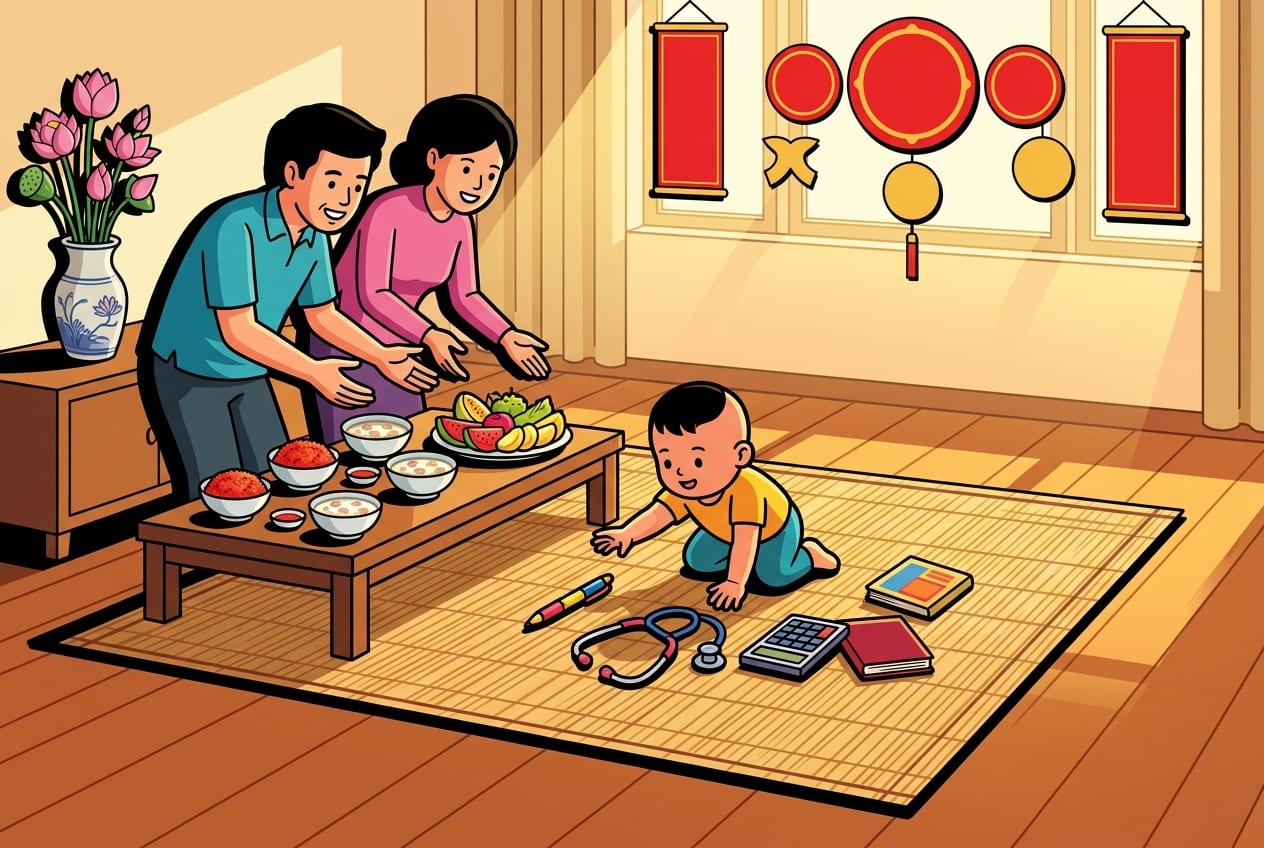
The family spreads a mat on the floor and places several items in front of the baby. The baby is then encouraged to crawl toward the items and pick one. Whatever they grab first is said to represent their future. It’s a lighthearted moment, but parents still hold their breath, hoping the baby doesn't pick the 'wrong' thing (like a mirror, which some old-school folks think implies vanity, though modern parents might just see a future influencer!).
The 'Picking' Tray: Modern Meanings of Symbolic Objects
The objects placed before the baby during Thôi Nôi have evolved from traditional tools to modern symbols of professional success. Common items include pens for scholars, calculators for business leaders, and stethoscopes for medical professionals, reflecting the family's aspirations for the child's future career and character.
In the past, the tray might have had a sword (for a soldier) or a piece of silk (for a weaver). Today, the tray is a hilarious mix of old and new. Here is what you might see:
- A Pen or Book: The child will be a scholar, a teacher, or a writer. High intelligence is the prediction here.
- A Calculator or Abacus: A future in finance, accounting, or a savvy business person who knows how to handle money.
- A Stethoscope (usually plastic): The parents are likely dreaming of a doctor or nurse in the family.
- Money (Lì xì): This is the crowd favorite. If the baby grabs the cash, they are destined to be wealthy or a successful entrepreneur.
- A Computer Mouse: A modern addition for future tech moguls or software engineers.
- A Comb or Mirror: Traditionally linked to beauty or the arts, though some jokingly say it means the child will be a bit 'fabulous.'
- A Camera: A future traveler or photographer.
Social Etiquette: What to Bring and How to Act
Guests at Vietnamese baby celebrations are typically expected to bring a gift of money in a red envelope or practical items like clothing and toys. Social etiquette also dictates using protective language when complimenting the baby to avoid attracting bad luck or unwanted spiritual attention.
If you are invited to a Đầy Tháng or Thôi Nôi, don't panic. Unlike the high-pressure environment of a Vietnamese street game competition, these events are about family warmth. The most common gift is a 'Lì xì' (red envelope) containing money. The amount depends on your relationship with the family, but for a colleague or friend, 200,000 to 500,000 VND is a standard range.
If you prefer a physical gift, clothing is always welcome, but buy it a few sizes too big—babies grow fast! Gold jewelry, like a small bracelet or anklet with a 'silver' bell (believed to ward off bad spirits), is a traditional gift from close relatives. When you arrive, you’ll likely be ushered to a table to eat. Vietnamese hospitality means you will be fed until you can barely walk, so come hungry.
The Magic Word: Why You Must Say 'Trộm Vía'
The phrase 'trộm vía' is a linguistic shield used before complimenting a baby to protect them from the 'evil eye' or jealous spirits. It is an essential piece of etiquette that shows respect for traditional beliefs while allowing guests to express their genuine admiration for the child.
This is the most important 'pro-tip' for an expat. In Western culture, we say, 'Oh, what a beautiful, chubby baby!' In traditional Vietnamese culture, saying that out loud is considered risky. It is believed that such high praise might attract the attention of wandering spirits who might become jealous and make the baby sick.
To 'neutralize' the compliment, you must preface it with the phrase 'Trộm vía.' It roughly means 'by the grace of the spirits' or 'stealing away the bad luck.' For example: 'Trộm vía, bé dễ thương quá!' (By the grace of the spirits, the baby is so cute!). If you forget this, don't worry—people know you're a foreigner—but using it will earn you massive respect and a few surprised smiles from the grandmothers.
Do
- Use the phrase 'trộm vía' before complimenting the baby.
- Bring a red envelope (Lì xì) with a modest amount of cash if you aren't sure what to buy.
- Try the Xôi Gấc (red sticky rice)—it's delicious and brings luck.
- Dress neatly but comfortably; these are usually home-based events.
Don't
- Don't compliment the baby too excessively without the 'trộm vía' disclaimer.
- Don't arrive late for the ritual part; the food follows the ceremony, but the ceremony is the heart of it.
- Don't feel pressured to buy expensive gold unless you are a very close family member.
What if the baby picks up the 'money' first during Thôi Nôi?
Everyone will cheer! It is considered a very lucky sign that the child will be prosperous and have a 'rich' life. It’s the most popular outcome for guests to root for.
Is it okay to bring a toy instead of money?
Absolutely. While money is practical, a thoughtful toy or a set of clothes is perfectly acceptable. Just ensure the clothes are for a slightly older age (e.g., 6-12 months for a 1-month-old) so the baby can use them longer.
Do I need to bow to the altar as a guest?
No, you aren't required to participate in the religious or ancestral offerings unless you are a family member. You are there as a witness and a guest of the parents. Just standing respectfully nearby while they pray is enough.
Ultimately, these celebrations are about community. Whether it's a small gathering in a city apartment or a large feast in a rural courtyard, the goal is the same: to surround the new life with love, protection, and a little bit of fun. If you're lucky enough to be invited, enjoy the chè, watch the baby's big career choice, and don't forget to say 'Trộm vía!'
Practise the words you just read
Vietnamese phrases for real situations, each with native audio in both accents.
Topics
Read more
Other posts from our Vietnamese learning blog.
By Xinchao team
Một, Hai, Ba, Dzô! How to Survive a 500-Guest Vietnamese Wedding Banquet Without Losing Your Liver
Survive the legendary 'Một, hai, ba, dzô!' cycle at Vietnamese weddings. Learn why people toast, how the rounds work, and how to decline drinks politely.
By Xinchao team
Red, White, or Blue? How Not to Dress Like a Ghost at a Vietnamese Wedding
Attending your first Vietnamese wedding? Avoid the social faux pas of wearing funeral colors and learn why a splash of pink or blue goes a long way in showing respect to the happy couple.
By Xinchao team
The Red Envelope Dilemma: How Much Cash Should You Actually Give at a Vietnamese Wedding?
How much cash goes in a Vietnamese wedding envelope? From city banquets to rural feasts, we break down the 2026 rates so you can celebrate with confidence.