The Red Envelope Dilemma: How Much Cash Should You Actually Give at a Vietnamese Wedding?
Standing at the reception desk with a blank envelope? Here is the definitive guide to navigating 'tiền mừng' in 2026, ensuring you honor the couple without breaking your budget.
The Short Answer: 2026 Wedding Gift Benchmarks
In 2026, the standard wedding gift for a casual friend or colleague in a major city like Ho Chi Minh City or Hanoi is 500,000 VND. If the wedding is held at a luxury five-star hotel, this amount typically increases to 1,000,000 VND or more to cover the high cost of the meal.
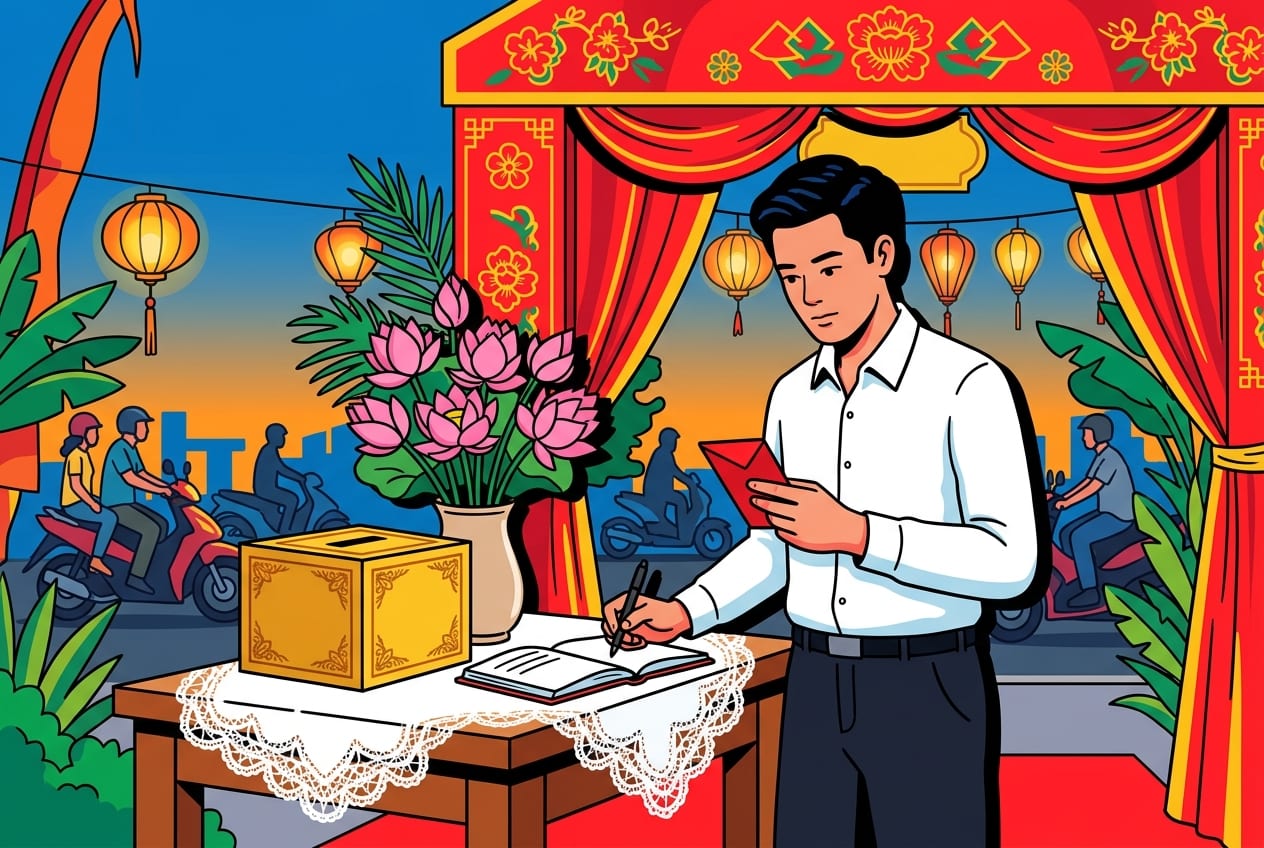
You are standing at the entrance of a brightly lit wedding hall. To your left is a table with a decorative box—often shaped like a heart or a tiered cake—and a stack of pens. To your right, the bride and groom are posing for photos with a line of guests. Your hand is in your pocket, gripping a red envelope. The question burning in your mind is: "Is 500,000 VND enough, or am I going to look cheap?" In Vietnam, the wedding gift isn't just a gesture; it is a practical contribution to the couple's new life and, more urgently, a way to help them pay for the lavish feast you are about to eat. Unlike Western weddings where a toaster or a blender might suffice, in Vietnam, cash is king. For more on the flow of the ceremony itself, check out our survival guide to Vietnamese weddings.
City vs. Countryside: The Cost of the Venue
Location drastically changes the expected gift amount because the primary goal of the money is to offset the cost per guest. Rural weddings in the provinces generally require 300,000 to 500,000 VND, while urban weddings at professional event centers start at a baseline of 500,000 VND per person.
The geography of Vietnam dictates the "market rate" for weddings. In rural areas (vùng nông thôn), weddings are often held at home or in a community space with catering brought in. The overhead is lower, and the community is tighter, so 300,000 VND is a perfectly acceptable and respectful amount for a neighbor or distant relative. However, the 2026 economy has pushed urban prices higher. In the city, the venue alone might cost the couple 400,000 to 600,000 VND per plate. If you give 300,000 VND at a fancy HCMC ballroom, the couple is essentially paying for you to be there. As a guest, you want to at least "break even" for the couple. According to Vietnam Tourism, cultural celebrations are deeply communal, and your contribution is seen as part of that shared responsibility.
Understanding 'Tiền Mừng': Why It’s Not Just a Gift
Tiền mừng, or 'congratulatory money,' functions as a social insurance system and a communal fund. It represents a cycle of giving where the money you give today will eventually be returned to you at your own wedding or a major family event, maintaining a balance of social debt.
In the West, we think of gifts as optional expressions of affection. In Vietnam, tiền mừng is closer to a social obligation. When you arrive, you will notice someone sitting at the table with a large notebook. This is the sổ mừng (congratulatory book). They aren't just taking names; they are recording exactly how much each guest gives. This isn't done out of greed. It’s done for record-keeping. When you eventually get married or host a funeral, the couple will look at their book to see how much you gave them, and they will aim to match or exceed that amount for you. It is a beautiful, albeit slightly mathematical, way of ensuring that no one family bears the entire financial burden of a 500-guest event. This concept of "face" and reciprocity is a cornerstone of Vietnamese social life, similar to the respect shown in Vietnamese calligraphy.
The Relationship Scale: From Coworker to Bestie
Your personal closeness to the bride or groom is the second most important factor after the venue. While a standard colleague might give 500,000 VND, a close childhood friend or a direct supervisor is expected to give between 1,000,000 VND and 2,000,000 VND to show deeper support.
If you are an expat working in a Vietnamese office, you will likely be invited to many weddings. If you aren't particularly close to the person, the "standard" 500,000 VND is the safe, polite choice. However, if the person is your boss or a key business partner, you might consider 1,000,000 VND or 2,000,000 VND. This isn't a bribe; it’s an acknowledgement of their status and your professional relationship. For your absolute best friends—the ones who helped you move apartments or took you to the hospital when you got food poisoning—the sky is the limit. Many close friends in 2026 choose to give 2,000,000 VND or even gold jewelry, though cash remains the most practical and appreciated option. You can read more about traditional social structures in Vietnam via Britannica's overview of Vietnamese society.
How to Prepare Your Envelope Without Losing Face
Properly preparing the envelope involves more than just the cash; it requires writing a clear message so the couple knows who the gift is from. Use the provided envelope from the invitation, write your name clearly, and include a short, traditional blessing for the couple’s future.
When you receive a Vietnamese wedding invitation, it usually comes with a small, empty envelope. Use that specific envelope. It often has the couple's names or a wedding motif on it, making it easy for the family to sort later. If you lost it, any red or gold envelope will do—just avoid plain white envelopes, as white is traditionally associated with funerals (though this rule is softening in modern cities). On the front, write: [Your Name] mừng hạnh phúc hai bạn (Your Name congratulates the two of you on your happiness). If you are coming with a partner, make sure to adjust the amount. If the individual rate is 500,000 VND, a couple should give 1,000,000 VND. Bringing a "plus one" without doubling the gift is considered a major social faux pas.
What Happens If You Get the Amount Wrong?
Giving too little can cause the couple to lose money on your attendance, leading to a sense of 'nợ' or social debt that feels unbalanced. Conversely, giving significantly more than others in your social circle can sometimes be seen as 'flexing,' though this is rarely a problem for foreign guests.
Don't lose sleep over this. Vietnamese people are generally very forgiving of foreigners. If you give 300,000 VND at a 500,000 VND wedding, they will likely assume you didn't know the custom rather than thinking you are being intentionally rude. However, the goal of being a good guest is to contribute to the joy of the day. If you are truly unsure, ask a Vietnamese colleague or friend who is also invited: "Bạn mừng bao nhiêu?" (How much are you giving?). They will usually be very blunt and tell you the exact amount. It is a practical culture; discussing the cost of the envelope is not considered taboo among friends.
Do
- Use crisp, new bills if possible; it shows extra respect.
- Write your name and a short wish on the envelope clearly.
- Hand the envelope to the bride, groom, or their parents at the greeting line, or place it in the box at the entrance.
- Double the amount if you are bringing a spouse or date.
Don't
- Don't give amounts with the number 4 (e.g., 400,000), as 4 is associated with death.
- Don't leave the envelope blank; the couple needs to know who to thank (and record in their book).
- Don't feel pressured to give more than you can afford; the 500,000 VND baseline is a safe bet for most city weddings.
I was invited but I cannot attend. Do I still need to send money?
Yes, it is polite to send a gift even if you don't go. Usually, you can send a smaller amount (e.g., 300,000 VND instead of 500,000 VND) through a mutual friend who is attending. This shows you value the relationship despite your absence.
Is it okay to give a physical gift like a toaster or picture frame instead of cash?
While not 'forbidden,' it is very uncommon and often impractical. Most Vietnamese wedding venues do not have a designated area for physical gifts, and the couple will have to lug them home. Cash in an envelope is the standard and most helpful gift you can provide.
Ultimately, a Vietnamese wedding is a celebration of community. Whether you are drinking bia hơi at a sidewalk table or sipping wine in a grand ballroom, your presence is what matters most. The money is simply the fuel that keeps the party going. So, tuck that 500k bill into your envelope, practice your "Một, hai, ba, dô!" (One, two, three, cheers!), and get ready for one of the most energetic parties of your life. If you find yourself in Da Nang for a celebration, don't forget to check out the local food festival guide to keep the party moving!
Practise the words you just read
Vietnamese phrases for real situations, each with native audio in both accents.
Topics
Read more
Other posts from our Vietnamese learning blog.
By Xinchao team
The 'Em Ơi' Minefield: Your Expat Survival Guide to Addressing Anyone on the Vietnamese Street (Without Causing an Accidental Crisis)
Think 'Em ơi' is a magic pass to get any waiter's attention? Think again. Dive into the complex, rewarding world of Vietnamese pronoun etiquette and learn how to navigate the streets like a seasoned expat.
By Xinchao team
Sweet Sâm or Face-Melting Đắng? Your Expat Survival Guide to Cholon’s Ancient Herbal Tea Culture
Discover Saigon's ancient herbal tea culture in Cholon. Learn how to order sweet nước sâm and survive face-melting nước đắng with this expat survival guide.
By Xinchao team
The Point-and-Eat Protocol: Your Expat Survival Guide to Vietnam's 'Cơm Bình Dân' Buffet Trays
Demystify Vietnam's legendary 'commoner's rice' stalls. Learn the step-by-step point-and-eat protocol, discover must-try dishes, and master sidewalk etiquette.