The Point-and-Eat Protocol: Your Expat Survival Guide to Vietnam's 'Cơm Bình Dân' Buffet Trays
Stepping up to a Vietnamese 'commoner's rice' stall can be intimidating for newcomers. Here is how to navigate the metal trays, order like a local, and master the unspoken rules of the sidewalk buffet.
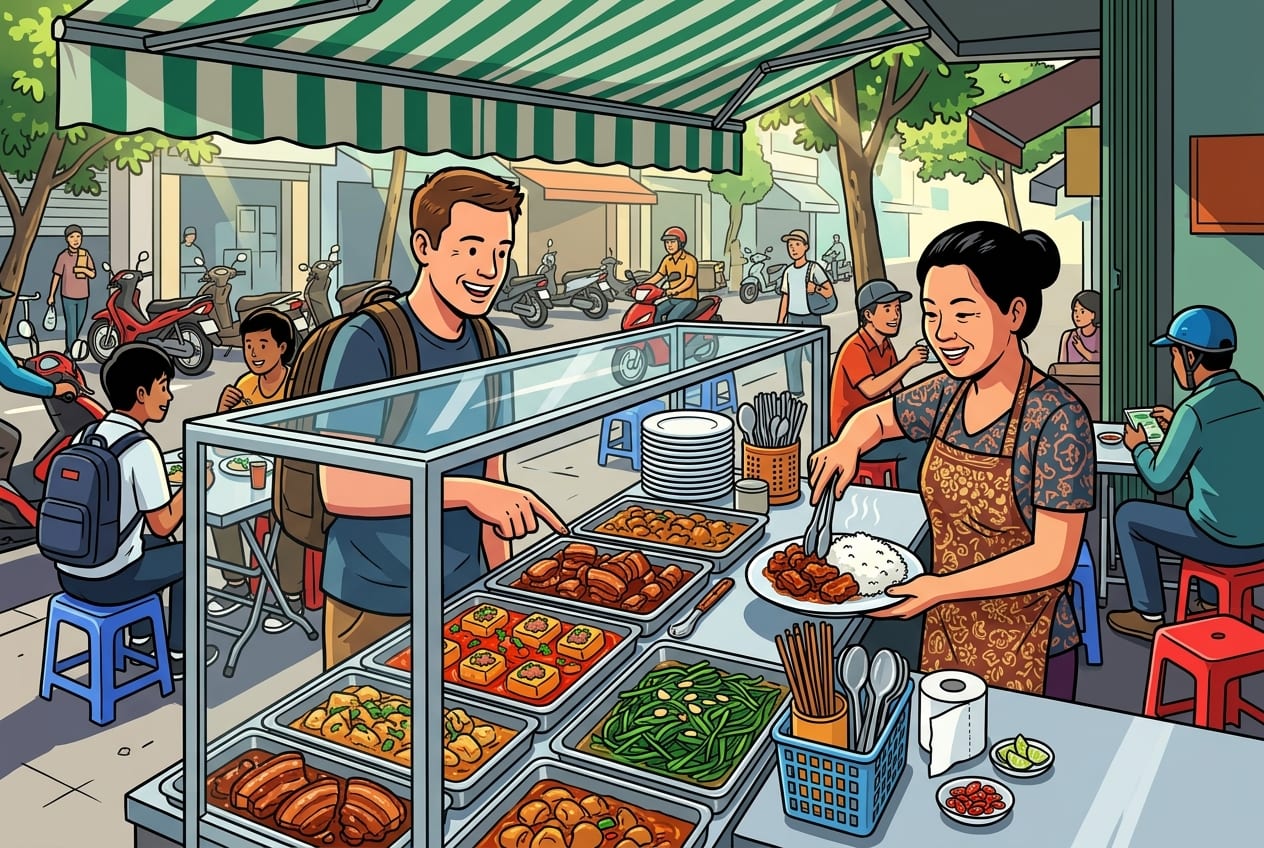
The Ultimate Equalizer: Why Every Expat Needs Cơm Bình Dân
Cơm bình dân, or 'commoner's rice,' serves as Vietnam's ultimate social equalizer where people from all walks of life share communal spaces. Understanding this system allows expats to access high-quality, home-style meals affordably while participating in a vital daily ritual of Vietnamese community culture.
Step onto any street corner in Hanoi or Ho Chi Minh City around noon, and you will encounter the sensory symphony of cơm bình dân. Literally translating to "commoner's rice"—and affectionately dubbed cơm bụi ("dusty rice") due to its open-air, roadside nature—this dining style is the true culinary heartbeat of Vietnam. It is a place where social hierarchies completely dissolve. At any given lunch hour, you will find blue-collar construction workers, motorbike taxi drivers, university students, and high-earning office workers in sharp business attire sitting shoulder-to-shoulder on the same low plastic stools (ghế nhựa). This egalitarian dining style is deeply rooted in Vietnam's communal history. It offers a comforting, home-style meal to anyone regardless of class or income. For expats navigating their new life, mastering this sidewalk buffet is the ultimate milestone of local integration. Unlike choosing between rice or noodles at a specialized shop, a cơm bình dân stall lets you have a little bit of everything. It is fast, incredibly cheap, and serves the kind of comforting, slow-cooked food that Vietnamese mothers make at home.
The Point-and-Eat Protocol: A Step-by-Step Survival Guide
The point-and-eat protocol is a visual ordering method that bypasses language barriers at Vietnamese buffet stalls. By approaching the counter, selecting a rice base, pointing to proteins and greens, and receiving a complimentary soup, diners can easily secure a complete, budget-friendly meal without needing fluent Vietnamese.
If you do not speak fluent Vietnamese, ordering food can sometimes feel like a high-stakes guessing game. Fortunately, cơm bình dân operates on a highly visual, universally accessible system we call the "Point-and-Eat Protocol." Here is exactly how to execute it like a seasoned local:
- Approach the Counter: Walk straight up to the glass-fronted display case. Do not wait to be seated; the action starts at the counter where dozens of steaming stainless steel trays are laid out.
- Receive Your Base: The server will pick up a plate and scoop a generous mountain of steaming hot white rice (cơm trắng).
- Point to Your Proteins: This is where the fun begins. Point clearly to one or two main dishes. If you are unsure of what to choose, look for staples like thịt kho tàu (caramelized braised pork belly with egg) or đậu hũ dồn thịt (tofu stuffed with minced pork in tomato sauce).
- Add Your Greens: Point to your vegetables. The most common options are rau muống xào tỏi (stir-fried morning glory with garlic) or pickled mustard greens, which provide a perfect acidic crunch to cut through the rich meats.
- Grab Your Soup: The server will almost always hand you a small, complimentary bowl of canh (a light, clear vegetable broth). Do not refuse it! Locals use this broth to moisten their rice or drink it at the end of the meal to aid digestion.
- Sit and Eat: Find an open stool. Grab a pair of chopsticks and a spoon from the communal container on the table, wipe them down with a paper tissue, and dig in.
- Pay at the End: When you are finished, catch the eye of the staff and say "Tính tiền" (pronounced ting tian). The cashier will walk over, visually scan the remnants on your plate to calculate what you ate, and give you the total.
How to Spot a High-Quality Cơm Bình Dân Joint
Finding a safe and delicious cơm bình dân venue requires observing local foot traffic, motorbike density, and food turnover rates. High-volume stalls with chaotic sidewalk parking ensure that the food is freshly prepared, frequently replenished, and highly trusted by the neighborhood's residents.
As of 2025–2026, com binh dan vietnam remains one of the most budget-friendly ways to eat exceptionally well. A standard plate consisting of a mountain of rice, one or two proteins, and a couple of vegetable sides typically ranges from 35,000 to 50,000 VND ($1.40 to $2.00 USD). When hunting for a great spot on your own, always follow the golden rule of Vietnamese street food: choose the venue with the largest, most chaotic pile of motorbikes parked on the sidewalk out front. High motorbike density equals rapid food turnover. Because these dishes sit in open-air trays, you want to eat at places where the trays are constantly being emptied and refilled with piping-hot batches fresh from the kitchen. If you want to start with some tried-and-tested gold standards, check out Cơm Tự Chọn at 38 Lãn Ông in Hanoi’s Old Quarter, the bustling, expat-friendly joints along Xuân Diệu in Hanoi's Tay Ho district, or Quán Cơm Tấm Cây Khế 5 at 409 Lê Quang Định in Ho Chi Minh City’s Bình Thạnh District. For more culinary inspiration and official travel safety tips, you can consult the Vietnam National Authority of Tourism or explore the rich history of Vietnamese Cuisine on Wikipedia.
Unwritten Rules: The Etiquette of the Low Plastic Stool
Etiquette at busy cơm bình dân stalls dictates a fast-paced, communal dining flow where space is shared and lingering is discouraged. Because these venues operate on thin margins, patrons are expected to eat efficiently, pay promptly, and immediately vacate their seats for waiting customers.
The environment of a cơm bình dân joint is vibrant, sensory-rich, and fast-paced. Inside a narrow, high-ceilinged storefront spilling onto a shaded sidewalk, bright fluorescent lights cut through the humid air. On each simple aluminum table sits a plastic basket holding chopsticks, metal spoons, a roll of toilet paper used as napkins, and small dishes of fresh lime wedges and sliced red bird's-eye chilies. Because these businesses operate on razor-thin margins, they rely entirely on high volume. This means there is a strict, unwritten code of conduct you must follow to avoid frustrating the staff and locals:
- No Lingering: Once you swallow your last grain of rice, pay immediately and vacate your stool. This is not a cafe; do not pull out your laptop or scroll through your phone. People are waiting to sit down.
- Embrace the Shared Table: During the peak lunch rush (11:30 AM to 1:00 PM), seating is tight. If there is an empty stool at your table, another customer will sit down without asking. Simply nod, keep your elbows tucked in, and continue eating.
- The Floor is the Trash Can: You will notice a layer of used tissues, lime wedges, and toothpick wrappers on the floor beneath the tables. While it may feel counterintuitive to expats, throwing non-food trash on the floor is the norm here; staff sweep it all up in bulk between rushes. Keeping the table clean for the next diner is prioritized.
Do
- Point clearly and confidently to the dishes you want to make the server's job easier.
- Wipe down your chopsticks and spoon with a paper tissue from the table dispenser before eating.
- Keep small cash bills (20,000 to 100,000 VND) ready to pay, as large bills are hard for vendors to change.
- Vacate your seat immediately after finishing your meal during the busy lunch rush.
Don't
- Do not linger at the table to check your emails or chat after you have finished eating.
- Do not point at the food trays with your chopsticks or feet, as this is considered highly disrespectful.
- Do not hesitate too long at the display glass when a long line of hungry locals is forming behind you.
What should I do if the cashier doesn't understand my request to pay?
If saying 'Tính tiền' is not understood due to street noise or pronunciation, simply make a writing motion in the air with your hand while looking at a staff member, or point to your empty plate. The cashier will walk over, visually inspect your plate to calculate the total, and tell you the price.
Is the complimentary soup (canh) safe to drink at these street-side stalls?
Yes, the complimentary soup (canh) is completely safe. It is made daily from boiled vegetable broth and served hot. It is a standard part of the meal used by locals to moisten the rice or cleanse the palate at the end of the meal.
Can I pay with a credit card or mobile wallet at a cơm bình dân stall?
These local stalls are strictly cash-only or bank-transfer (via local QR codes if you have a Vietnamese bank account). Credit cards are never accepted. Always carry small physical bills like 20,000 or 50,000 VND, as paying for a $1.50 meal with a 500,000 VND bill is highly discouraged.
Practise the words you just read
Vietnamese phrases for real situations, each with native audio in both accents.
Topics
Read more
Other posts from our Vietnamese learning blog.
By Xinchao team
Entering the Red Kingdom: An Expat's Guide to Navigating Vĩnh Long’s Majestic Mang Thít Brick Kilns
Discover the majestic Mang Thít brick kilns of Vĩnh Long. This comprehensive expat guide covers boat tours, scooter routes, local etiquette, and the rich cultural history of the Mekong Delta's 'Red Kingdom'.
By Xinchao team
Alleyway Symphonies: Can You Decode Vietnam's Hilarious Street Vendor Cries?
What are those loud megaphone sounds in Vietnam's alleys? Learn to decode Vietnamese street vendor cries (tiếng rao) and order food like a local expat.
By Xinchao team
Duck! Your Expat Survival Guide to Catching Flying Rice at Vietnam's Chaotic 'Cơm Niêu Đập' Restaurants
Ready for dinner and a show? Discover how to navigate Vietnam's chaotic flying clay pot rice restaurants without taking a crispy projectile to the face.