Entering the Red Kingdom: An Expat's Guide to Navigating Vĩnh Long’s Majestic Mang Thít Brick Kilns
Tucked away in the Mekong Delta lies a surreal landscape of terracotta domes and winding canals. This guide helps expats navigate the historic Mang Thít brick kilns with cultural respect and practical ease.
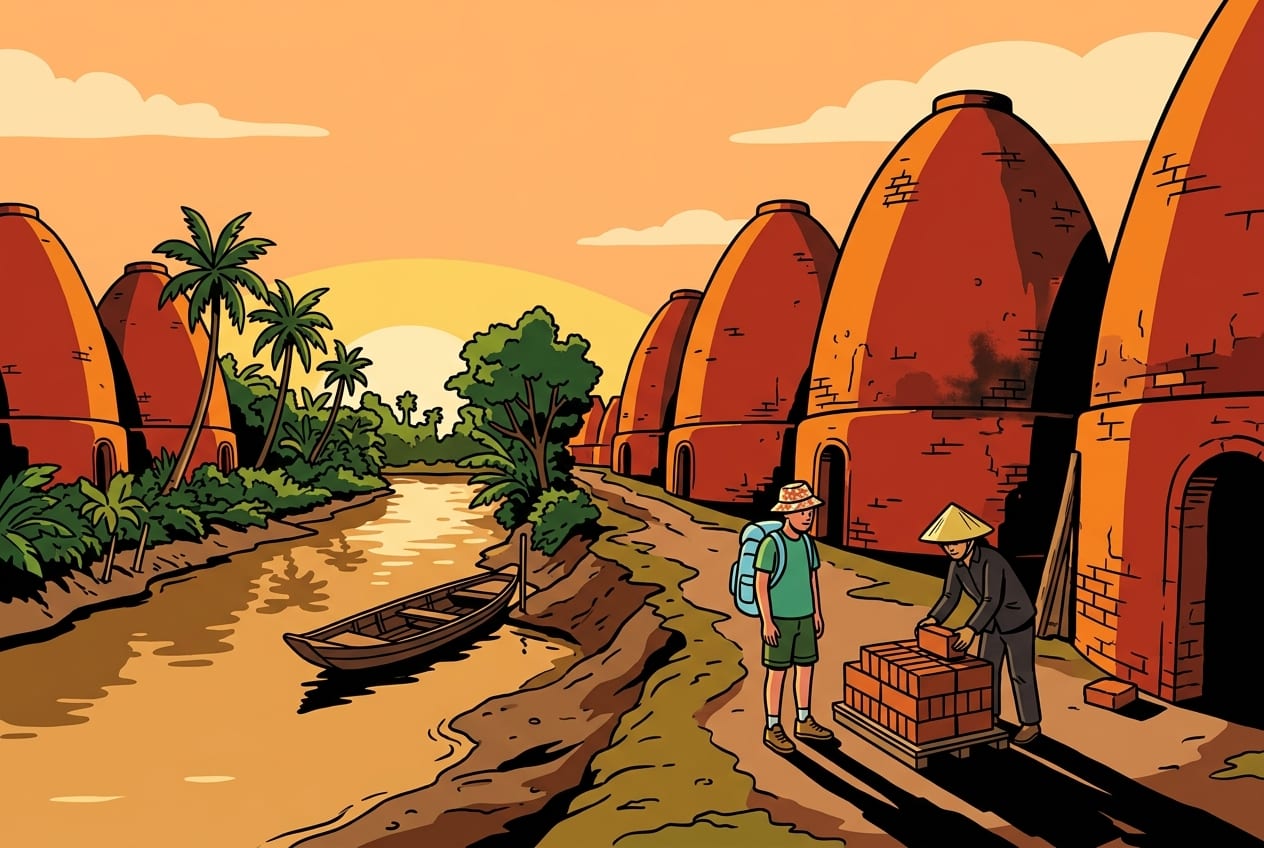
If you travel about 130 kilometers south of Ho Chi Minh City into the heart of the Mekong Delta, the lush green coconut palms suddenly give way to something straight out of a fantasy novel. Rising from the banks of the muddy Cổ Chiên River and the winding Thầy Cai Canal are thousands of towering, beehive-shaped terracotta structures. This is the "Red Kingdom" (Vương quốc đỏ) of Mang Thít, located in Vĩnh Long Province. For years, these incredible brick kilns operated as a bustling industrial hub, but today they stand as a breathtaking, silent monument to the region's artisanal history.
For expats living in Vietnam's chaotic urban centers, a journey to the Mang Thít brick kilns offers a profound change of pace. If you have already explored the bustling water trade detailed in our Mekong Delta floating markets guide, you will find that Mang Thít offers a completely different, highly contemplative rhythm. This is not a polished tourist theme park; it is a living, breathing rural community where ancient heritage sits directly in people's backyards. Navigating this delicate space requires a blend of practical preparation and deep cultural respect.
What is the "Red Kingdom" of Mang Thít?
The "Red Kingdom" of Mang Thít is a unique cultural landscape in Vĩnh Long Province featuring over 1,500 historic, dome-shaped terracotta brick kilns. Stretching along the Thầy Cai Canal, these architectural wonders represent a century-old artisanal brick-making heritage now preserved under a major eco-cultural conservation project.
For over a century, the local communities in Mang Thít utilized the rich, iron-heavy clay of the Mekong Delta to craft high-quality red bricks. At the peak of the industry, thousands of kilns lined the waterways, billowing sweet smoke fueled by burning rice husks (trấu). However, due to modern environmental regulations aiming to phase out traditional coal- and wood-fired kilns, the fires have largely gone cold. The structures themselves were threatened with demolition until the local government stepped in.
Under the ongoing Mang Thít Contemporary Heritage Territory (Di sản Đương đại Mang Thít) project, these 1,500-plus domes are now protected. As reported by Vietnam News, the initiative aims to preserve these architectural marvels while transforming the area into an eco-friendly tourism destination. The resulting visual landscape is a striking contrast of weathered, burnt-orange terracotta against the vibrant, emerald green of banana palms, coconut trees, and floating water hyacinths.
Navigating the Red Kingdom: Boat vs. Scooter
Navigating the Mang Thít brick kilns is best done via a private wooden boat tour along the Thầy Cai Canal or by renting a scooter in Vĩnh Long City. Boat tours cost between 400,000 to 600,000 VND, while daily scooter rentals run about 120,000 to 150,000 VND.
To get to Vĩnh Long from Ho Chi Minh City, expats can easily book a high-quality sleeper bus, such as Phương Trang (Futa Bus Lines), departing from the Western Bus Station (Bến xe Miền Tây) for approximately 150,000 VND ($6 USD). The journey takes between 2.5 to 3 hours. Once you arrive in Vĩnh Long City, you have two primary options for exploring the Red Kingdom: the water route or the land route.
Cruising the Thầy Cai Canal by Boat
Cruising the Thầy Cai Canal offers a majestic, water-level perspective of the towering brick kilns lining the riverbanks. Departing from Vĩnh Long pier, these wooden boat tours allow travelers to witness local river life, floating vegetation, and the grand scale of the terracotta domes without traversing muddy paths.
Hiring a private wooden boat from the Vĩnh Long pier is the most relaxing way to take in the sheer scale of the kilns. As you glide along the silt-rich, brown water of the Thầy Cai Canal, you will see the massive brick domes rising up like ancient stupas. The perspective from the water is unmatched, offering clear, unobstructed views of the kilns reflecting on the river surface. A typical private boat tour costs between 400,000 to 600,000 VND ($16–$24 USD) and can be arranged directly at the pier or through local homestays like Út Trinh Homestay.
Weaving Through Land Paths by Scooter
Exploring Mang Thít by scooter provides intimate access to the narrow land pathways winding directly through family backyards and rural orchards. This self-guided land route allows travelers to stop at local cafes, interact closely with residents, and photograph the delicate brick structures at their own leisurely pace.
For the more adventurous expat, renting a scooter in Vĩnh Long City for 120,000 to 150,000 VND ($5–$6 USD) per day offers unparalleled freedom. The land pathways around Mang Thít are narrow, paved tracks that wind through local fruit orchards, over small arched bridges, and directly past the doorsteps of local residents. Traveling by scooter allows you to stop at trending local spots like Cà Phê Lò Gạch (Brick Kiln Cafe), where you can sip an iced coffee right in the shadow of a towering brick dome.
The Cultural Soul of the Clay: Why These Kilns Matter to Locals
The Mang Thít brick kilns represent a century of joint artisanal labor by Vietnamese, Khmer, and Chinese craftsmen utilizing local clay and rice husks. Rather than mere industrial ruins, these towers are highly revered symbols of ancestral hard work, family pride, and the Mekong Delta's historical economic identity.
To truly appreciate Mang Thít, you must understand why these kilns look and feel the way they do. The architectural shape—resembling a religious stupa or a massive beehive—is actually a highly functional design. The circular base and tapering dome allow heat to circulate evenly when the bricks are baked. Traditionally, local artisans loaded millions of raw clay bricks into the kiln, sealed the entrance with temporary brickwork, and fired the kiln using mounds of golden-yellow rice husks (trấu) as fuel. The baking process could take up to a month, requiring constant monitoring.
Because these kilns were built by hand, brick by brick, they represent generations of family labor. Many of these structures sit directly on private residential land. When you walk around them, you are literally walking through someone's family history. This is why practicing polite etiquette is crucial. Many locals still wear traditional, lightweight áo bà ba (southern Vietnamese shirts) and nón lá (conical hats) as they go about their day, tending to their orchards or maintaining the inactive kilns. Always treat the structures and the people with the utmost respect.
Survival Guide: Timing, Safety, and Essential Gear
To safely explore the Mang Thít brick kilns, visit during the cooler golden hours of sunrise or sunset to avoid intense heat. Travelers should wear sturdy, closed-toe shoes to navigate sharp terracotta fragments, apply heavy-duty mosquito repellent, and carry plenty of drinking water through the humid delta environment.
The Mekong Delta's climate can be incredibly punishing, especially during the middle of the day. Because the brick kilns are designed to trap heat, standing near them under the midday sun can feel like stepping into an oven. Plan your visit during the golden hours of 5:30 AM – 7:30 AM or 4:30 PM – 6:00 PM. Not only is the temperature bearable, but the warm, hazy morning or evening sunlight streaming through the tropical mist makes for spectacular photography.
Safety is another key consideration. The ground around the kilns is highly uneven, dusty, and often littered with sharp, broken terracotta fragments. Ditch the flip-flops and wear sturdy, closed-toe shoes. Additionally, because the kilns are located along water hyacinth canals, mosquitoes are highly active. Apply a generous layer of heavy-duty insect repellent before heading out, and always carry a bottle of water to stay hydrated in the humid air.
Do
- Always ask for permission before entering a kiln or walking onto private residential property.
- Buy a drink or snack at local spots like Cà Phê Lò Gạch to support the local economy.
- Wear sturdy, closed-toe shoes to protect your feet from sharp brick fragments.
- Visit during sunrise or sunset for the best lighting and cooler temperatures.
Don't
- Do not climb on the fragile, crumbling brickwork of the historic kilns.
- Do not touch or lean heavily on structural arches, as many domes are structurally delicate.
- Avoid visiting during the midday heat when temperatures inside the brick fields skyrocket.
- Do not leave trash or disturb the peace of the local residential neighborhoods.
Is there an entrance fee to visit the Mang Thít brick kilns?
No, there is no official entrance fee to visit the Mang Thít brick kiln area. However, because many of these historic structures are located on private family land, it is highly encouraged to buy a drink at a local cafe like Cà Phê Lò Gạch or tip the local caretakers if they show you around their property.
Are any of the Mang Thít brick kilns still actively operating?
While the vast majority of the 1,500-plus kilns have gone silent due to environmental regulations phasing out traditional wood- and husk-fired methods, a few kilns occasionally operate under strict guidelines or are used for demonstration purposes. You may still smell the sweet, smoky aroma of burning rice husks (trấu) during your visit.
Can I go inside the brick kilns to take photos?
Yes, you can often step inside the massive dome structures, which feel incredibly spacious and look like rustic cathedrals from the inside. However, you must always ask the nearby landowners for permission first using a polite phrase like 'Cho con vào tham quan được không ạ?', and never touch or lean on the fragile brick arches.
Practise the words you just read
Vietnamese phrases for real situations, each with native audio in both accents.
Topics
Read more
Other posts from our Vietnamese learning blog.
By Xinchao team
Alleyway Symphonies: Can You Decode Vietnam's Hilarious Street Vendor Cries?
What are those loud megaphone sounds in Vietnam's alleys? Learn to decode Vietnamese street vendor cries (tiếng rao) and order food like a local expat.

By Xinchao team
Duck! Your Expat Survival Guide to Catching Flying Rice at Vietnam's Chaotic 'Cơm Niêu Đập' Restaurants
Ready for dinner and a show? Discover how to navigate Vietnam's chaotic flying clay pot rice restaurants without taking a crispy projectile to the face.

By Xinchao team
Left Foot First: How to Avoid Cosmic Chaos at Tay Ninh's Technicolor Cao Dai Temple
Heading to Tay Ninh's spectacular Cao Dai Holy See? Avoid a spiritual faux pas with this essential guide to gender doors, threshold rules, and cosmic balance.