Left Foot First: How to Avoid Cosmic Chaos at Tay Ninh's Technicolor Cao Dai Temple
A jaw-dropping fusion of world religions, technicolor dragons, and strict cosmic protocols. Here is how to step over the threshold without throwing the universe off balance.
The Cosmic Rules of the Cao Dai Holy See
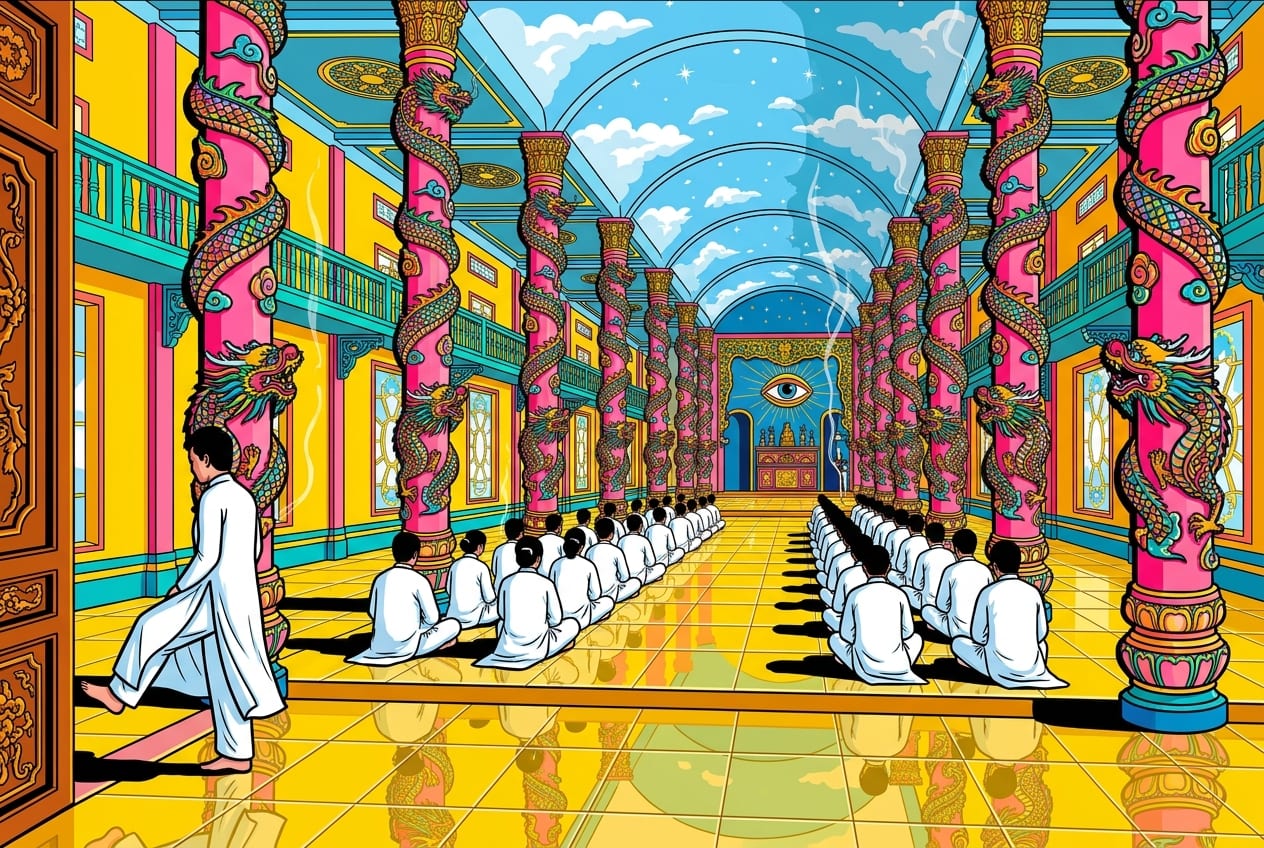
Cao Dai Temple etiquette requires visitors to respect the delicate balance of yin and yang by adhering to gender-segregated entrances and stepping cleanly over sacred wooden thresholds. Men must enter through the right-side door, leading with their left foot, while women enter through the left, leading with their right foot.
Just 90 kilometers northwest of Ho Chi Minh City, in the Hòa Thành district of Tây Ninh Province, lies one of the most visually stunning and spiritually unique places in Southeast Asia: the Cao Dai Holy See (Tòa Thánh Tây Ninh). Established in 1926, Caodaism is a fascinating syncretic religion that blends Buddhism, Taoism, Confucianism, Islam, and Christianity into a single, harmonious belief system. To locals, this vibrant temple is the literal center of the universe. For expats living in Saigon, it is a premier weekend escape, frequently paired with a journey up the nearby, highly trending Sun World Ba Den Mountain cable car.
Getting here is remarkably seamless. Modern limousine vans run by operators like Saco Travel or Huệ Nghĩa depart regularly from Ho Chi Minh City, costing between 150,000 and 220,000 VND ($6–$9 USD) each way. While admission to the temple grounds and the daily ceremonies is entirely free, leaving a small donation in the designated onsite boxes is a highly appreciated gesture of goodwill. However, before you jump on a bus, you must understand that the temple's strict rules are not merely tourist policing; they are vital practices designed to maintain cosmic balance (yin and yang).
Why the Threshold Matters: The Spiritual Science of Yin and Yang
In Cao Dai belief, stepping on a temple's raised wooden threshold is seen as trampling on its spiritual guardians and disrupting the boundary between the sacred and profane. Visitors must step over the threshold using a gender-specific foot to align harmoniously with the flow of cosmic energy.
When you approach the entrance of the Holy See, the first thing you will notice is the separate doors for men and women. This is where your lesson in Cao Dai Temple etiquette truly begins. Men must enter through the right-side door, while women must enter through the left. But the real test of mindfulness lies at your feet: the raised wooden threshold.
In Vietnamese spiritual culture, the threshold is not just an architectural feature; it represents the energetic boundary between the chaotic, profane outer world and the sacred, peaceful inner sanctuary. Stepping on the threshold is considered incredibly disrespectful—essentially trampling on the spiritual guardians who protect the space. Instead, you must step cleanly over it. To align with the cosmic flow of yin (female) and yang (male) energies, men should step over leading with their left foot first, while women should lead with their right foot. This mindful movement mirrors other traditional practices you might observe across the country, such as the polite physical gestures detailed in our guide on why everyone bows at the transit stops in Vietnam.
Planning Your Visit: Timing, Cost, and What to Wear
Visiting the Cao Dai Holy See is free, though donations are appreciated. To witness the most vibrant daily prayer service, plan to arrive by 11:30 AM for the noon ceremony, wear modest clothing that covers shoulders and knees—ideally white—and remove your shoes before entering the temple balcony.
To witness the temple at its most vibrant, you should aim for the 12:00 PM (noon) prayer service, which is the most popular of the four daily ceremonies. We highly recommend arriving by 11:30 AM to secure a prime spot on the upper gallery balcony, which serves as the designated viewing area for international visitors. Before ascending the stairs, you must remove your shoes and leave them on the designated outdoor racks. Going barefoot on the cool marble is all part of the grounding experience.
Modest dress is strictly mandatory. Your shoulders and knees must be covered. While any modest clothing is acceptable, wearing white is a highly respected nod to the lay practitioners' uniform. Once you are upstairs on the balcony, maintain absolute silence, disable your camera flash, and keep your phone on silent. If you choose to sit on the balcony floor to watch the service, make sure you do not point your feet toward the altar or the worshippers below, as pointing the soles of your feet is considered offensive in Vietnamese culture. For more context on global religious practices and syncretism, you can read more on Britannica's Cao Dai overview.
The Visual Feast: Technicolor Dragons and the Divine Eye
The interior of the Cao Dai Holy See features a spectacular blend of French cathedral and Buddhist pagoda design, highlighted by pastel pink walls, sky-blue ceilings, and twenty-eight dragon-wrapped columns. At the high altar sits a massive blue sphere depicting the glowing Divine Eye, symbolizing cosmic consciousness.
Stepping inside the Holy See feels like walking into a brilliant, technicolor dream. The architecture is a dizzying masterpiece that looks like a cross between a French cathedral, a Buddhist pagoda, and a fantasy palace. The exterior facade features a striking canary yellow, while the interior boasts pastel pink walls and a sky-blue ceiling painted with fluffy white clouds and stars, representing the heavens.
Supporting the roof are twenty-eight grand columns, each wrapped in hand-painted, emerald-green and gold dragons that seem to writhe upward toward the ceiling. These columns guide your eyes toward the high altar, where a massive, deep-blue sphere representing the universe dominates the space. At its center glows the 'Divine Eye' (Thiên Nhãn), staring back with a serene, all-knowing gaze. The air inside is thick with the sweet, heavy scent of burning incense and fresh jasmine, creating an atmosphere that is deeply spiritual, sensory, and unforgettable.
Post-Ceremony Survival: Sugarcane Juice and Spicy Souvenirs
After the midday ceremony, visitors can cool down with fresh sugarcane juice from street vendors outside the temple grounds. Tay Ninh is famous for its unique regional snacks, including dew-soaked rice paper and spicy shrimp chili salt, which make excellent souvenirs to take back to Ho Chi Minh City.
Once the ceremony concludes, you will step back out into the intense midday heat of Tay Ninh. The tropical sun beats down relentlessly on the vast, dusty courtyard, which is framed by beautifully manicured gardens where wild macaques occasionally play. To cool down, grab a refreshing glass of nước mía (sugarcane juice) from the local vendors lining the perimeter of the temple grounds.
Before you head back to Saigon, make sure to buy some of Tay Ninh's famous culinary specialties. The region is legendary for bánh tráng phơi sương (dew-soaked rice paper) and muối tôm (shrimp chili salt). Despite being entirely landlocked, Tay Ninh produces the most famous shrimp salt in Vietnam—a savory, spicy, and slightly sweet seasoning that locals shake over fresh fruit. It is a fantastic souvenir that perfectly encapsulates the creative, resourceful spirit of the region.
Do
- Step cleanly over the wooden threshold; never step directly on it.
- Enter through the correct door: men on the right, women on the left.
- Wear modest clothing that covers your shoulders and knees; white clothing is highly appreciated.
- Remove your shoes and leave them on the designated racks before heading up to the viewing balcony.
Don't
- Do not use flash photography or make noise during the prayer ceremonies.
- Do not point your feet toward the altar or the worshippers if you sit on the floor.
- Do not block the pathways of the practitioners as they enter the temple.
Why is it called 'Left Foot First' for men and 'Right Foot First' for women when entering?
This rule is rooted in the ancient Eastern philosophy of yin and yang (âm dương). In cosmic alignment, the left side represents yang (masculine energy) and the right side represents yin (feminine energy). By stepping over the threshold with their corresponding foot, visitors symbolically harmonize their personal energy with the sacred spiritual flow of the temple.
Are non-believers allowed to attend the daily ceremonies at the Cao Dai Holy See?
Yes, absolutely! Caodaism is an incredibly welcoming, inclusive religion that preaches universal brotherhood. Visitors of all faiths are encouraged to observe the daily prayer services from the upper balcony, provided they follow the basic rules of modesty, silence, and respect.
What is the best way to travel from Ho Chi Minh City to Tay Ninh for a day trip?
The most convenient option is booking a modern limousine van (such as Saco Travel or Huệ Nghĩa). They depart hourly from HCMC, take roughly 2 to 2.5 hours, and cost between 150,000 and 220,000 VND ($6–$9 USD) each way. This makes it incredibly easy to combine a morning visit to the temple with an afternoon trip to nearby Ba Den Mountain.
Practise the words you just read
Vietnamese phrases for real situations, each with native audio in both accents.
Topics
Read more
Other posts from our Vietnamese learning blog.
By Xinchao team
The Silent Alley Threat: Your Survival Guide to Vietnam's Ultra-Quiet EV Revolution
Vietnam's iconic, roaring alleyways are falling silent as electric bikes and mini-EVs take over. Here is how to navigate these sensory-shifted streets safely.

By Xinchao team
The Cat-and-Mouse Game of Hanoi's Train Street: Your 2026 Survival Guide to Visiting Safely (and Legally)
How do you navigate the guards, barricades, and narrow tracks of Hanoi's Train Street in 2026? Learn the insider rules to visit safely, legally, and respectfully.

By Xinchao team
Midnight at the Cemetery: Why Thousands of Vietnamese Pilgrims Flock to Cô Sáu under the Stars
Discover the deep history, essential etiquette, and practical steps for participating in Côn Đảo's famous midnight pilgrimage to the grave of Cô Sáu.