From Tea Trays to 500-Guest Toasts: Your Survival Guide to a Vietnamese Wedding
Navigating a Vietnamese wedding can be a whirlwind of red silk, loud toasts, and ancient rituals. Here is why the party is so big and how to handle it like a local.
The Whirlwind of the Vietnamese Wedding
Vietnamese weddings are not just celebrations of love; they are massive community events that bridge the gap between ancient ancestral worship and modern, high-energy banquets. According to Vietnam Tourism, these events are among the most important milestones in a person's life, involving months of preparation and hundreds of guests. If you have been invited, you aren't just a spectator; you are part of a social fabric that values presence, face, and collective joy.
You might find yourself at an intimate home ceremony in the morning, surrounded by the scent of incense and jasmine tea, only to end up in a neon-lit ballroom with 500 people by evening. Understanding the 'why' behind these shifts helps you navigate the day with confidence. It is a transition from the private realm of the family to the public realm of the community. Whether you are an expat living in Saigon or a traveler lucky enough to be invited by a new friend, knowing the rules of the game will save you from accidental awkwardness.
The Three Stages: From Proposal to Party
Vietnamese weddings traditionally consist of several distinct ceremonies that emphasize the union of two families rather than just two individuals, a concept deeply rooted in Confucian values as detailed by Britannica. While modern couples might combine these, the spirit of the 'Lễ Dạm Ngõ' (The Proposal) and 'Đám Hỏi' (The Engagement) remains central to the process.
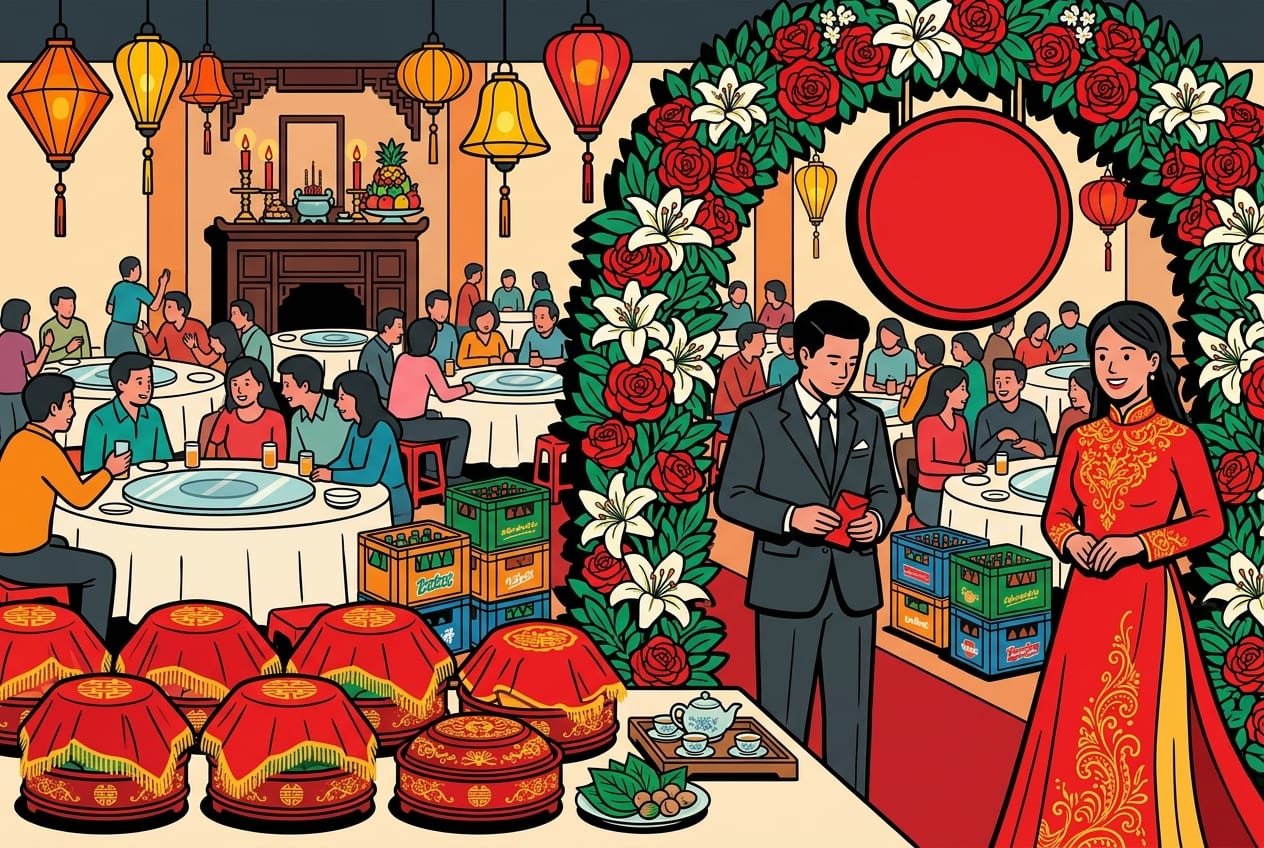
The first step is often the Lễ Dạm Ngõ. This is the first official meeting between the two families. It is small, intimate, and focused on 'checking the vibes.' If you are a very close friend of the groom, you might see the row of ornate red-lacquered trays wrapped in gold-fringed silk. These trays, called 'mâm quả,' carry gifts like betel leaves, areca nuts, wine, and tea. In Vietnamese culture, 'the betel leaf starts the conversation.' It is a symbolic peace offering that signals the start of a new alliance.
The Đám Hỏi (Engagement) is the 'big announcement.' This is where the groom’s family formally asks for the bride’s hand. You will see a colorful procession of young men and women (the 'bê tráp' team) carrying those red trays through the streets. The entrance to the bride’s house is usually marked by a large floral arch of roses and lilies, often featuring a blank, circular red board where the couple's names will later be written in gold. This stage is about respect—showing the neighborhood that this union is official and honorable.
The Red Envelope: The Economics of Celebration
In Vietnam, you don't go to a wedding registry to buy a toaster. Instead, the tradition is 'tiền mừng'—lucky money in a red envelope. This is a form of communal crowdfunding. The guests help the couple pay for the massive banquet and give them a 'nest egg' to start their lives. It is a practical, efficient system that ensures the couple doesn't start their marriage in debt.
How much should you give? This is the most common question for expats. A good rule of thumb is to cover the cost of your meal plus a little extra. In a standard city hotel, 500,000 VND to 1,000,000 VND per person is common. If it is a high-end luxury venue, you might go higher. You place the money inside the small, unadorned red envelope that often comes with the invitation. If you didn't get one, a simple white envelope with your name on it works fine. You hand this to the couple or place it in a decorative box (often shaped like a heart or a tiered cake) at the entrance of the reception hall.
What to Wear: Red, Gold, and Respect
Vietnamese weddings are colorful affairs, and your attire should reflect that. The 'why' behind the dress code is simple: you want to look prosperous and happy to honor the couple. Bright colors like red, pink, and gold are highly encouraged because they symbolize luck and vitality.
For women, wearing a vibrant red áo dài with gold embroidery is a wonderful way to show respect for the culture. However, be careful not to outshine the bride—if she is wearing a bright red áo dài, you might choose a different pastel or bright color. For men, formal Western suits or a 'semi-formal' look (slacks and a button-down shirt) are standard. A major 'don't' is wearing all-black or all-white. In Vietnamese tradition, all-black is associated with funerals, and all-white can sometimes carry similar connotations, though white dresses are becoming more common due to Western influence. When in doubt, go for color!
The Banquet: 10 Courses and 'Mot, Hai, Ba, Dzo!'
The reception is where the energy explodes. Unlike Western weddings with a long dance floor session, the focus here is the food and the toasts. You will be seated at a round table, usually with 10 people, featuring a revolving glass platter (Lazy Susan). The food comes out in a steady stream—shrimp, chicken, sticky rice, hotpot, and fruit. It is a marathon, not a sprint.
The most important part of the banquet is the Chào Bàn (Table Greeting). The bride and groom, along with their parents, will visit every single table. When they get to yours, everyone stands up. This is the time for the 'Mot, Hai, Ba, Dzo!' (1, 2, 3, Cheers!) chant. If you have read about the secret rules of the Vietnamese 'Quán Nhậu', you will recognize this energy. It is loud, it is sweaty, and it is incredibly friendly. Expect to have your glass clinked a dozen times by strangers who want to welcome the 'foreign guest.'
Do
- Arrive on time for the photo session at the entrance, but don't be surprised if the actual food starts 30-45 minutes late.
- Write your name clearly on the red envelope so the couple knows who gave what.
- Stand up and join the group toast when the couple visits your table.
- Try a little bit of every dish; it shows you appreciate the host's hospitality.
Don't
- Don't wear all-black; it is traditionally associated with mourning.
- Don't leave immediately after eating; wait at least until the couple has finished their table rounds.
- Don't feel pressured to drink more beer than you can handle, even if people are shouting 'Dzo!'—a polite 'không, cảm ơn' (no, thank you) is fine.
The Spiritual Heart: The Ancestral Altar
While the banquet is for the living, the morning ceremony is for the ancestors. In a Vietnamese home, the polished wooden ancestral altar is the most sacred spot. During the wedding, it is adorned with flickering candles, incense, and tiered fruit arrangements. The 'why' is simple: the couple must inform their ancestors of the marriage to receive their blessing and protection.
If you are invited to the home ceremony, you will see the couple bowing before the altar. This is a moment of deep 'Hiếu' (filial piety). It is quiet and solemn, a sharp contrast to the crates of beer you will see later at the reception. Observing this ritual gives you a glimpse into the spiritual backbone of Vietnamese family life—the belief that those who came before us are still part of our most important days.
What should I do if I am the only foreigner at the table and don't speak Vietnamese?
Don't worry! Vietnamese people are incredibly hospitable at weddings. Smile, keep your glass ready for toasts, and use simple gestures. Learning to say 'Chúc mừng!' (Congratulations!) or 'Dzo!' (Cheers!) will instantly make you the star of the table. Most people will be eager to practice their English with you or offer you the best pieces of food from the revolving platter.
Is it okay to bring a 'plus one' if they weren't explicitly on the invitation?
In Vietnamese culture, weddings are 'the more the merrier,' but modern venues have fixed seating. If the invitation is addressed only to you, it is best to ask the host first. However, if you are an expat and the host knows you have a partner, they often assume you will bring them. Just remember to increase the 'tiền mừng' (gift money) in your envelope to cover the second person!
Attending a Vietnamese wedding is a sensory overload in the best way possible. From the delicate ceramic tea sets of the morning to the stacks of beverage crates in the evening, it is a celebration of life, family, and community. By following these simple rules of etiquette, you move from being a confused observer to an honored guest, participating in a tradition that has bound Vietnamese families together for centuries.
Practise the words you just read
Vietnamese phrases for real situations, each with native audio in both accents.
Topics
Read more
Other posts from our Vietnamese learning blog.
By Xinchao team
Entering the Red Kingdom: An Expat's Guide to Navigating Vĩnh Long’s Majestic Mang Thít Brick Kilns
Discover the majestic Mang Thít brick kilns of Vĩnh Long. This comprehensive expat guide covers boat tours, scooter routes, local etiquette, and the rich cultural history of the Mekong Delta's 'Red Kingdom'.
By Xinchao team
Alleyway Symphonies: Can You Decode Vietnam's Hilarious Street Vendor Cries?
What are those loud megaphone sounds in Vietnam's alleys? Learn to decode Vietnamese street vendor cries (tiếng rao) and order food like a local expat.
By Xinchao team
Duck! Your Expat Survival Guide to Catching Flying Rice at Vietnam's Chaotic 'Cơm Niêu Đập' Restaurants
Ready for dinner and a show? Discover how to navigate Vietnam's chaotic flying clay pot rice restaurants without taking a crispy projectile to the face.