The 'Em Ơi' Minefield: Your Expat Survival Guide to Addressing Anyone on the Vietnamese Street (Without Causing an Accidental Crisis)
Navigating the streets of Vietnam requires more than just knowing what to order; it requires knowing how to speak to people. Learn how to master local pronouns and avoid accidental social blunders.
Why "Em Ơi" Isn't Just "Excuse Me"
Unlike the neutral English 'excuse me,' the Vietnamese phrase 'em ơi' is deeply rooted in a kinship-based pronoun system. Calling someone 'em' literally defines them as your younger sibling. Using it incorrectly with an older person unintentionally demotes their social standing, disrupting the respectful hierarchy central to Vietnamese social harmony.
In Vietnam, language is not merely a tool for communication; it is a dynamic social map. Unlike English, which relies on the neutral pronouns "you" and "I," the Vietnamese language uses a rich, kinship-based pronoun system. When you speak to someone, you are not just addressing them as an individual; you are instantly placing them—and yourself—into a symbolic family tree. You can read more about this complex linguistic structure on Wikipedia's overview of Vietnamese pronouns.
The famous phrase "Em ơi!" (literally translating to "younger sibling, hey!") is the universal siren call for expats trying to get a server's attention. However, using it blindly is a cultural minefield. If you address a street food vendor in her fifties or an older shop owner as "em," you are subtly demoting them in social standing. In a culture where age and social hierarchy command deep respect, this can cause a flash of awkwardness or mild offense. Conversely, choosing the correct pronoun—such as "Anh ơi" (older brother), "Chị ơi" (older sister), or "Cô ơi" (aunt)—instantly signals respect, breaks the ice, and guarantees warmer, faster service.
This linguistic dance is central to what linguists call honorifics and relational language. According to Britannica's guide to the Vietnamese language, the vocabulary of Vietnamese reflects a highly structured social system where age, gender, and social status dictate the exact words used to define relationships. When you step onto the sidewalk, you are entering this living web of relationships. Getting it right isn't about being grammatically flawless; it's about showing that you see the person behind the counter as a human being worthy of respect.
The Modern Cafe Scene: Safe Zones and Danger Zones
Modern Vietnamese cafes like Phê La or Katinat are staffed by Gen Z workers, making the youthful 'em ơi' a safe, polite default. However, traditional street food stalls run by older generations require shifting to respectful terms like 'cô ơi' (aunt) or 'chú ơi' (uncle) to match local social expectations.
Grounding your pronouns in the modern landscape requires knowing where you are and who you are addressing. If you are ordering a trendy Oolong milk tea at a sleek Phê La outlet in Hanoi’s Old Quarter, or grabbing a specialty cà phê muối (salt coffee) for 45,000 VND at a chic, solar-powered roastery in Ho Chi Minh City’s Thao Dien district, the staff are almost certainly Gen Z. In these contemporary, youth-dominated spaces, a cheerful "Em ơi!" is the perfect, safe default because the staff are almost certainly younger than you (or at least comfortable with the default service industry dynamic).
However, if you step onto the sidewalk for a traditional 30,000 VND cà phê sữa đá (iced milk coffee) served from a cart, or visit a historic spot like Cafe Giang, you must pivot. The woman running that cart is likely a mother or a grandmother who has spent decades mastering her craft. Addressing her as "em" is a social misstep. Instead, calling her "Cô ơi" (aunt, please!) or the older gentleman next to her as "Chú ơi" (uncle, please!) shows you understand the local social fabric. This small shift immediately elevates you from a clueless tourist to a culturally savvy guest. It also highlights the fascinating regional variations in how coffee is enjoyed across the country—for instance, you might notice differences in naming conventions and preparations, which you can explore in our guide on why your coffee is brown in Hanoi but milky in Saigon.
This duality between modern franchise culture and traditional street life is what makes Vietnam's culinary scene so vibrant. As detailed by BBC Travel's exploration of Vietnamese coffee culture, the sidewalk cafe is a social equalizer where professors, motorbike taxi drivers, and expats sit side-by-side on low stools. In this shared space, using the correct term of address is the key that unlocks genuine local hospitality.
The "Assess, Match, Reciprocate" Method
To master street interactions, quickly estimate a person's age relative to yours, match them with the correct kinship pronoun, and use the corresponding self-referential pronoun. This linguistic symmetry ensures you treat others with appropriate respect while maintaining your own standing in the conversation, preventing awkward social friction.
To navigate the streets of Vietnam without causing an accidental social crisis, expats can master a simple three-step survival method: Assess, Match, and Reciprocate.
First, Assess. When you walk up to a stall or sit down at a cafe, quickly estimate the other person's age relative to yours. You do not need to guess their exact birth year; you just need to place them into a general demographic bracket relative to yourself. Are they younger than you? Older? Old enough to be your parent? Or perhaps your grandparent?
Second, Match. Pair their estimated demographic with the word "ơi" (pronounced like a soft, breathy "uh-ee" originating from the throat). Use "Em ơi" for anyone clearly younger than you. Use "Anh ơi" for a man who looks slightly older than you, and "Chị ơi" for a woman slightly older. If they are of your parents' generation, pivot to "Cô ơi" (for women) or "Chú ơi" (for men). If they are of your grandparents' generation, use "Bà ơi" (grandmother) or "Ông ơi" (grandfather).
Third, Reciprocate. Remember that Vietnamese pronouns are a two-way street. If you call a young barista "em," you should refer to yourself as "anh" (if you are male) or "chị" (if you are female) when speaking. For example, instead of just saying "Give me a coffee," say: "Em ơi, cho anh/chị một ly cà phê sữa đá" (Excuse me, please give [older brother/sister] an iced milk coffee). This linguistic symmetry is highly appreciated because it shows you are participating in the culture's relational harmony rather than acting like a demanding customer.
Street Scenarios: Putting Pronouns Into Practice
Applying correct pronouns on the street transforms your interactions from transactional to warm and personal. Whether you are ordering a salt coffee in Saigon or a hot brew in Hanoi, using the right honorific signals cultural awareness, often resulting in broader smiles, friendlier service, and a deeper connection to local life.
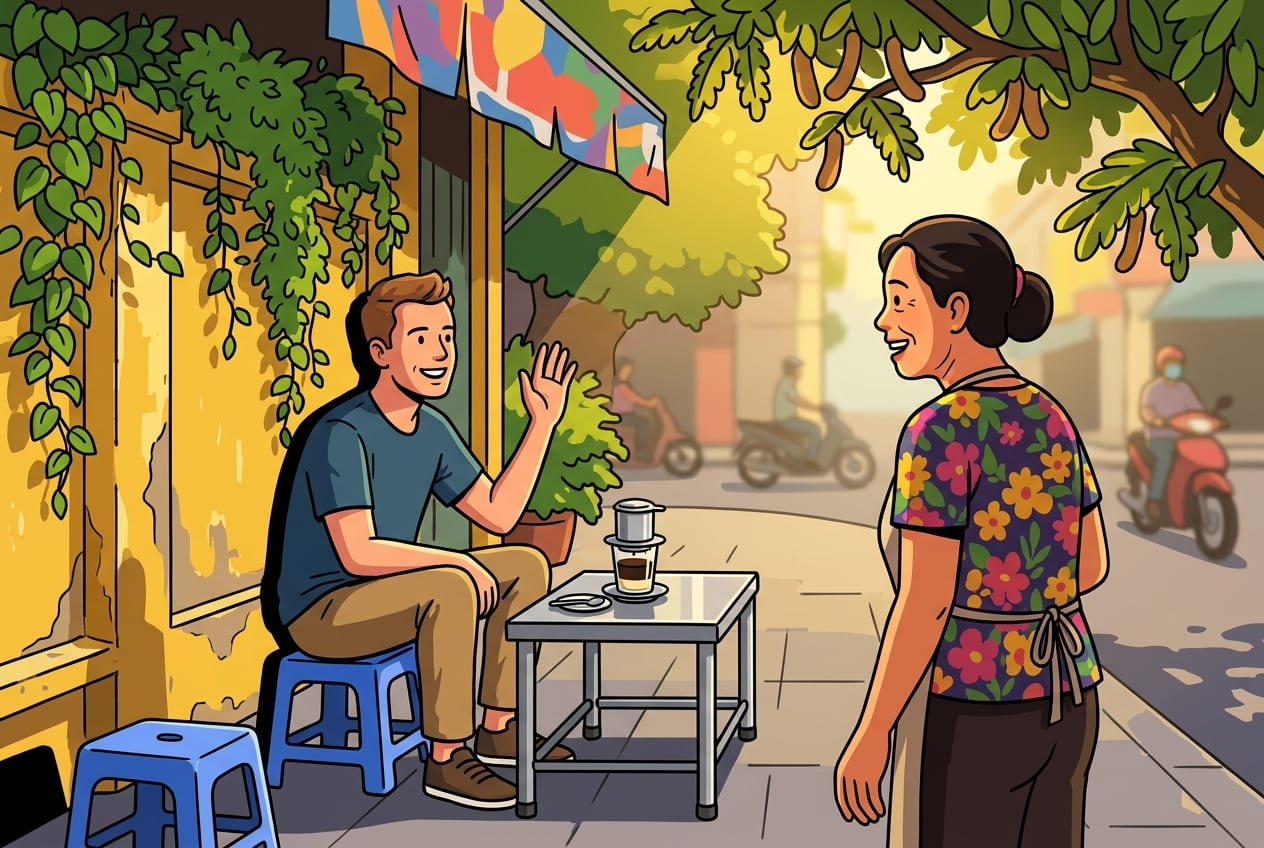
To picture this linguistic dance in real life, imagine sitting on a low, vibrant blue plastic stool on a bustling sidewalk in District 1, Ho Chi Minh City. The air is warm, humid, and thick with the rich, chocolatey aroma of roasting robusta coffee beans. Dappled golden-hour sunlight filters through the broad leaves of a massive tamarind tree, casting shadows across a weathered, French-colonial yellow wall. On a small, low-slung stainless steel table sits a traditional aluminum phin filter slowly dripping dark coffee over a thick layer of condensed milk, next to a modern, pastel-colored takeaway cup from a nearby Katinat cafe.
The street is alive with motion: locals in breezy linen shirts and trendy streetwear zip past on motorbikes, while a vendor wearing a traditional nón lá (conical hat) balances a shoulder pole nearby. When you raise your hand and call out a perfectly pitched "Chị ơi!" to the busy woman in her late thirties managing the stall, she pauses, beams a wide smile, and rushes over to take your order. By choosing "chị" over "em," you have acknowledged her as an esteemed older sister rather than a subordinate. This tiny shift in vocabulary changes the entire energy of the interaction.
Understanding these subtle social cues is just as important as knowing transit etiquette. For instance, just as you learn to navigate the pronoun landscape on the street, you'll find unique behavioral norms when traveling, which we cover in our transit etiquette guide. Mastering both shows a deep appreciation for the quiet, respectful rhythms of Vietnamese daily life.
Do
- Use 'Cô ơi' or 'Chú ơi' for older street food vendors to show respect for their age and hard work.
- Listen to what pronouns locals use for themselves and try to mirror them.
- Smile and use a soft, rising tone when saying 'ơi' to keep it friendly.
- Refer to yourself as 'anh' (male) or 'chị' (female) when speaking to someone younger than you.
Don't
- Do not call a grandmother or an elderly street vendor 'Em ơi'—it is highly disrespectful.
- Do not snap your fingers, hiss, or whistle to get a waiter's attention; always use a polite pronoun + 'ơi'.
- Do not worry too much about making mistakes; locals are incredibly forgiving of expats trying to learn.
What should I do if I accidentally call an older street vendor 'em ơi'?
Don't panic! Vietnamese people are incredibly welcoming and understand that foreigners are still learning the language. Simply smile, correct yourself by switching to 'cô ơi' (aunt) or 'chị ơi' (older sister), and continue your order. The effort to correct yourself will be highly appreciated.
Can I use 'bạn ơi' as a safe, gender-neutral pronoun on the street?
Yes, 'bạn ơi' (literally 'hey friend!') is a great, neutral option when addressing peers who are clearly around your own age. However, avoid using it for older street vendors, as it can sound overly casual or dismissive of their life experience. For older individuals, always stick to 'cô', 'chú', 'anh', or 'chị'.
How do I get a server's attention in a very busy, noisy restaurant?
In a noisy venue, make eye contact, raise your hand slightly (palm facing down or flat, never with a pointing finger), and call out the appropriate pronoun + 'ơi' clearly. For example, 'Anh ơi!' or 'Em ơi!' delivered with a friendly smile will cut through the noise without sounding demanding.
Hear these phrases
Each one is recorded in both the northern and southern accent.
Topics
Read more
Other posts from our Vietnamese learning blog.
By Xinchao team
Sweet Sâm or Face-Melting Đắng? Your Expat Survival Guide to Cholon’s Ancient Herbal Tea Culture
Discover Saigon's ancient herbal tea culture in Cholon. Learn how to order sweet nước sâm and survive face-melting nước đắng with this expat survival guide.
By Xinchao team
The Point-and-Eat Protocol: Your Expat Survival Guide to Vietnam's 'Cơm Bình Dân' Buffet Trays
Demystify Vietnam's legendary 'commoner's rice' stalls. Learn the step-by-step point-and-eat protocol, discover must-try dishes, and master sidewalk etiquette.

By Xinchao team
Entering the Red Kingdom: An Expat's Guide to Navigating Vĩnh Long’s Majestic Mang Thít Brick Kilns
Discover the majestic Mang Thít brick kilns of Vĩnh Long. This comprehensive expat guide covers boat tours, scooter routes, local etiquette, and the rich cultural history of the Mekong Delta's 'Red Kingdom'.