Why Is Your Coffee 'Brown' in Hanoi but 'Milky' in Saigon?
Discover the spicy rivalry between Hanoi's Nâu Đá and Saigon's Cà Phê Sữa Đá. Learn the sidewalk etiquette, brewing secrets, and why the stools are so low.
The Great Coffee Divide: North vs. South
Vietnam’s coffee culture is split between the traditional, concentrated 'Nâu đá' of Hanoi and the sweet, icy 'Cà phê sữa đá' of Saigon. This regional divide reflects differences in climate, history, and the pace of daily life, turning a simple caffeine fix into a deeply rooted social ritual that defines the local identity.
If you walk through the streets of Vietnam, you will realize that coffee is not just a drink; it is the social glue that holds the country together. However, if you order a coffee in Hanoi the same way you do in Saigon, you might get a confused look from the server. The two cities have been in a friendly 'coffee war' for decades, each claiming their style is the 'true' Vietnamese experience. In the North, coffee is an intense, slow-motion affair. In the South, it is a refreshing, high-volume necessity. Understanding this difference is your first step to becoming a true 'Vietnamese Street Specialist.'
The geography of Vietnam plays a huge role here. Hanoi has four seasons, including a chilly winter that makes people want to huddle together in small, cozy spaces. Saigon, on the other hand, is eternally hot. This climate difference has dictated everything from the amount of ice in your glass to the height of the chair you sit on. Whether you are leaning against a thousand-year-old mossy wall in the Old Quarter or sitting on a plastic sheet in a Saigon park, the coffee in your hand tells a story of survival, adaptation, and local pride.
Hanoi's 'Nâu Đá': A Bitter, Beautiful Ritual
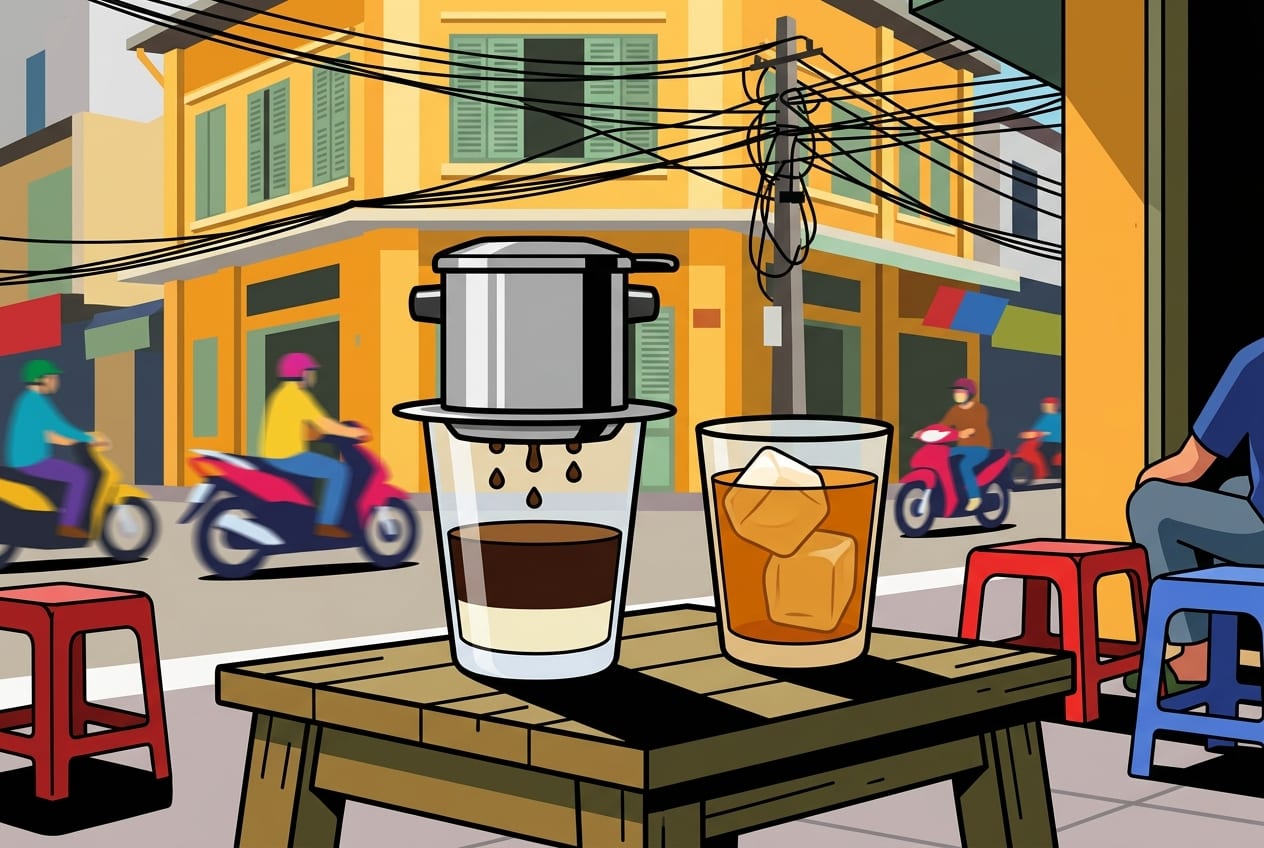
Hanoi coffee is a test of patience and a love for intensity. Served in small glasses with a thick layer of condensed milk, it is designed to be sipped slowly. The 'Nâu đá' name describes the dark brown color created when the bitter robusta beans meet the sweet milk, emphasizing a balanced flavor.
In Hanoi, the coffee is famously strong. Most shops use 100% Robusta beans, which have almost double the caffeine content of Arabica. When you order a 'Nâu đá' (literally 'Brown Ice'), you aren't getting a tall latte. You are getting a small, thick glass. At the bottom lies a layer of sweetened condensed milk. On top, a concentrated blast of black coffee. You are expected to stir it yourself, watching the dark liquid swirl into a creamy, caramel-colored 'brown.' Then, you add just a few cubes of ice.
The Hanoian way of drinking is about 'nhâm nhi'—lingering. You don't gulp this coffee. It is too strong for that. You take a tiny sip, let the bitterness hit the back of your throat, followed by the sugary punch of the milk, and then you look out at the street. Hanoi coffee shops are often tiny, tucked into narrow 'tube houses' or spilling out onto sidewalks with yellow-painted walls. The vibe is nostalgic, slightly moody, and very focused on the 'vỉa hè' (sidewalk) view.
The Sidewalk Stool and Sunflower Seeds
Sitting on low plastic stools on Hanoi's sidewalks is more than just a seating arrangement; it is a front-row seat to the city's history. This 'vỉa hè' culture encourages people to linger, crack sunflower seeds, and engage in quiet observation of the bustling Old Quarter traffic while enjoying a slow drip.
You cannot talk about Hanoi coffee without mentioning 'Hạt hướng dương' (sunflower seeds). If you see a group of locals sitting on blue or red plastic stools that are only 20 centimeters off the ground, look at the floor. It will likely be covered in seed shells. This is the Hanoian 'fidget spinner.' Cracking seeds while sipping 'Nâu đá' is the ultimate way to pass time. It keeps your hands busy while your brain relaxes. It is a slow, rhythmic activity that matches the slow drip of the 'Phin' filter.
There is a certain 'face' to Hanoi coffee. It’s slightly more formal in its informality. People might sit in silence for thirty minutes, just watching motorbikes pass. It is a meditative state. If you want to fit in, don't rush. Don't look at your watch. Just crack a seed, take a sip, and realize that in Hanoi, time is measured in coffee drops, not minutes.
Saigon's 'Cà Phê Sữa Đá': The Tall, Sweet Thirst Quencher
In the heat of Saigon, coffee is a refreshing necessity rather than a slow ritual. The local 'Cà phê sữa đá' features a generous amount of condensed milk and a glass filled to the brim with ice, providing a sweet, cold energy boost that matches the city’s vibrant, fast-paced energy.
Now, let’s fly 1,000 miles south to Ho Chi Minh City (Saigon). Here, the coffee is a different beast entirely. While Hanoi calls it 'Nâu đá,' Saigonese call it 'Cà phê sữa đá' (Iced Milk Coffee). But the difference isn't just the name. In Saigon, the glass is huge. It is packed with crushed ice—not just a few cubes, but a mountain of ice that reaches the rim. Why? Because Saigon is hot, and you need hydration as much as you need caffeine.
Saigon coffee is generally sweeter and more diluted than its northern cousin. It is designed to be drunk throughout the morning. You’ll see people carrying it in plastic cups with carriers made of thin plastic string, hanging from the handlebars of their scooters. It is the fuel of the southern economy. While Hanoi is about the 'view,' Saigon is about the 'vibe.' The shops are more open, the music is louder, and the people are generally more talkative with strangers.
'Cà Phê Bệt' and the Spirit of Freedom
'Cà phê bệt' represents the youthful, rebellious, and free-spirited side of Saigon. By sitting directly on the pavement in parks or near the Cathedral, locals break away from formal structures, enjoying their coffee from plastic bags or cups while chatting loudly with friends in the open air.
If Hanoi has the low stool, Saigon has the cardboard sheet. 'Cà phê bệt' (literally 'flat coffee' or 'sitting-on-the-ground coffee') is a legendary part of Saigon youth culture. Usually found around the Notre Dame Cathedral or the April 30th Park, this style involves buying a coffee from a mobile street vendor and sitting directly on the ground. The vendor will give you a piece of cardboard to sit on so you don't get your pants dirty.
This reflects the Saigon spirit: democratic, easy-going, and unpretentious. There are no walls, no fancy decor, just you, your friends, and the open air. It is the ultimate social equalizer. You might see a university student sitting next to a businessman, both enjoying the same 15,000 VND coffee. In Saigon, coffee is a bridge between people, while in Hanoi, it is often a wall of reflection.
The Brewing Battle: Phin vs. Vợt
The technical difference between North and South lies in the brewing method. While the metal 'Phin' filter is king in the North for its slow drip, the South preserves the traditional 'Vợt' or stocking filter method, where coffee is steeped in large pots, resulting in a smoother, lighter taste.
The 'Phin' is that iconic metal filter that sits on top of a glass. It is the symbol of Vietnamese coffee. In Hanoi, the Phin is used for almost every cup. It forces the water to pass through the grounds very slowly, drop by drop. This creates a thick, syrupy extract that can stand up to the heavy condensed milk. If you are in a rush, a Phin is your worst enemy. If you are in Hanoi, the Phin is your best friend because it gives you an excuse to do nothing for ten minutes while it brews.
In Saigon, however, you can find 'Cà phê vợt' (Net Coffee). This is an old-school method where the coffee is brewed in a large clay pot using a long fabric filter that looks like a stocking. The coffee is kept simmering all day. This results in a flavor that is less 'punchy' than the Phin but has a deeper, more mellow aroma. It’s a dying art, but in the old alleys of District 5 or District 3, you can still find 70-year-old shops that have been using the same 'vợt' for decades. It is the soul of old Saigon.
The Sound of the City: Clinking Spoons vs. Crushing Ice
The auditory experience of coffee drinking varies wildly between the two hubs. In Hanoi, you hear the rhythmic 'clink-clink' of small spoons stirring thick milk in glass. In Saigon, the dominant sound is the 'shuck-shuck' of ice being crushed or the roar of motorbikes passing by open-air cafes.
Close your eyes in a Hanoi cafe. You will hear the 'tách, tách, tách' of sunflower seeds being cracked between teeth. You will hear the metallic 'ting' of a spoon hitting a small glass as someone tries to incorporate that stubborn layer of condensed milk. It is a quiet, domestic sound. It feels like being in someone's living room, even if you are on a busy street corner.
Now, close your eyes in a Saigon cafe. The soundscape is dominated by the 'rào rào' of ice being shoveled into glasses. Because the glasses are larger and the ice is often crushed, there is a constant rattling sound. You hear the 'vroom' of the city moving at 60km/h. Saigon coffee is the sound of motion; Hanoi coffee is the sound of a pause button being pressed. Both are equally addictive.
Social Etiquette: How to Sit Like a Local
Mastering coffee etiquette in Vietnam means understanding the 'Trà đá' (iced tea) culture. In both cities, coffee is rarely consumed alone; it is almost always accompanied by a free or very cheap glass of diluted tea, which serves to cleanse the palate and extend the social gathering.
When you arrive at a sidewalk cafe, don't wait for a hostess to seat you. Just find a stool, make eye contact with the staff, and point. In Hanoi, if the place is crowded, it is perfectly normal to share a tiny table with a stranger. You don't have to talk to them; you just share the space. This is 'sitting culture.' Your knees might be up to your chest, but that is part of the charm.
One crucial rule: The 'Trà đá' (iced tea) is your companion. In Saigon, it is almost always free and refilled constantly. In Hanoi, you might have to pay a few thousand VND for it. Don't drink your coffee in one go and leave. The tea is there so you can sit for an hour, sip the tea to wash away the sweetness of the milk, and enjoy the 'vỉa hè' atmosphere. If you finish your coffee and your tea is still full, you haven't finished the experience yet.
Do
- Do stir your coffee thoroughly; the milk sits at the bottom and is very thick.
- Do try 'Hạt hướng dương' (sunflower seeds) in Hanoi to look like a local.
- Do feel free to sit for a long time; nobody will chase you away from a sidewalk cafe.
- Do use the provided 'Trà đá' to cleanse your palate between sips.
Don't
- Don't expect a large cup in Hanoi if you order a 'Nâu đá'.
- Don't be surprised if people smoke at outdoor sidewalk cafes; it's very common.
- Don't worry about 'perfect' posture; the low stools are designed for crouching, not sitting straight.
Why is my coffee served with a side of iced tea?
This is called 'Trà đá.' It's meant to cleanse your palate because Vietnamese coffee is very strong and the condensed milk is very sweet. It also allows you to stay hydrated and linger at the cafe longer without having to buy another drink.
Can I order a 'Nâu đá' in Saigon?
You can, and most servers will understand you, but they might giggle. In Saigon, the local term is 'Cà phê sữa đá.' If you use the Hanoi term 'Nâu đá' in the South, you are signaling that you prefer the smaller, stronger Northern style.
Why are the chairs so low to the ground?
Low plastic stools (ghế nhựa) are portable, cheap, and easy to clear away if the police come to check sidewalk permits. Culturally, they create an informal, 'level' playing field where everyone sits at the same height, fostering a sense of community.
Which One Should You Choose?
Choosing between Hanoi and Saigon coffee styles is ultimately a choice of mood and environment. Whether you prefer the concentrated, contemplative 'Nâu đá' or the refreshing, social 'Cà phê sữa đá,' both styles offer a unique window into the resilient and creative spirit of Vietnamese street life.
If you are waking up on a misty morning in Hanoi, surrounded by French colonial architecture and the smell of Pho, the 'Nâu đá' is the only correct choice. It matches the gravity and the history of the city. It wakes up your brain with a sharp, bitter kick that demands you pay attention to the world.
But if you are in the middle of a 35-degree afternoon in Saigon, with the sun bouncing off glass skyscrapers and thousands of bikes humming around you, the 'Cà phê sữa đá' is a lifesaver. It is cold, it is sweet, and it is generous. It represents the 'open arms' of the South. In the end, the 'coffee war' has no loser—only the lucky traveler who gets to drink both.
Hear these phrases
Each one is recorded in both the northern and southern accent.
Topics
Read more
Other posts from our Vietnamese learning blog.
By Xinchao team
Entering the Red Kingdom: An Expat's Guide to Navigating Vĩnh Long’s Majestic Mang Thít Brick Kilns
Discover the majestic Mang Thít brick kilns of Vĩnh Long. This comprehensive expat guide covers boat tours, scooter routes, local etiquette, and the rich cultural history of the Mekong Delta's 'Red Kingdom'.
By Xinchao team
Alleyway Symphonies: Can You Decode Vietnam's Hilarious Street Vendor Cries?
What are those loud megaphone sounds in Vietnam's alleys? Learn to decode Vietnamese street vendor cries (tiếng rao) and order food like a local expat.
By Xinchao team
Duck! Your Expat Survival Guide to Catching Flying Rice at Vietnam's Chaotic 'Cơm Niêu Đập' Restaurants
Ready for dinner and a show? Discover how to navigate Vietnam's chaotic flying clay pot rice restaurants without taking a crispy projectile to the face.