Một, Hai, Ba, Dzô! How to Survive a 500-Guest Vietnamese Wedding Banquet Without Losing Your Liver
Stepping into a Vietnamese wedding is a whirlwind of red silk, loud music, and endless toasts. Here is your survival guide to the drinking cycle and the art of saying no.
The Roar of the Banquet Hall: Your First Five Minutes
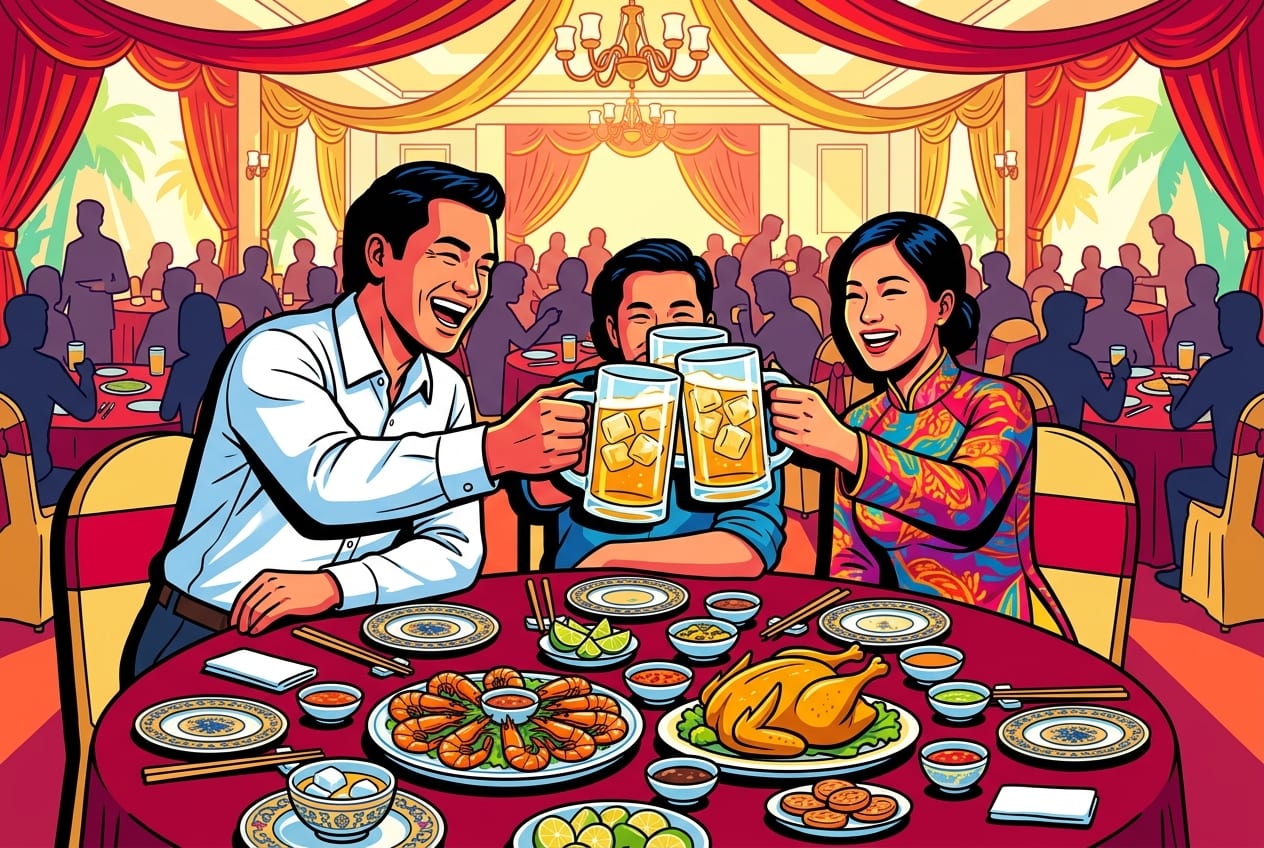
Vietnamese weddings are not the quiet, candle-lit affairs you might expect in the West. As soon as you step into the hall—usually a massive room draped in red and gold—you are hit by a wall of sound. It is a mix of V-pop remixes, the clinking of heavy glass mugs, and the smell of roasted meats. If you've read our From Tea Trays to 500-Guest Toasts: Your Survival Guide to a Vietnamese Wedding, you know that the reception is where the 'real' party happens. But for a traveler, the most intimidating part isn't the food; it's the drinking culture that powers the entire room.
Vietnamese wedding banquets are high-energy social events where food and alcohol serve as the primary glue for communal bonding. Guests are seated at round tables to facilitate shared dishes and frequent group toasts, creating an atmosphere of 'vui' (fun/joy). Understanding the rhythm of these celebrations is key to enjoying the experience without feeling overwhelmed by the social pressure.
Understanding the 'Một, Hai, Ba, Dzô!' Spirit
The phrase 'Một, hai, ba, dzô!' (One, two, three, yo!) is the heartbeat of the Vietnamese banquet. You will hear it every few minutes, starting from a single table and often spreading like a wave across the room. But why the shouting? In Vietnam, drinking is rarely a solitary act. It is a team sport. When someone wants to take a sip, they don't just drink from their own glass; they invite the whole table to join them. This is rooted in a culture that values collective joy over individual experience. According to Britannica's overview of Vietnamese cultural life, social harmony and communal activities are foundational to the country's identity.
The 'Dzô' (pronounced like 'yo' or 'zo') is the signal that everyone is on the same page. It levels the playing field. Whether you are a high-ranking official or a young traveler, when the 'dzô' happens, everyone is just a friend at the table. It is an equalizer that breaks the ice faster than any formal introduction could.
Toasting in Vietnam is a communal ritual used to express respect, build rapport, and celebrate shared milestones. The 'Một, hai, ba, dzô!' chant synchronizes the group, ensuring that no one drinks alone and that the collective energy remains high. It reflects a cultural emphasis on solidarity and the outward expression of happiness during major life events.
The Rules of Engagement: How the Rounds Work
You don't just drink whenever you're thirsty. There is a specific 'drinking cycle' you need to watch for. First, there is the 'Table Toast.' This happens when the food arrives. Everyone stands up, reaches their glasses to the center of the table, and chants. Second, there is the 'Visiting Toast.' This is when the groom, bride, and their parents walk from table to table. When they reach yours, you must stand. This is the most important toast of the night—it’s a show of respect for the new union. As noted by Reuters in their exploration of Vietnam's beer culture, beer is the social lubricant that facilitates these mandatory interactions.
Then come the 'Challenge Toasts.' This is when a guest from another table walks over to yours, glass in hand, to 'challenge' you or a friend. They might have heard you're a foreigner and want to welcome you. This is meant to be friendly, not aggressive. They will usually say 'Trăm phần trăm' (one hundred percent), which means you are expected to drain your glass. If you aren't ready for that, you can negotiate for 'Năm mươi phần trăm' (fifty percent).
Drinking rounds at a wedding follow a hierarchical and social structure, beginning with the host's welcome and followed by inter-table visits. These rounds serve to weave the large guest list into a single cohesive celebration. Participation is seen as a gesture of goodwill, though the intensity of the drinking can vary significantly between different regions and social circles.
The '100%' (Trăm Phần Trăm) Pressure
The 'Trăm phần trăm' culture is real, but it’s often misunderstood by travelers. It isn't a command; it's an invitation to show enthusiasm. If you can't do it, don't panic. The key is to keep the energy high even if the glass stays half-full. Smile, make eye contact, and use your hands to gesture that you've reached your limit. Most Vietnamese people are incredibly hospitable and will not actually force you to drink if they see you are struggling, as 'saving face' also means not making your guest uncomfortable.
The 'Trăm phần trăm' request is a social invitation to demonstrate full commitment to the toast and the relationship. While it implies finishing the drink, it is often used playfully. Guests can navigate this pressure by offering a counter-proposal or using humor, as the primary goal is the shared moment of connection rather than the actual volume of alcohol consumed.
The Art of the Polite Refusal
So, how do you say no without being the 'party pooper'? In Vietnam, a flat 'No' can feel like a rejection of the person's friendship. You need a 'soft' refusal. The best way is to use a health-related excuse. Saying you are taking medicine or that you have a 'weak stomach' (bụng yếu) is a universally accepted get-out-of-jail-free card. Another trick is the 'Nhấp môi'—literally 'touching the lips.' You join the toast, clink the glass, but only take a tiny, symbolic sip. This shows you are participating in the spirit of the event without actually consuming the alcohol.
If you are truly done, keep your glass full of water or soda. When someone comes to toast, raise your glass of water with just as much enthusiasm as if it were whiskey. They will likely laugh and clink glasses anyway. The 'dzô' is about the sound and the gesture, not just the liquid inside.
Refusing a drink in Vietnam requires a balance of politeness and persistence to avoid causing offense. By providing a valid reason, such as health or driving responsibilities, and continuing to engage in the social atmosphere, guests can maintain their boundaries. The 'nhấp môi' technique is particularly effective as it fulfills the ritual requirement of toasting without requiring significant consumption.
Essential Refusal Phrases for Your Survival
Having a few phrases ready can save you a lot of awkward smiling. If someone is pushing a drink on you, try: 'Em không uống được nhiều' (I can't drink much). If you want to be more firm but polite, say 'Cho em xin kiêng' (Please let me abstain/excuse me). The word 'xin' (to ask/beg) adds a layer of politeness that softens the refusal. Remember, the goal is to keep the 'vui' (fun) going, so always deliver these lines with a big smile.
Using specific Vietnamese phrases for refusal demonstrates cultural awareness and respect, which often makes the host more likely to accept the boundary. Phrases that emphasize personal limits or the need to stay healthy are generally well-received. Maintaining a friendly demeanor ensures that the refusal is seen as a personal necessity rather than a rejection of the host's hospitality.
Do
- Always use two hands when clinking glasses with someone older than you.
- Make eye contact during the toast; it shows sincerity.
- Keep your glass slightly lower than the glass of the elder/host when clinking to show respect.
- Smile and participate in the 'Một, hai, ba' chant even if you are drinking water.
Don't
- Don't drink before the first collective toast of the table.
- Don't feel forced to finish your glass if you feel unwell; health comes first.
- Don't pour your own drink; wait for a neighbor to pour for you, and return the favor.
- Don't leave the table immediately after a toast; stay for a minute of conversation.
Is it okay to toast with a glass of water or soda instead of beer?
Yes, absolutely! It is very common for women, non-drinkers, or those who have to drive to toast with Coke, 7-Up, or water. The important part is the act of raising the glass and joining the 'Một, hai, ba, dzô!' chant. As long as you are participating in the group energy, nobody will mind what is in your glass.
What should I do if someone insists I drink '100%' but I'm already feeling tipsy?
Smile, shake your head gently, and say 'Em say rồi' (I'm already drunk). You can also use the '50%' (năm mươi phần trăm) compromise. If they keep pushing, just take a tiny sip ('nhấp môi') and put the glass down. Usually, they will get the hint and move on to the next person without any hard feelings.
Why do people put ice in their beer at these weddings?
In the tropical heat of Vietnam, and especially in crowded banquet halls, beer gets warm very quickly. Large chunks of ice (đá) are added to keep it cold and, ironically, to slightly dilute the alcohol so people can last through the long multi-course meal and the dozens of toasts. It's a practical survival tactic!
Hear these phrases
Each one is recorded in both the northern and southern accent.
Topics
Read more
Other posts from our Vietnamese learning blog.
By Xinchao team
Red, White, or Blue? How Not to Dress Like a Ghost at a Vietnamese Wedding
Attending your first Vietnamese wedding? Avoid the social faux pas of wearing funeral colors and learn why a splash of pink or blue goes a long way in showing respect to the happy couple.
By Xinchao team
The Red Envelope Dilemma: How Much Cash Should You Actually Give at a Vietnamese Wedding?
How much cash goes in a Vietnamese wedding envelope? From city banquets to rural feasts, we break down the 2026 rates so you can celebrate with confidence.
By Xinchao team
The 'Em Ơi' Minefield: Your Expat Survival Guide to Addressing Anyone on the Vietnamese Street (Without Causing an Accidental Crisis)
Think 'Em ơi' is a magic pass to get any waiter's attention? Think again. Dive into the complex, rewarding world of Vietnamese pronoun etiquette and learn how to navigate the streets like a seasoned expat.