Why Vietnam’s Hottest Summer Island is Covered in Garlic: The Legend of Ly Son and Its Boldest Salad
Forget what you know about garlic breath. Off the coast of Central Vietnam, an ancient volcanic island serves up a sweet, crunchy salad made entirely from young garlic stalks.
The Volcanic Kingdom: Why Garlic Rules Ly Son
Ly Son Island’s garlic thrives due to a unique agricultural recipe combining mineral-rich volcanic basalt soil, a top layer of white coral sand, and organic seaweed fertilizer. This volcanic terroir strips away the harsh, eye-watering pungency of typical garlic, leaving a mild, sweet flavor celebrated across Vietnam.
To understand Ly Son Island, you must first understand its violent, fiery past. Millions of years ago, active volcanic eruptions shook the waters off the coast of what is now Quang Ngai Province. When the lava cooled, it left behind a dramatic landscape of dark basalt cliffs, craters, and incredibly fertile soil. Today, this remote island is known affectionately to Vietnamese as the "Kingdom of Garlic." If you look at the island from above, the terraced fields climbing up the slopes of ancient craters like Thoi Loi Peak look like a geometric patchwork of brilliant green and sparkling white. You can read more about the island's geography and history on the official Wikipedia Ly Son District page.
But why is the sand white? This is where the genius of local Vietnamese farming comes into play. To grow their world-famous garlic, farmers do not just plant seeds in the dirt. They laboriously carry heavy sacks of fine white sand—made from crushed coral reefs—up from the beaches to cover the dark volcanic soil. This dual-layer method acts as a natural temperature regulator, keeping the roots cool under the blazing Central Vietnamese sun while trapping moisture in the mineral-rich earth below. Nourished by local seaweed gathered from the shoreline, the resulting garlic is unlike anything you have ever tasted: small, potent, yet incredibly smooth and sweet, without the aggressive burn that usually lingers on the tongue.
Traveling to this volcanic paradise has become highly accessible for adventurous foodies. The primary gateway is Sa Ky Port in Quang Ngai. Modern, high-speed ferry services, including the newly resumed Phu Quoc Express, operate daily to ferry travelers across the water. A standard adult eco-ticket costs approximately 160,000 VND (~$6.40 USD), while VIP seats are priced at 216,000 VND (~$9.00 USD). Alternative operators charge around 227,000 VND (~$9.00 USD) for the smooth, 45-minute journey. Once you step off the boat and rent a local motorbike for about 120,000 to 150,000 VND per day, the salty sea breeze immediately guides you toward the island's ultimate culinary treasure.
The Mystery of Male Garlic and the Secret Salad
Male garlic, or 'tỏi đực', refers to single-clove garlic plants that do not split into multiple cloves. On Ly Son, these rare, scallion-like stalks are harvested young to create 'Gỏi tỏi', a nutrient-dense salad traditionally reserved for honored guests and exhausted fishermen seeking physical recovery.
At the absolute center of Ly Son’s culinary identity is Gỏi tỏi (young garlic salad). If you are expecting a plate of raw, pungent garlic cloves that will leave you socially isolated for a week, prepare to be delighted. This legendary dish is not made from the bulb cloves at all. Instead, it features "tỏi đực" (male garlic) or "tỏi non" (young garlic). In a typical garlic crop, a few plants fail to split into multiple cloves, instead growing a single, slender, scallion-like stem with a small, solid bulb at the base. Because these plants are limited in number and require careful hand-harvesting, they were historically treated as a "secret stash" by island families.
In Vietnamese culture, sharing this rare harvest is the ultimate expression of hospitality. Traditionally, Gỏi tỏi was only prepared for major family celebrations or to welcome khách quý (honored guests) who made the long journey from the mainland. But this salad is more than just a welcoming gesture; it is also treated as a vital traditional medicine. For generations, Ly Son’s brave fishermen have faced the volatile conditions of the East Sea. Upon returning from long, exhausting voyages, their bodies are often depleted by the damp sea air and physical fatigue. Eating a plate of freshly steamed young garlic salad is believed to warm the body from the inside out, ward off colds, boost immunity, and restore their vital energy (khí).
How to Experience Gỏi Tỏi Like a Local
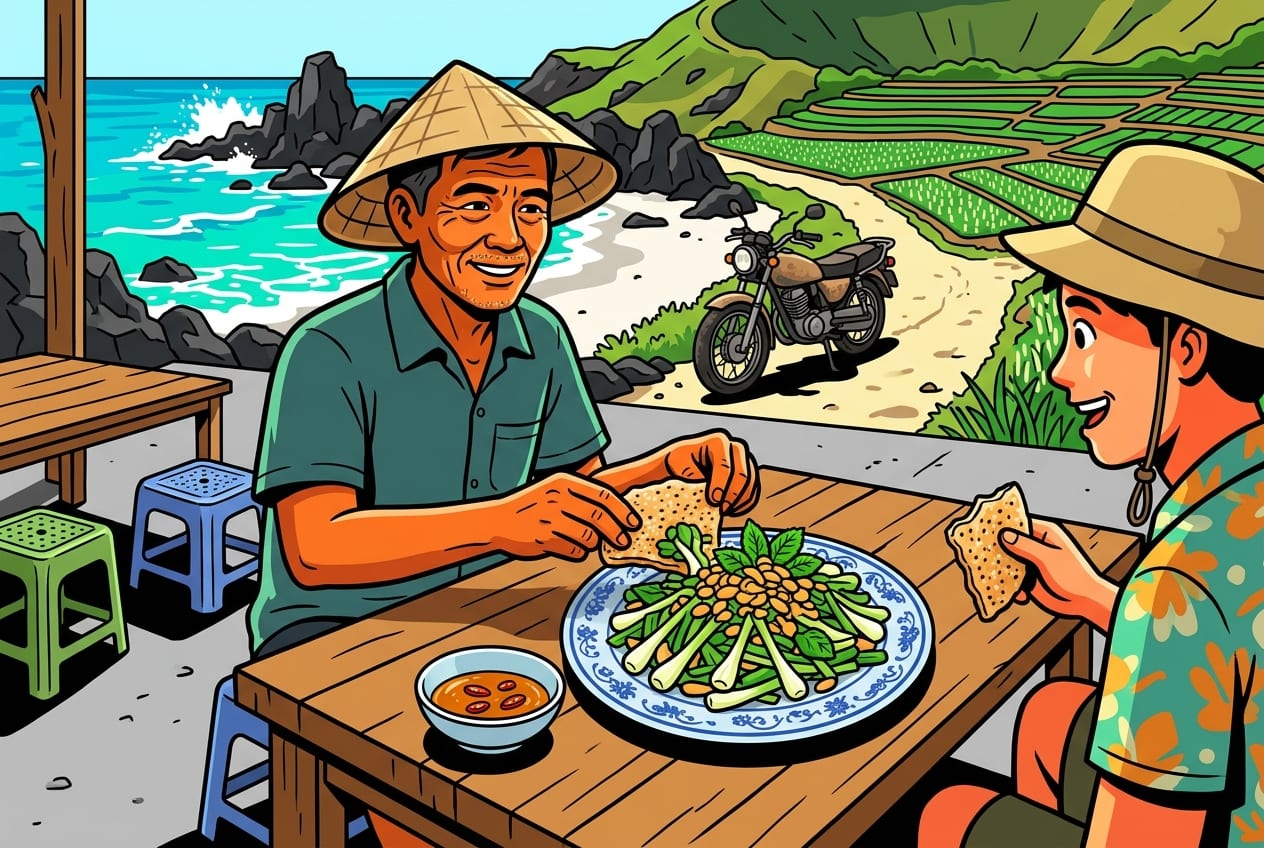
To eat Ly Son garlic salad authentically, break off a piece of crispy, toasted sesame rice cracker ('bánh tráng nướng') and use it to scoop the steamed garlic stalks, herbs, and peanuts. Dip the loaded cracker directly into sweet-and-sour chili fish sauce instead of using western utensils.
To experience this legendary dish at its peak, plan your journey to Ly Son between March and September, when the island enjoys beautiful, sunny summer weather. However, if you want to catch the height of the young garlic harvest, the season actually peaks from October to February, culminating around the festive Tet Lunar New Year. When you sit down at local culinary hotspots like Dai Hang Restaurant (famous for its stunning ocean views and local salads) or Hoang Khuyen Restaurant (renowned for its fresh seafood and garlic specialties), you will be served a plate that is a visual masterpiece.
The salad features a striking contrast of vibrant emerald-green steamed garlic stalks, pale cream-colored stems, fresh mint, and basil, all topped with a generous dusting of golden-brown roasted peanuts and crispy fried shallots. It is served alongside a small bowl of amber-colored fish sauce flecked with bright red chili seeds. If you ask for a fork or a spoon, you will instantly mark yourself as an outsider. The authentic, local way to eat Gỏi tỏi is to pick up a piece of bánh tráng nướng—a thick, crispy, toasted sesame rice cracker. Use the cracker as an edible scoop to gather a generous portion of the steamed garlic and herbs, then dip it directly into the fish sauce.
This combination of textures is mind-blowing: the smoky, nutty crunch of the sesame cracker gives way to the tender, sweet, and mildly spicy garlic stalks, all tied together by the savory, sweet-and-sour punch of the dipping sauce. In Vietnam, fish sauce is the ultimate culinary glue that holds families and flavors together; you can dive deeper into this cultural phenomenon in our guide on why fish sauce is the secret glue of Vietnamese families. For more general travel tips and seasonal highlights across the country, check out the official Vietnam Tourism Portal.
Do
- Use the crispy sesame rice cracker (bánh tráng nướng) as your spoon to scoop up the salad.
- Pair your garlic salad with fresh local seafood, as the sweet garlic perfectly cuts through the rich oils of grilled fish or clams.
- Rent a motorbike to explore the narrow, scenic coastal roads that lead to the garlic fields.
Don't
- Do not ask for western utensils like forks when eating this salad; using the cracker is part of the cultural experience.
- Avoid stepping directly onto the delicate sandy garlic beds when taking photos near the volcanic craters.
- Don't worry about garlic breath—on Ly Son, smelling like fresh garlic is a sign of a meal well-enjoyed!
Is the garlic salad on Ly Son Island incredibly spicy or pungent like raw garlic?
Not at all! Because the salad uses young 'male' garlic stalks that are gently steamed, the harsh, burning compounds found in raw mature garlic cloves are completely softened. The resulting flavor is remarkably mild, sweet, and refreshing, closer to a tender green onion with a delicate garlic aroma.
When is the best time of year to visit Ly Son to try authentic Gỏi tỏi?
While Ly Son is a fantastic summer destination from March to September due to calm seas and sunny weather, the young garlic harvesting season actually peaks from October to February. Visiting around the Tet Lunar New Year offers the freshest young garlic stalks directly from the fields.
Can I bring Ly Son garlic back home with me as a souvenir?
Yes! Travelers highly prize the dried multi-clove garlic and the rare, single-clove 'tỏi cô đơn' (lonely garlic) as souvenirs. You can easily purchase beautifully packaged bags of dried garlic from local markets near the port to take home, though you should check your home country's agricultural import customs rules first.
Practise the words you just read
Vietnamese phrases for real situations, each with native audio in both accents.
Topics
Read more
Other posts from our Vietnamese learning blog.

By Xinchao team
The Red Envelope Dilemma: How Much Cash Should You Actually Give at a Vietnamese Wedding?
How much cash goes in a Vietnamese wedding envelope? From city banquets to rural feasts, we break down the 2026 rates so you can celebrate with confidence.

By Xinchao team
The 'Em Ơi' Minefield: Your Expat Survival Guide to Addressing Anyone on the Vietnamese Street (Without Causing an Accidental Crisis)
Think 'Em ơi' is a magic pass to get any waiter's attention? Think again. Dive into the complex, rewarding world of Vietnamese pronoun etiquette and learn how to navigate the streets like a seasoned expat.
By Xinchao team
Sweet Sâm or Face-Melting Đắng? Your Expat Survival Guide to Cholon’s Ancient Herbal Tea Culture
Discover Saigon's ancient herbal tea culture in Cholon. Learn how to order sweet nước sâm and survive face-melting nước đắng with this expat survival guide.