Why is there a tiny hole in your blue water jug? The 20L survival guide.
Master the social etiquette of Vietnam's iconic 20L blue water jugs. Learn the 'secret' hole-poking trick and how to navigate communal drinking like a local.
The Blue Jug: Vietnam’s Unofficial National Monument
In every Vietnamese home, shop, or office, the 20-liter blue water jug is a permanent fixture. It provides essential hydration in a tropical climate where tap water isn't drinkable. Understanding how to interact with this jug is a foundational skill for anyone living in or visiting Vietnam today.
Walk into any 'hẻm' (alleyway) in Saigon or any 'ngõ' in Hanoi, and you will see them. Piles of translucent blue plastic, ribbed like a Greek column, waiting on doorsteps. These are the 20-liter (20L) water jugs that fuel the nation. While travelers often focus on the coffee or the phở, the humble water jug is the true silent hero of Vietnamese survival. It’s not just about thirst; it’s about a complex social ecosystem of delivery men, ceramic stands, and a very specific way of opening the bottle that separates the 'newbies' from the 'locals.'
Why do these jugs exist? Simply put, the tap water in Vietnam is generally not considered safe for direct consumption. While the city infrastructure is improving, the majority of people rely on these large-scale purified water systems. They are cheap, convenient, and delivered right to your door on the back of a motorbike. But because they are shared in communal spaces—like the entrance of a small shop or a shared office—there is a set of unwritten rules you need to follow.
The Anatomy of the 20L Jug
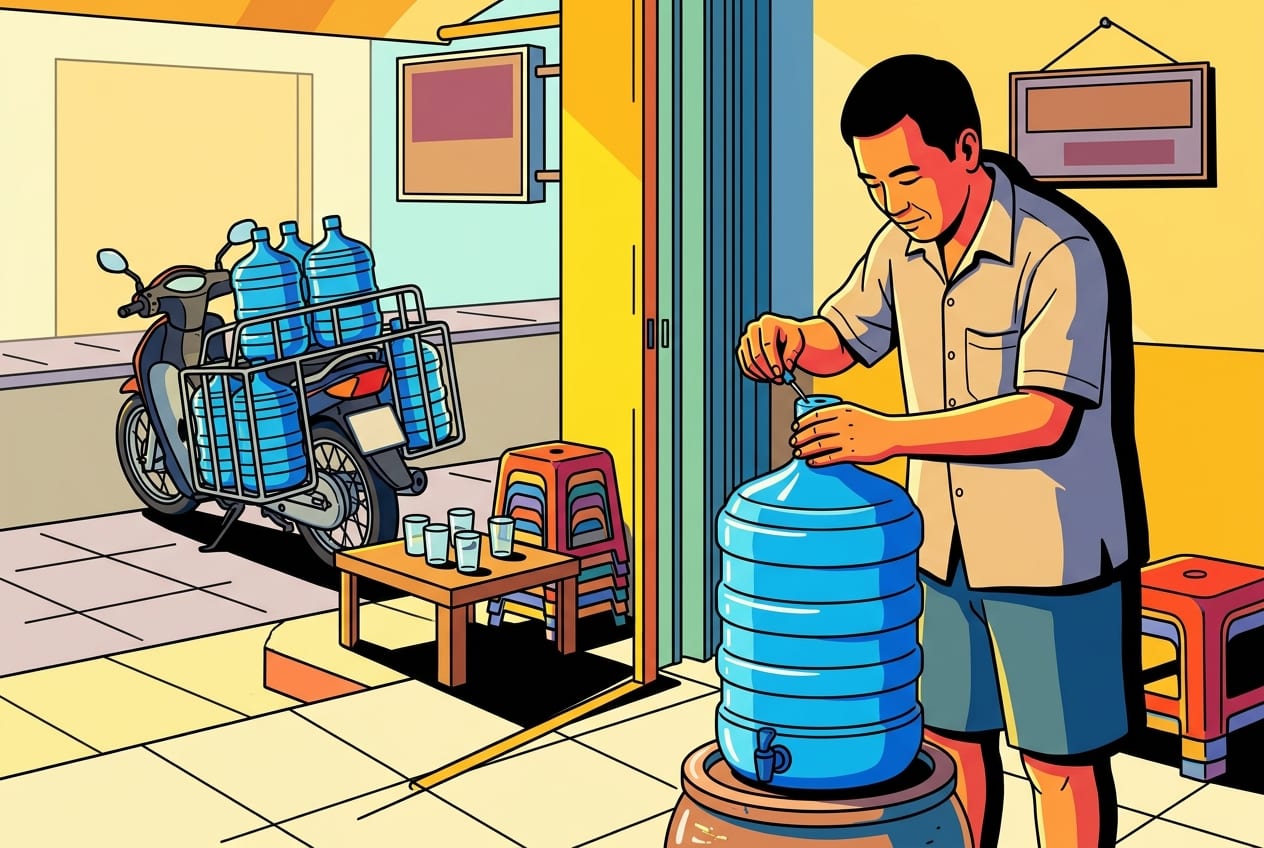
The standard 20L jug is designed for durability and transport, featuring a thick blue plastic body and a specific seal. It usually sits on a ceramic or metal stand, allowing gravity to feed the water through a small plastic tap at the bottom or a dispenser pump on top.
When you look at a fresh jug, it’s sealed with a thin layer of plastic film over the cap. Inside that cap is a small valve. If you are using a dispenser (the ones that hold the bottle upside down), the dispenser has a plastic spike that pushes this valve in. If you are using a manual tap, you’ll be dealing with the jug sitting upright. Every part of this setup is designed for a quick swap. The delivery driver—often called the 'shipper'—can carry four or five of these at once on a custom metal rack attached to his bike, balancing them with the grace of a circus performer.
The 'Secret' Poke: Why We Stab the Cap
If you don't poke a small hole in the top seal of a new water jug, the water will glug and splash because of the vacuum effect. This simple act of venting the bottle is a mark of a seasoned local who knows how to ensure a smooth flow.
Imagine this: you’ve just hauled a heavy 20kg jug onto the ceramic stand. You turn the tap, and... glug... glug... splash! The water comes out in uneven bursts, splashing your shoes and the polished tile floor. This happens because air cannot get into the bottle to replace the water leaving it. To fix this, Vietnamese people use a key, a pen, or a specialized little tool to poke a tiny hole—just a few millimeters wide—into the plastic seal on the very top of the jug.
This 'vent hole' allows air to flow in smoothly. It is a small gesture, but it shows you care about the person coming after you. If you leave a jug 'un-poked,' the next person has to deal with the splashing. In a culture that values 'duyên' (grace/charm) and collective harmony, being the person who ensures a smooth pour is a minor but respected social win. Just be careful not to make the hole too big, or dust might get in!
The Social Contract of the Shared Glass
In many street-side shops or local homes, a single set of clear glasses sits next to the water jug for anyone to use. This communal approach to hydration emphasizes trust and shared resources, though many modern Vietnamese now prefer using their own reusable bottles for hygiene.
You will often see a small tray with two or three glasses. If you are a guest, your host will likely pour the water for you. If you are in a public space, like a small 'tiệm tạp hóa' (grocery store), there might be a communal cup. While Western travelers might be hesitant about the 'shared cup' culture, it’s a deep-rooted part of the 'tình làng nghĩa xóm' (neighborly affection). However, in a post-pandemic world, it is perfectly acceptable—and even expected—to carry your own bottle and simply use the jug to refill it.
The Logistics: Motorbike Warriors and the Ceramic Throne
The delivery of these jugs is a masterpiece of Vietnamese logistics, involving specialized motorbike racks that can carry hundreds of kilograms. Once delivered, the jug is placed on a ceramic or wooden stand, which is often positioned near the entrance to keep the floor clean.
The 'Shipper' is the lifeblood of the water system. You’ll hear the clinking of plastic bottles before you see them. These drivers weave through traffic with five jugs on the back and two between their legs. When they arrive at a house, they don't just drop the bottle off; they usually take the empty one back. This is a circular economy. You pay a deposit for the plastic bottle (the 'vỏ bình'), and from then on, you only pay for the water inside.
The stand itself is usually a decorative ceramic cylinder. Why ceramic? Because it’s heavy and stable. A 20L jug is heavy, and if it sits on a flimsy plastic table, it’s a recipe for a flood. The ceramic stand also keeps the water slightly cooler than the ambient air temperature, providing a refreshing (though not ice-cold) drink in the heat.
Etiquette for Foreigners: Don't Be the One Who Runs Out
If you are staying in a shared house or working in an office, the most important rule is to never leave the jug empty. Replacing the bottle or calling the delivery service before it runs dry is essential for maintaining good relationships with your roommates or colleagues.
If you notice the water level is below the tap line, it's time to act. In a Vietnamese household, the youngest person or the person who finished the water is usually expected to do the heavy lifting. If you are a guest, don't worry—your host will handle it. But if you are living there, learning how to lift the jug correctly (using your legs, not your back!) and seating it properly on the dispenser is a rite of passage. If you can't lift it, simply asking 'Hết nước rồi, đổi bình ở đâu?' (Out of water, where do I exchange the jug?) shows you are paying attention.
Do
- Use a clean, sharp object to poke a tiny air hole in the top seal for a smooth pour.
- Offer to pour water for elders or guests first if you are near the jug.
- Keep the area around the ceramic stand dry; wet tiles are a major slipping hazard.
- Return the empty jug to the delivery person to get your deposit back or a fresh bottle.
Don't
- Don't leave the jug completely empty without notifying someone or ordering a replacement.
- Don't touch the mouth of the jug or the inside of the cap with dirty hands.
- Don't drink directly from the communal glass if you are sick; use your own bottle.
- Don't throw away the empty jug; it is a reusable asset belonging to the water company.
Sustainability and the Cycle of the Blue Bottle
The 20L water system is one of Vietnam's most effective recycling loops, as the bottles are collected, professionally cleaned, and refilled hundreds of times. This system significantly reduces the consumption of single-use plastic bottles that would otherwise end up in landfills or the ocean.
While we often think of 'green' initiatives as new and high-tech, this traditional water delivery system is incredibly eco-friendly. The 'vỏ bình' (empty shell) is a valuable commodity. When you see a motorbike loaded with empty blue jugs, you're looking at a fleet of containers heading back to a factory to be sterilized and reused. This is why the deposit is so important. By participating in the 20L system instead of buying dozens of 500ml bottles, you are actually doing the environment a huge favor. It’s survival, social etiquette, and sustainability all wrapped into one big, blue, plastic package.
Why do people leave the empty jugs on the sidewalk?
This is the signal for the 'shipper' (delivery driver). When they see an empty jug outside a shop or house, they know to stop, drop off a full one, and collect the empty one for refilling. It's a silent communication system that keeps the water flowing without needing a phone call every time.
Is the water in the blue jugs actually safe to drink?
Generally, yes. These are 'nước tinh khiết' (purified water) produced through filtration and UV/ozone treatment. However, quality can vary between brands. It's best to stick to reputable brands like Lavie, Vĩnh Hảo, or local ones that your neighbors trust. If the jug looks extremely old or dirty, you might want to skip it.
What should I do if the tap on the jug is leaking?
Usually, it just needs a quick tighten. If it's a manual tap, try screwing it tighter into the bottle. If it's the 'push' type tap, check if a bit of grit is stuck in the seal. If it keeps leaking, locals often put a small plastic bowl underneath to catch the drips—never let the water pool on the ceramic tile floor, as it becomes very slippery!
Hear these phrases
Each one is recorded in both the northern and southern accent.
Topics
Read more
Other posts from our Vietnamese learning blog.
By Xinchao team
The 'Em Ơi' Minefield: Your Expat Survival Guide to Addressing Anyone on the Vietnamese Street (Without Causing an Accidental Crisis)
Think 'Em ơi' is a magic pass to get any waiter's attention? Think again. Dive into the complex, rewarding world of Vietnamese pronoun etiquette and learn how to navigate the streets like a seasoned expat.
By Xinchao team
Sweet Sâm or Face-Melting Đắng? Your Expat Survival Guide to Cholon’s Ancient Herbal Tea Culture
Discover Saigon's ancient herbal tea culture in Cholon. Learn how to order sweet nước sâm and survive face-melting nước đắng with this expat survival guide.
By Xinchao team
The Point-and-Eat Protocol: Your Expat Survival Guide to Vietnam's 'Cơm Bình Dân' Buffet Trays
Demystify Vietnam's legendary 'commoner's rice' stalls. Learn the step-by-step point-and-eat protocol, discover must-try dishes, and master sidewalk etiquette.