Is Saigon Book Street a Library or a Fashion Runway?
Navigate the etiquette of Saigon's famous Book Street. Learn why locals take so many photos and how to enjoy this literary oasis without breaking social norms.
The Living Room of Saigon’s Soul
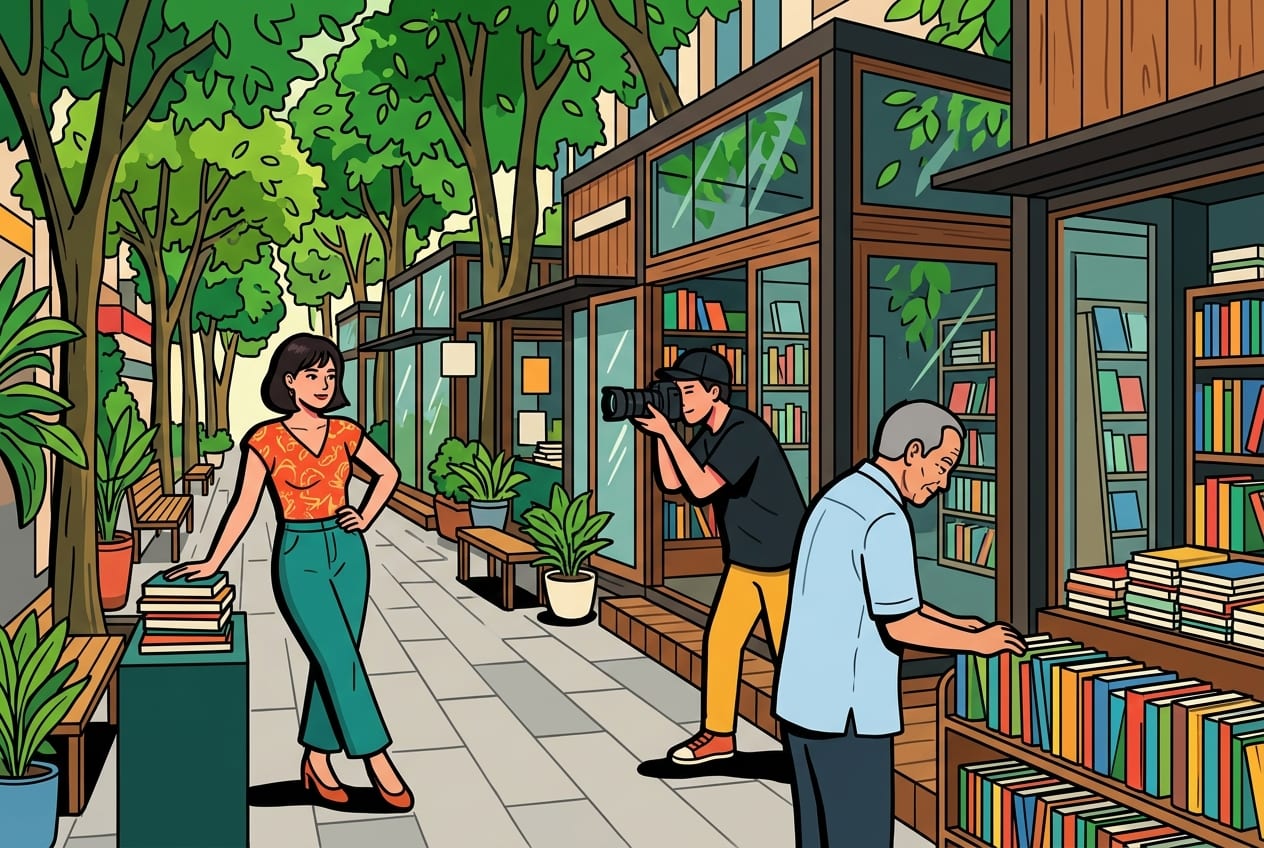
Saigon Book Street, or Đường Sách, serves as a peaceful pedestrian sanctuary where the city's love for literature meets its passion for social media. Located next to the Notre Dame Cathedral, it offers a shaded escape where visitors can browse modern kiosks while navigating the complex etiquette of public photography.
When you step off the frantic, motorbike-filled streets of District 1 and onto the gray stone tiles of Nguyen Van Binh street, the volume of the city suddenly drops. It feels like walking into a giant, open-air living room. This isn't just a place to buy books; it is a cultural statement. For decades, Saigon was known for its hustle, its commerce, and its heat. The Book Street, established relatively recently, was a gift to the citizens—a place to slow down. The tall, leafy trees provide a canopy that keeps the humidity at bay, and the wooden kiosks look more like tiny boutiques than dusty old bookstores.
To understand the etiquette here, you first have to understand the Vietnamese concept of 'public space.' In many Western countries, a street is just a way to get from A to B. In Vietnam, a street is a stage, a dining room, and a community center. On Book Street, you are expected to treat the space with a bit more reverence than a standard sidewalk, but with much more life than a library. You will see students studying, elderly men discussing history over coffee, and young couples on their first dates. It is a 'shared' space in the truest sense of the word, meaning your behavior should always account for the comfort of those around you.
The Art of the 'Check-in' and the Selfie Struggle
In Vietnam, 'checking in' at beautiful locations is a significant social ritual that proves one's participation in trendy cultural spaces. On Book Street, this means balancing your desire for the perfect Instagram shot with the practical need to let actual readers access the bookshelves without being interrupted by cameras.
If you spend more than five minutes here, you will notice something: there are a lot of cameras. You might see a girl in a traditional Ao Dai posing against a wall of books, or a group of friends using a professional DSLR to capture the dappled sunlight. This is part of the 'Sống ảo' (virtual living) culture. For many young Vietnamese, the beauty of the location is just as important as the books inside. It is a way of showing their social circle that they value culture and aesthetics.
The etiquette here is simple but crucial: if you see someone posing for a photo, it is polite to wait a few seconds or walk quickly behind the photographer. However, photographers must also be mindful. It is considered rude to block a bookstore entrance or a specific shelf for twenty minutes just to get the 'perfect' angle. If you are the one taking the photo, a quick smile and a 'Cảm ơn' (thank you) to those waiting goes a long way. The street is a shared resource; nobody owns the view, but everyone respects the effort put into a good photo.
Coffee, Conversation, and Quiet
Unlike Western libraries that demand total silence, Vietnamese book streets are social hubs where conversation and coffee are integral to the experience. While you shouldn't shout, expect a lively atmosphere filled with the sound of clinking glasses, low-volume chatter, and the occasional laughter of families enjoying their weekend.
At the ends of the street and tucked between the kiosks are several cafes, like Phuong Nam or Trung Nguyen. In Vietnam, coffee is the fuel for intellectual life. You will see people sitting for hours with a single 'Cà phê sữa đá' (iced milk coffee) and a stack of books. The etiquette here is 'sit as long as you like.' Unlike in some busy Western cities where waiters might pressure you to leave to free up a table, the staff here generally leave you alone. This is part of the 'slow' culture of the street.
However, 'slow' doesn't mean 'messy.' You will notice that despite the crowds, the street is remarkably clean. There is an unspoken rule about maintaining the beauty of the area. If you finish your coffee, don't leave the plastic cup on a stone bench. Find one of the many wooden trash bins. Because this street is a point of pride for Saigonese, littering is seen as a direct insult to the city's modern image. If you want to fit in like a local, keep your personal space tidy and your voice at a 'coffee shop' level—audible, but not disruptive.
The Value of 'Tri Thức': Why the Street Exists
Education and knowledge, known as 'tri thức,' are deeply respected in Vietnamese society, making the creation of a dedicated book street a point of civic pride. This space isn't just about commerce; it represents a collective effort to promote a reading culture among the younger generation in a digital age.
To a traveler, it might just look like a pretty street. To a local, it is a symbol of progress. For a long time, buying books in Vietnam meant going to cramped, dusty shops or navigating the chaos of the city's traffic to reach a mall. The Book Street centralized the best publishers in the country into one accessible, beautiful location. When you browse the books, even if you can't read Vietnamese, you are participating in this respect for 'Tri thức.' Parents bring their children here specifically to instill a love for books from a young age.
You might see 'Book Exchange' stations or small exhibitions about Vietnamese history or art. The etiquette here is to engage with these exhibits respectfully. Don't just walk past; stop and look. Even if you don't understand the text, showing interest in the displays signals to the locals that you value their culture. This builds 'face' for both you and the hosts. It shows you aren't just a tourist looking for a photo, but a visitor who appreciates the intellectual heart of the city.
How to Interact with the Kiosk Staff
Interacting with staff at the book kiosks requires a blend of politeness and patience, as many employees are students or young professionals who value a respectful 'Chào em.' While browsing is encouraged, showing genuine interest in the displays helps maintain the friendly, community-focused atmosphere that defines this zone.
Most of the kiosks are run by major publishing houses. The staff are usually very knowledgeable but might be shy if their English isn't perfect. A great way to break the ice is to use a simple Vietnamese greeting. When you enter a small kiosk, a slight nod of the head is a sign of respect. Unlike in a market (like Ben Thanh), there is absolutely no haggling here. The prices are fixed and usually printed on the back cover. Trying to bargain for a book is considered quite rude and 'low class' in this specific environment.
If you are looking for English books, many kiosks have a dedicated section. If you can't find what you need, asking 'Có sách tiếng Anh không?' (Do you have English books?) is very helpful. Even if they don't have what you want, they might point you to a neighboring kiosk that does. The staff here aren't just salespeople; they are often book lovers themselves, and they appreciate it when visitors take the time to actually look at the titles rather than just using the shop as a background for a photo.
Do
- Ask for permission before taking a close-up photo of someone's face or their private reading moment.
- Keep your voice at a moderate level; it's a social street, but people are still reading.
- Use the designated trash bins to keep the street beautiful.
- Wait patiently if a 'sống ảo' photoshoot is blocking your path for a moment.
Don't
- Don't try to haggle over book prices; it's not a traditional market.
- Don't sit on the displays or the decorative book piles.
- Don't block the narrow entrances of the kiosks with large backpacks or camera tripods.
- Don't smoke in the pedestrian-only areas if there are children or crowds nearby.
Can I take professional photos with a tripod on Book Street?
Generally, casual photography with a phone or camera is encouraged. However, if you are doing a professional shoot with a tripod, lighting equipment, or multiple outfit changes, you may be approached by security. For large-scale commercial shoots, you technically need permission from the street management board.
Are the books only in Vietnamese, or can I find English titles?
While the majority are in Vietnamese, most major kiosks (like Fahasa or Phuong Nam) have a dedicated section for English literature, travel guides, and translated Vietnamese classics. There are also often beautiful 'art books' that are visual-heavy and great for international visitors.
What is the best time to visit to avoid the 'sống ảo' crowds?
If you want a quiet experience, visit on a weekday morning before 10:00 AM. The street is peaceful, the air is cooler, and there are fewer people posing for photos. Weekends, especially Saturday afternoons, are the busiest and can feel more like a festival than a library.
Ultimately, navigating Saigon Book Street is about finding the balance between being a tourist and being a guest in a local sanctuary. By respecting the 'Check-in' culture while prioritizing the 'Reading' culture, you get to experience one of the most sophisticated and charming corners of Ho Chi Minh City. Whether you leave with a bag full of books or just a phone full of beautiful photos, your presence contributes to the vibrant life of this unique urban experiment.
Practise the words you just read
Vietnamese phrases for real situations, each with native audio in both accents.
Topics
Read more
Other posts from our Vietnamese learning blog.
By Xinchao team
Midnight at the Cemetery: Why Thousands of Vietnamese Pilgrims Flock to Cô Sáu under the Stars
Discover the deep history, essential etiquette, and practical steps for participating in Côn Đảo's famous midnight pilgrimage to the grave of Cô Sáu.
By Xinchao team
Beyond the Beach: Why You Must Experience Ninh Thuan’s Mystical Cham Kate Festival
Ready to go beyond the beach? Experience Ninh Thuan's mystical Cham Kate Festival at Po Klong Garai. Learn the deep cultural meanings, crucial etiquette, and expert survival tips for expats.
By Xinchao team
Don't Be the First Customer! An Expat’s Guide to Vietnam's Sacred Morning Rituals of 'Mở Hàng' and 'Đốt Vía'
Ever wondered why a Vietnamese street vendor looked terrified when you asked for a price early in the morning? Welcome to the delicate, sacred rituals of Mở Hàng and Đốt Vía.