Why is There a Mirror Hanging Over Your Neighbor's Door? Decoding the Secret Feng Shui of Vietnamese Streets
If you look up while walking through Vietnam's narrow alleys, you'll spot mysterious octagonal mirrors hanging over doorways. Here is the fascinating, unspoken world of spiritual defense, neighborhood diplomacy, and street-level feng shui.
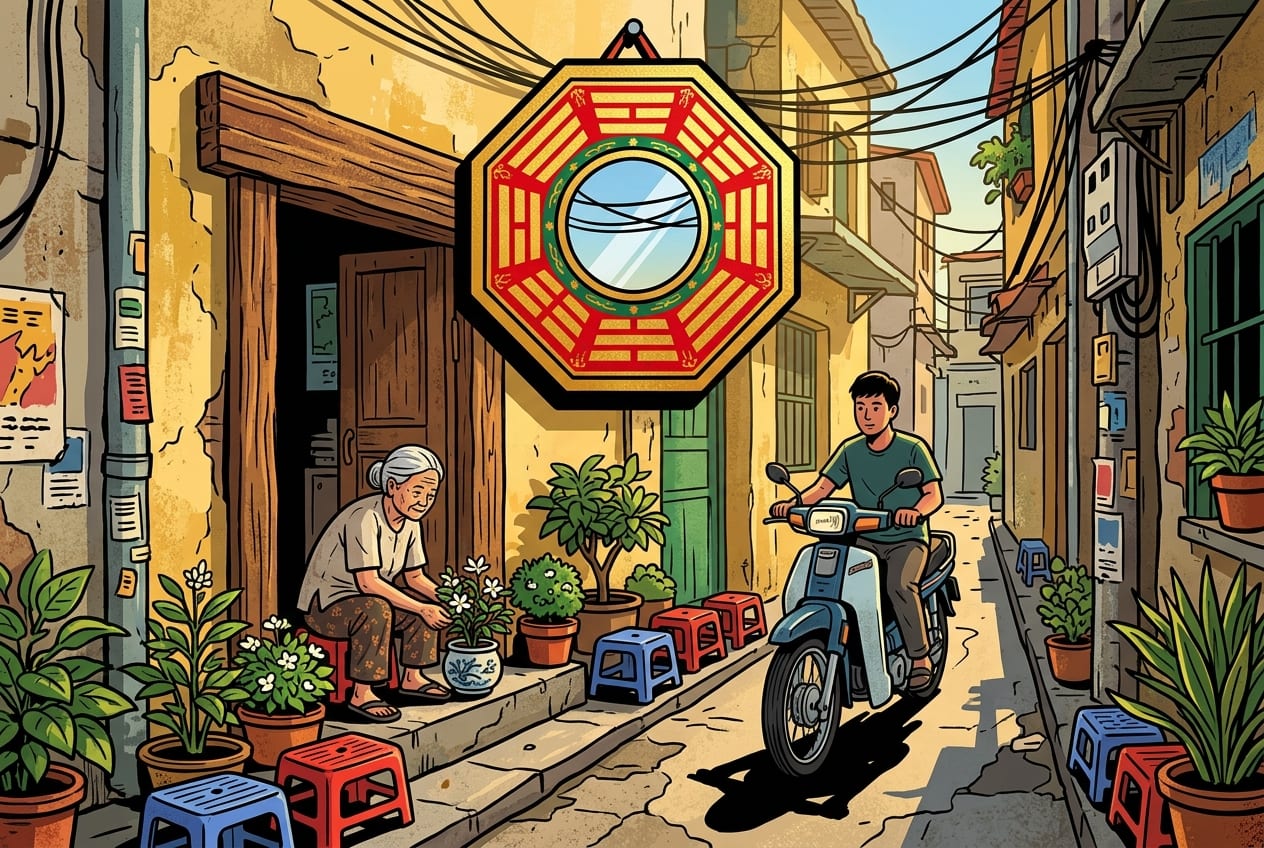
The Visual Tapestry of the Vietnamese Threshold
The front threshold of a Vietnamese home serves as a vital spiritual boundary where families hang octagonal Bagua mirrors to regulate energy. These mirrors, often decorated with red ribbons and tiger heads, protect the household from negative influences in dense urban alleys.
Step into a narrow, winding alleyway (known as a ngõ in Hanoi or a hẻm in Ho Chi Minh City), and you are immediately enveloped in a sensory collage. The humid, tropical air hangs heavy with the sweet scent of jasmine incense and the faint undertone of motorbike exhaust. You hear the low, rhythmic hum of passing scooters, the clatter of metal chopsticks, and the laughter of neighbors sharing iced teas on tiny plastic stools. If you look up, past the faded yellow plaster of French-colonial tube houses and the chaotic webs of overhead electrical wires, you will spot something intriguing: a small, octagonal mirror hanging directly above the front doorframe.
This striking object is called a gương bát quái (Bagua mirror). Typically framed in vibrant, auspicious red and gold wood—or sometimes weathered peach wood—it features the eight Taoist trigrams painted in black and white around a central circular mirror. In many traditional setups, a fierce, stylized tiger head (Hổ Phù) biting a sword is carved onto the frame to double its protective power, while a faded red silk ribbon flutters gently in the breeze. For travelers, these mirrors are a fascinating visual cue that hints at a deeper, unseen layer of Vietnamese spiritual life.
Cultural Depth: The Silent War of the Mirrors
Vietnamese Bagua mirrors are spiritual defenses used to redirect harmful energy, known as sát khí, away from homes. While concave mirrors attract wealth, convex mirrors deflect negative energy, sometimes causing neighborhood disputes when pointed directly at a neighbor's front door.
To locals, these mirrors are not mere decorations or quirky historical relics. They are active spiritual shields used to manipulate khí (energy) and ward off sát khí (harmful or "killing" energy). The octagonal shape of the mirror is derived from the ancient Taoist concept of the Bagua, which represents the fundamental principles of reality. This practice is deeply rooted in the broader philosophy of Feng Shui, which has been adapted over centuries to fit the dense, vertical architecture of Vietnamese cities.
In Vietnam, houses that face T-junctions, cemeteries, hospitals, or even a neighbor's sharp roofline are considered highly vulnerable to bad luck. However, hanging a mirror comes with strict, unwritten social rules. There are two main types of mirrors used: concave mirrors (gương lõm), which act like a vacuum to attract positive energy and wealth into a home, and convex mirrors (gương lồi), which act as a shield to deflect and scatter negative energy outward.
The social friction arises with the convex mirrors. If a homeowner hangs a highly reflective convex mirror that points directly across a narrow alley into a neighbor’s front door, it is culturally perceived as an aggressive act. It is seen as reflecting bad luck and malevolent spirits straight into the neighbor's household. This often sparks silent, polite, yet incredibly tense neighborhood "cold wars." The conflict is usually resolved only when the neighbor hangs an even larger mirror, a defensive tiger plaque, or a specialized talisman to bounce the energy back. This creates a quiet, fascinating feng shui arms race right above the heads of passing motorbikes.
Just like when you are pagoda-hopping for peace and perfect shots, understanding the local spiritual architecture helps you see the invisible threads that tie these tight-knit communities together. What looks like a simple street ornament is actually a highly calculated tool of spiritual defense and neighborhood diplomacy.
Market Trends: Where Spiritual Shields Are Sourced
To acquire authentic spiritual mirrors, Vietnamese locals visit historic craft streets like Phố Hàng Quạt in Hanoi or Chợ Lớn in Ho Chi Minh City. Prices range from basic plastic models to expensive, pagoda-blessed peach wood carvings.
In the modern, bustling markets of Vietnam, purchasing a gương bát quái remains a deeply personal and spiritual task. Locals rarely buy these mirrors online or from generic supermarkets without consulting a feng shui master (thầy phong thủy) first. The physical epicenters for sourcing these protective items are legendary and offer a wonderful window into local trade.
In Hanoi, residents head straight to Phố Hàng Quạt in the Old Quarter, a historic street that has dedicated itself to spiritual crafts, woodcarvings, and ancestral altars for generations. In Ho Chi Minh City, the go-to destination is the vibrant Chinese-Vietnamese enclave of Chợ Lớn (District 5), specifically along Lương Nhữ Học or Hải Thượng Lãn Ông streets. Here, the air smells of medicinal herbs and fresh lacquer.
Prices for these mirrors vary widely based on materials and spiritual significance. A basic, mass-produced plastic and glass mirror can cost as little as 50,000 VND (~$2 USD). However, premium, hand-carved peach wood (gỗ đào) or solid bronze mirrors that have been blessed at local pagodas can range from 350,000 VND to over 1,200,000 VND ($14 to $50 USD). Many families view this as a vital investment in their household's peace of mind and prosperity.
Practical Survival: A Traveler’s Guide to Mirror Spotting
Travelers can spot these mirrors in historic neighborhoods by looking above doorframes next to outdoor altars. Respectful observation is essential; you should avoid pointing, touching, or taking intrusive photographs of these sacred protective shields to prevent offending local residents.
For travelers wishing to experience this living culture firsthand, the key is respectful observation. Some of the best places to spot these mirrors are the labyrinthine, high-density residential alleys of District 3 or District 4 in Ho Chi Minh City, or the historic alleyways surrounding the Vạn Phúc silk village on the outskirts of Hanoi. Walk slowly, look upward just above the doorframes of older residences, and look for them alongside small, red-and-gold outdoor altars dedicated to the Earth God (Bàn thờ Thiên).
When you spot one, keep these crucial etiquette rules in mind: never touch, point directly at, or make fun of a gương bát quái, as this is seen as inviting bad luck upon yourself and disrespecting the home's spiritual boundary. If you want to take a photograph, do so from a respectful distance across the street using a zoom lens. Avoid taking photos if the family is actively sitting on their threshold eating, socializing, or washing dishes. Photographing their protective spiritual shield while they are vulnerable can make residents feel exposed, judged, or uncomfortable.
Do
- Look above front doors in older, narrow residential alleys to spot these mirrors.
- Take photos from a respectful distance without interrupting the daily lives of the residents.
- Keep your voice down when exploring quiet residential alleys (ngõ or hẻm).
Don't
- Never touch, tap, or point directly at a Bagua mirror.
- Avoid taking photos if the family is eating or relaxing right on their threshold.
- Do not mock or make light of the spiritual placements, as they are taken very seriously by locals.
Why do some Vietnamese feng shui mirrors have a tiger biting a sword on them?
The tiger head biting a sword represents the deity Hổ Phù. It is added to the Bagua mirror to double its protective power, warding off extremely aggressive evil spirits and neutralizing severe negative energy coming from T-junctions or sharp physical structures facing the house.
What should I do if a neighbor's mirror accidentally reflects blinding sunlight into my eyes while walking?
Simply look down and continue walking. The mirror is not meant to harm pedestrians. It is positioned to redirect spiritual energy, and any physical glare is just a byproduct of the afternoon sun hitting the glass angle.
Can I buy a gương bát quái as a souvenir to take home?
Yes, you can purchase them at spiritual craft streets like Phố Hàng Quạt in Hanoi. However, if you plan to use it at home, feng shui practitioners advise consulting a professional first, as hanging a convex mirror incorrectly can accidentally disrupt the energy of your own neighborhood.
Practise the words you just read
Vietnamese phrases for real situations, each with native audio in both accents.
Topics
Read more
Other posts from our Vietnamese learning blog.

By Xinchao team
Midnight at the Cemetery: Why Thousands of Vietnamese Pilgrims Flock to Cô Sáu under the Stars
Discover the deep history, essential etiquette, and practical steps for participating in Côn Đảo's famous midnight pilgrimage to the grave of Cô Sáu.

By Xinchao team
Beyond the Beach: Why You Must Experience Ninh Thuan’s Mystical Cham Kate Festival
Ready to go beyond the beach? Experience Ninh Thuan's mystical Cham Kate Festival at Po Klong Garai. Learn the deep cultural meanings, crucial etiquette, and expert survival tips for expats.

By Xinchao team
Don't Be the First Customer! An Expat’s Guide to Vietnam's Sacred Morning Rituals of 'Mở Hàng' and 'Đốt Vía'
Ever wondered why a Vietnamese street vendor looked terrified when you asked for a price early in the morning? Welcome to the delicate, sacred rituals of Mở Hàng and Đốt Vía.