Whispers in the Alley: Why Every Expat Needs to Brave a Traditional Vietnamese Ear-Cleaning Session
To the uninitiated, having a stranger stick thin metal tools into your ear canal sounds terrifying. But in Vietnam, 'lấy ráy tai' is a deeply relaxing cultural ritual every expat should experience at least once.
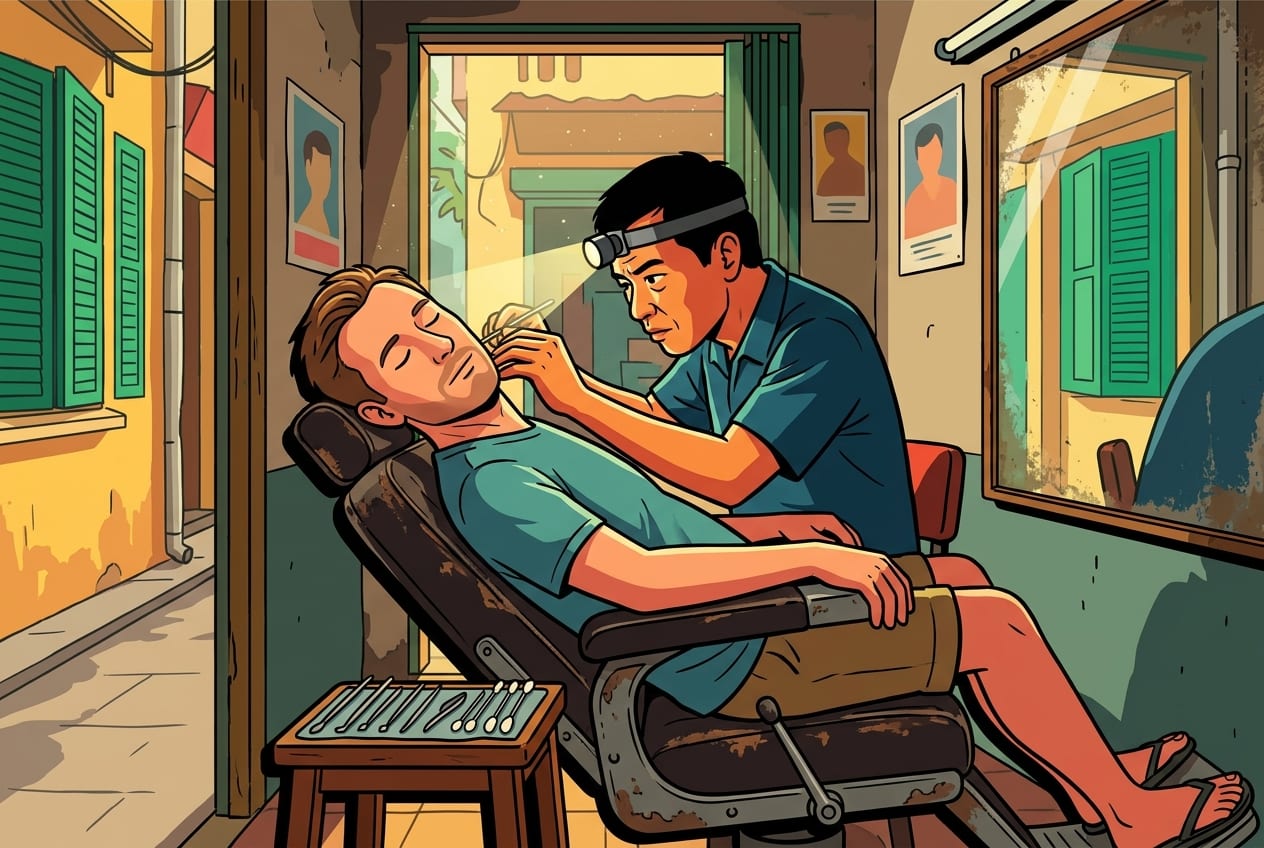
For the uninitiated expat navigating the high-octane streets of Hanoi or Ho Chi Minh City, the sights and sounds can be overwhelmingly intense. Between the roar of motorbikes and the fragrant smoke of street-side grills, you will eventually spot a curious sight in the narrow alleyways: a client reclined in a vintage leather barber chair, completely motionless, while a barber wearing an LED headlamp meticulously peers into their ear with a long, needle-thin metal wand. This is the world of lấy ráy tai—traditional Vietnamese ear cleaning.
While it might initially evoke a shudder of survival-instinct terror, this practice is not actually about basic hygiene. It is a deeply cherished cultural institution of relaxation and sensory therapy. Just as you might slow down to savor a slow-dripping morning brew (and perhaps puzzle over why your coffee is 'brown' in Hanoi but 'milky' in Saigon), stepping into a local barber chair for an ear-cleaning session is an invitation to pause, surrender control, and experience an ancient form of urban mindfulness.
The Art of Sensory Bliss: Why Do Vietnamese People Love Ear-Cleaning?
Vietnamese ear cleaning, known as lấy ráy tai, is a cherished cultural ritual valued for its therapeutic, meditative qualities rather than simple hygiene. Deeply rooted in local barbershop traditions, it induces a state of deep relaxation called phê, offering a quiet, sensory escape from the country's bustling, high-decibel urban environments.
To understand why locals block out an hour of their week for lấy ráy tai, you have to understand the concept of phê. In Vietnamese, phê translates to a state of intense, blissful satisfaction, floating euphoria, or sensory ecstasy. It is the feeling of absolute surrender to a pleasurable physical sensation. Because the human ear canal is packed with sensitive nerve endings, the gentle, rhythmic scraping of the canal walls triggers a profound autonomous sensory meridian response (ASMR). For many, it is the ultimate stress-reliever.
Historically, this practice was a staple of the neighborhood tiệm hớt tóc (men’s barbershop), serving as an informal community hub where men gathered to gossip, read the paper, and unwind. Today, it has transcended gender and generational boundaries. In a fast-paced society where quiet moments are rare, the barbershop chair functions as a sanctuary. The slow, deliberate movements of the practitioner create a meditative bubble, shielding the client from the chaotic world outside. Similar traditions of ear-cleaning exist across Asia, as documented in historical overviews of traditional Asian ear-picking culture on Wikipedia.
The Barber’s Toolkit: Metal, Feathers, and Tuning Forks
A traditional ear-cleaning session utilizes an array of specialized, highly delicate instruments including brass scoops, tiny tweezers, and long-handled scrapers. The experience culminates with a vibrating tuning fork held against a soft, white-tipped feather duster, creating a soothing, resonant tingling sensation deep inside the client’s ear canal.
The visual landscape of a traditional session is a striking study in vintage charm. Usually tucked away in a narrow, humid alley (hẻm in the south, ngõ in the north), the shop's interior often features faded mint-green walls, retro wooden frames, and the warm glow of indoor fluorescent lights. This nostalgic atmosphere is punctuated by the sharp, cool-white beam of the barber's LED headlamp, which looks more suited for a miner or a surgeon than a hair stylist.
Before you recline, the barber will lay out their tools on a small metal tray or a rolled-up leather pouch. This toolkit is a collection of needle-thin instruments, usually handmade from brass, steel, or bamboo. It includes tiny scoops to pull out debris, ultra-fine tweezers to grab stubborn particles, and flat scrapers to gently sweep the ear canal walls. The climax of the session involves the bông ngoáy tai (a fluffy, white-tipped feather duster attached to a thin bamboo stick) and the âm thoa (a steel tuning fork). The barber strikes the tuning fork to make it hum, then presses it against the metal shaft of the feather duster inside your ear. The resulting micro-vibrations send tingling, soothing waves throughout your entire head.
Where to Go: From Alleyway Barbers to Modern Spas
Expats in Vietnam can choose between vintage, no-frills neighborhood barbershops costing under two dollars, or hygienic, upscale grooming chains and specialized ear spas. Modern establishments combine ear-cleaning with head massages and facial washes, providing a safe, comfortable, and highly accessible introduction to this unique local custom.
Depending on your comfort level, the market for lấy ráy tai offers two distinct pathways. For the adventurous expat seeking an authentic, no-frills neighborhood experience, simply look for a local street-side barbershop displaying a sign that reads Hớt Tóc - Gội Đầu - Ráy Tai. These local shops offer basic, highly skilled sessions for a modest 50,000 to 100,000 VND ($2 to $4 USD). What they lack in modern aesthetics, they more than make up for in decades of community-tested expertise.
If you prefer a more curated, English-friendly, and clinical environment, Vietnam's urban centers have seen a massive rise in trendy grooming salons and specialized ear spas. Renowned barbershop chains like Liêm Barber Shop (with its distinct tattoo-parlor aesthetic across Ho Chi Minh City and Hanoi) and Vũ Trí Barber offer clean, reliable ear-cleaning services. Meanwhile, specialized relaxation spas like Quê Một Cục in Saigon provide comprehensive "ear spa combos." These premium sessions bundle ear-cleaning with a herbal hair wash, facial massage, and neck cracking, ranging from 150,000 to 350,000 VND ($6 to $15 USD). This makes it an incredibly affordable luxury, often highlighted in international travel features like those on BBC Travel showcasing unique global wellness traditions.
Survival Guide: How to Stay Safe and Still
To ensure a safe ear-cleaning experience, expats must remain absolutely motionless while the delicate metal tools are inside their ears. Communicating clearly with the barber, requesting tool sanitization with rubbing alcohol, and raising a hand to signal pauses are essential practices for maintaining safety and peace of mind.
Braving your first session requires a few practical rules of thumb to ensure a safe, comfortable, and culturally respectful experience. First and foremost, the golden rule of lấy ráy tai is absolute stillness. Once you are reclined in the chair and the barber's headlamp is focused on your ear, do not speak, nod, laugh, or make sudden head movements. Even a minor flinch can cause the delicate metal tools to scratch your sensitive canal. If you feel a sudden urge to cough, sneeze, or swallow deeply, slowly raise your hand. The barber will instantly recognize this universal signal and withdraw the tools safely.
Hygiene is another common concern for expats. In reputable, modern spas, tools are sterilized in autoclave machines. However, if you are visiting a local street-side shop, it is entirely acceptable to politely ask the barber to sanitize their tools in front of you. You can point to the metal tray and ask for sát trùng (sanitize) or gesture to a bottle of cồn (rubbing alcohol). Most barbers are happy to oblige, wiping the tips down with alcohol-soaked cotton pads to put your mind at ease. Finally, while tipping is not mandatory in local Vietnamese establishments, leaving a small tip of 20,000 to 50,000 VND ($1 to $2 USD) is a highly appreciated gesture of respect for the barber's meticulous, steady-handed labor.
Do
- Remain absolutely still while the tools are inside your ear canal.
- Raise your hand slowly if you need to cough, sneeze, or ask the barber to pause.
- Ask the barber to sanitize their tools with rubbing alcohol (cồn) if you are at a local street-side shop.
- Consider visiting a modern 'ear spa' chain if it is your very first time and you feel nervous.
Don't
- Do not try to speak, nod, or turn your head to look at the barber during the active cleaning.
- Do not feel pressured to go deep if you feel discomfort; politely say 'đau' (pain/it hurts) to stop.
- Do not hesitate to leave a small tip of 20,000 to 50,000 VND for exceptional, steady-handed service.
Is traditional Vietnamese ear cleaning actually safe for my eardrums?
Yes, when performed by an experienced, professional barber, it is generally very safe. Barbers who specialize in lấy ráy tai undergo extensive training to develop incredibly steady hands and an intimate understanding of ear anatomy. However, because the tools are metal, the safety relies heavily on you remaining completely still. If you have a history of ear infections, a ruptured eardrum, or highly sensitive skin, it is best to avoid the procedure entirely.
How do I tell the barber that they are going too deep or causing discomfort?
If you feel any pain or discomfort, do not make sudden head movements. Instead, say the word 'đau' (pronounced like 'dow', meaning pain) in a calm, clear voice, or slowly raise your hand. The barber will immediately pull the tool back. You can also say 'nhẹ nhàng thôi' (pronounced like 'nhe ngang toy'), which translates to 'please be gentle'.
What is the difference between a local street-side barber and a modern ear spa?
Local street-side barbershops offer a rustic, nostalgic, and incredibly cheap experience (usually under 100,000 VND). They are highly skilled but may not use medical-grade sterilization. Modern ear spas or premium grooming chains (like Quê Một Cục or Liêm Barber) operate in air-conditioned spaces, use autoclaves to sterilize tools, and often combine the service with relaxing hair washes, facial massages, and head therapy for a slightly higher price (150,000 to 350,000 VND).
Practise the words you just read
Vietnamese phrases for real situations, each with native audio in both accents.
Topics
Read more
Other posts from our Vietnamese learning blog.

By Xinchao team
The Cat-and-Mouse Game of Hanoi's Train Street: Your 2026 Survival Guide to Visiting Safely (and Legally)
How do you navigate the guards, barricades, and narrow tracks of Hanoi's Train Street in 2026? Learn the insider rules to visit safely, legally, and respectfully.

By Xinchao team
Midnight at the Cemetery: Why Thousands of Vietnamese Pilgrims Flock to Cô Sáu under the Stars
Discover the deep history, essential etiquette, and practical steps for participating in Côn Đảo's famous midnight pilgrimage to the grave of Cô Sáu.

By Xinchao team
Beyond the Beach: Why You Must Experience Ninh Thuan’s Mystical Cham Kate Festival
Ready to go beyond the beach? Experience Ninh Thuan's mystical Cham Kate Festival at Po Klong Garai. Learn the deep cultural meanings, crucial etiquette, and expert survival tips for expats.