Spaceships on Highway 1: An Expat's Survival Guide to Vietnam's Neon-Drenched 'Cabin' Sleeper Buses
Climb aboard Vietnam's glowing, double-decker 'palace buses' and discover why these futuristic capsules have revolutionized long-distance travel on Highway 1.
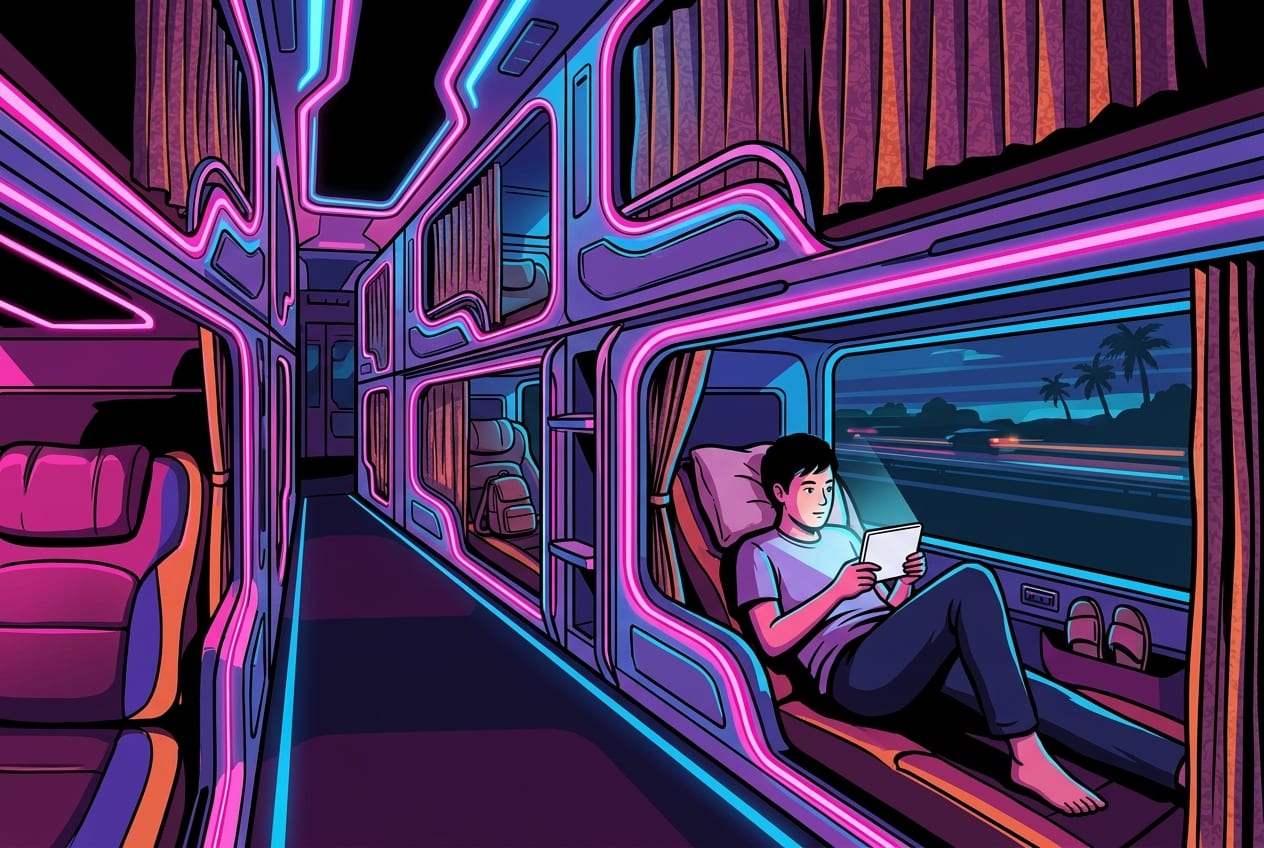
Hurtling down Vietnam’s National Route 1A under the cover of darkness, the modern xe khách giường nằm (cabin sleeper bus) looks less like standard public transit and more like a rogue spaceship from a cyberpunk film. The exterior is a towering, double-decker behemoth painted in glossy, saturated hues—often the fiery orange of the legendary Phuong Trang (FUTA) fleet, the sleek royal blue of Phong Phu, or the deep crimson of Sao Viet. These buses are outlined in brilliant, pulsing LED strip lights that cast a surreal, sci-fi glow onto the rain-slicked asphalt of roadside towns. Inside, the atmosphere shifts instantly to a high-tech capsule hotel. Two tiers of private, curtained cabins line the narrow aisles, bathed in a wash of neon magenta, cyan, and electric violet light. Each cabin is a self-contained pod featuring plush faux-leather reclining seats (often equipped with built-in massage rollers), personal LCD screens, USB charging ports, and individual air-conditioning vents, offering a stark, futuristic contrast to the rustic, dimly lit roadside stalls selling hot trà đá (iced tea) and bánh mì just outside the tinted windows.
For expats and travelers navigating the country, these "palace buses" have rapidly become the ultimate way to traverse popular routes like Hanoi to Sapa, or Saigon to Da Lat. But boarding one of these glowing behemoths for the first time can be a sensory overload. To make the most of your journey, you need to understand the cultural quirks, booking secrets, and unwritten rules of the road that keep Vietnam's highway transit system running smoothly.
What Exactly is a Cabin Sleeper Bus?
A Vietnamese cabin sleeper bus, or xe khách giường nằm, is a long-distance double-decker coach equipped with private, curtained sleeping compartments. Unlike standard reclining buses, these modern 'palaces on wheels' offer individual pods with charging ports, air conditioning, and massage seats, serving as a highly popular and affordable alternative to domestic flights.
In the highly competitive world of Vietnamese private transit, operators are constantly trying to outdo one another. Premium operators like Sao Viet (renowned for their ultra-luxurious "Palace Cabins"), Phong Phu Limousine, and An Anh have elevated the humble bus ride into a luxury experience. Tickets generally range from 350,000 to 450,000 VND ($14–$18 USD) for a single cabin, and 650,000 to 750,000 VND ($26–$30 USD) for a spacious double cabin designed for couples or close friends.
Booking has been entirely digitized through platforms like Vexere (the dominant transit booking engine in Vietnam) or local e-wallets like MoMo. This makes it incredibly easy to select your exact cabin in real-time, matching your preferences for deck level and position. Culturally, these buses represent the democratization of luxury travel in Vietnam. They allow students, migrant workers, and middle-class families to travel long distances in extreme comfort without the high expense of a domestic flight. To blend in, you must respect the local social code: the driver’s dashboard is a sacred space, usually adorned with a flashing LED Buddhist altar, fresh flowers, and incense to ensure safe passage. You can learn more about how locals interact with transit systems in our guide to why is everyone bowing at the bus stop.
The Unwritten Social Code of the Highway
Sleeper bus travel in Vietnam is governed by strict etiquette designed to maintain hygiene and collective peace in a shared, confined space. Passengers must remove their shoes at the door, speak in quiet whispers, and respect the driver's sacred dashboard altar, which ensures a safe journey along the country's busy highways.
The most critical ritual of the Vietnam sleeper bus begins the very second you step through the door: you must remove your shoes immediately. The driver or onboard attendant will hand you a black plastic bag to carry your footwear to your cabin. Walking on the carpeted bus deck with outdoor shoes is a major social faux pas. Culturally, this stems from the traditional Vietnamese home. In Vietnam, the home is a clean sanctuary, and shoes are always left at the threshold. Because these buses are essentially communal mobile bedrooms where people lie down near floor level, the same strict hygiene rules apply.
Once inside your pod, pull your privacy curtains shut. These buses are treated as shared quiet zones where locals immediately settle in to sleep, listen to music on headphones, or scroll silently through their phones. Keep your voice to a absolute whisper if you must speak. Loud conversations, speakerphone calls, or rustling food wrappers are highly frowned upon. Respecting this collective silence is a key way travelers show consideration (lịch sự) for their fellow passengers during a long, tiring journey.
Upper Deck vs. Lower Deck: Choosing Your Cabin
Choosing between the upper and lower deck of a sleeper bus significantly impacts your ride comfort. The lower deck (tầng dưới) is highly recommended for those prone to motion sickness because it experiences less sway, while the upper deck (tầng trên) offers a quieter, more isolated experience away from engine noise.
When booking your cabin on Vexere, you will face a crucial choice: the lower deck (tầng dưới) or the upper deck (tầng trên). If you are prone to motion sickness (say xe), always book a lower-deck cabin. Because of the physics of double-decker buses navigating winding mountain passes (such as the steep roads leading to Sapa or Da Lat), the upper deck sways significantly more. The lower deck provides a much more stable, grounded ride.
Conversely, the upper deck is ideal for solo travelers who want maximum privacy and quiet. It is further away from the rumble of the engine and the foot traffic of passengers boarding and exiting the bus. Whichever deck you choose, always pack a light jacket, hoodie, or socks in your carry-on bag. Onboard air conditioning is notoriously set to arctic temperatures. In Vietnamese hospitality culture, blasting cold air is actually a sign of premium service and luxury, showing that the operator is not cutting corners on fuel. While blankets are provided, they are rarely enough to combat the persistent chill of a 6-hour overnight ride.
Survival Strategies: Boarding, Shuttles, and Rest Stops
Surviving a long-distance bus ride requires arriving at the operator's city office early to catch the complimentary transit shuttle (xe trung chuyển). During midnight rest stops, passengers must memorize their bus's license plate and color, as dozens of identical neon-lit coaches park together, making it incredibly easy to board the wrong vehicle.
To ensure a seamless trip, never wait on the side of a busy highway for your bus to pass by. Instead, always arrive at the bus operator’s designated city office at least 30 to 45 minutes before departure. Most premium brands offer a complimentary shuttle van service, known as xe trung chuyển, which picks you up directly from their office and transfers you to the main highway terminal or the bus itself. This saves you the stress of navigating transit chaos on your own in a busy city.
When you board, your larger luggage will be tagged and locked securely in the under-carriage hold. Keep all your valuable items—passport, wallet, phone, chargers, and medication—in a small daypack inside your cabin pod. During the journey, the bus will make scheduled midnight stops at sprawling, brightly lit highway rest stations (trạm dừng chân). These stations are sensory experiences in themselves, packed with locals eating steaming bowls of noodle soup at 2 AM. When you step off the bus to use the restroom or stretch your legs, make a mental note of your bus's license plate number and color. Dozens of nearly identical neon-lit buses park side-by-side at these stations, and it is incredibly easy to accidentally board the wrong 'spaceship' in a sleepy daze.
Do
- Take off your shoes immediately upon stepping onto the bus and place them in the provided plastic bag.
- Book a lower-deck cabin (tầng dưới) if you are prone to motion sickness or prefer a more stable ride.
- Arrive at the operator's city office early to take advantage of the free 'xe trung chuyển' shuttle service.
- Keep your valuables in a small personal bag inside your private cabin compartment.
Don't
- Never walk down the carpeted aisles of the bus with your shoes on.
- Avoid making loud phone calls or playing audio out loud; use headphones to respect the quiet zone.
- Do not forget to note your bus's license plate number when stepping off at a crowded highway rest stop.
Why is the air conditioning on Vietnam's sleeper buses always set to freezing temperatures?
In Vietnam, blasting cold air conditioning is culturally associated with high-end luxury, cleanliness, and premium hospitality. It also helps prevent the accumulation of stale, humid air in a tightly enclosed vehicle. Always pack a hoodie, long pants, and socks in your daypack to stay comfortable during the ride.
What happens if I need to use the restroom during a long sleeper bus trip?
While some ultra-luxury cabin buses feature a tiny chemical toilet at the back, many do not. However, the drivers make regular, scheduled stops at massive, well-lit highway rest stations (trạm dừng chân) every 2 to 3 hours. If you have an emergency, you can politely ask the driver to stop by saying, 'Cho tôi đi vệ sinh' (Please let me use the restroom).
Can I book a single cabin for two people, or do we need a double cabin?
Single cabins on a Vietnam sleeper bus are strictly designed for one passenger and have weight and size limits. If you are traveling as a couple or with a child, you should book a designated double cabin (often located at the back or on the lower deck of premium lines like Phong Phu or An Anh), which is significantly wider and designed to comfortably accommodate two people.
By mastering these simple rules of the road, your journey on a Vietnam sleeper bus will transform from a daunting logistical challenge into one of the most memorable, comfortable, and distinctly Vietnamese travel experiences of your trip. For more practical survival tips, check out the official Vietnam National Authority of Tourism website to help plan your next route.
Practise the words you just read
Vietnamese phrases for real situations, each with native audio in both accents.
Topics
Read more
Other posts from our Vietnamese learning blog.
By Xinchao team
The Silent Alley Threat: Your Survival Guide to Vietnam's Ultra-Quiet EV Revolution
Vietnam's iconic, roaring alleyways are falling silent as electric bikes and mini-EVs take over. Here is how to navigate these sensory-shifted streets safely.

By Xinchao team
The Cat-and-Mouse Game of Hanoi's Train Street: Your 2026 Survival Guide to Visiting Safely (and Legally)
How do you navigate the guards, barricades, and narrow tracks of Hanoi's Train Street in 2026? Learn the insider rules to visit safely, legally, and respectfully.

By Xinchao team
Midnight at the Cemetery: Why Thousands of Vietnamese Pilgrims Flock to Cô Sáu under the Stars
Discover the deep history, essential etiquette, and practical steps for participating in Côn Đảo's famous midnight pilgrimage to the grave of Cô Sáu.