The Gold Rush: An Expat’s Survival Guide to Vietnam’s Chaotic 'God of Wealth' Day
Every year, Vietnam plunges into a high-stakes gold-buying frenzy to welcome the God of Wealth. Here is your ultimate practical guide to surviving the queues, understanding the rituals, and securing your own fortune.
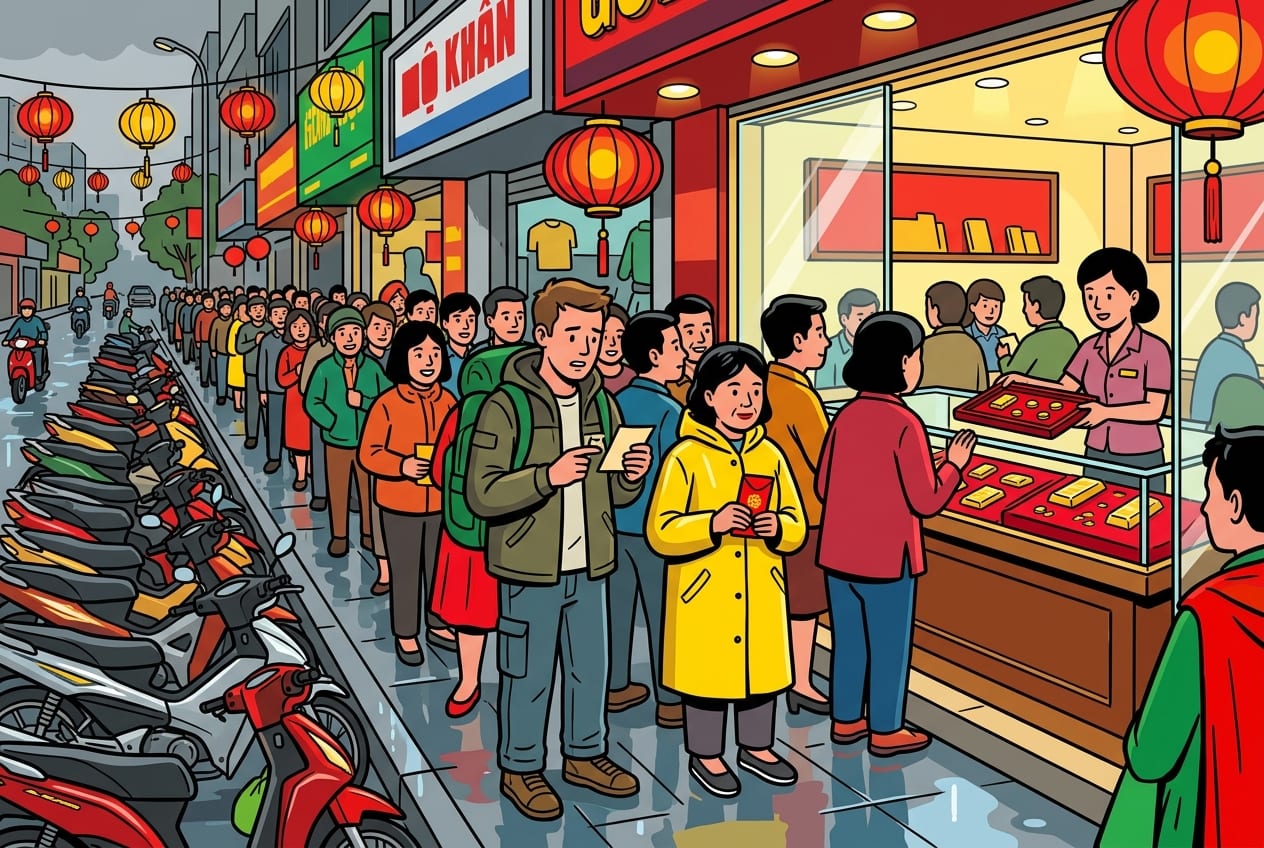
If you happen to walk past a jewelry store in Vietnam on the tenth day of the Lunar New Year, you might think a global financial collapse is underway. Hundreds of people, many still wearing their colorful motorbike helmets and sun-protective hoodies, stand shoulder-to-shoulder on the pavement. Inside, the atmosphere is electric, filled with the glint of 24K gold and the frantic rustle of cash. This is not a panic sell; it is quite the opposite. This is the annual gold rush of God of Wealth Day Vietnam (Ngày Vía Thần Tài), a high-stakes cultural phenomenon where millions of locals buy gold to lock in financial luck for the year ahead.
For expats living in Vietnam, witnessing this day is a fascinating window into the country's "spiritual economy." Whether you want to participate by buying a tiny piece of gold for your own prosperity, or you simply want to navigate the city streets without getting caught in a gridlock of motorbikes and charcoal smoke, you need a game plan. Falling on February 7, 2025, and February 26, 2026, the event requires a blend of cultural understanding and street-smart preparation to navigate successfully.
What is God of Wealth Day Vietnam? The Spiritual Economy of Fortune
God of Wealth Day Vietnam (Ngày Vía Thần Tài) is a cultural and spiritual event celebrated on the tenth day of the Lunar New Year. On this day, millions of Vietnamese buy gold to secure financial luck and positive energy for their households and businesses throughout the coming year.
To understand why people are willing to wait in line for hours just to buy a fraction of an ounce of gold, you have to understand the Vietnamese concept of vía (the spiritual energy or temperament of a person). On this day, the deity Caishen (the God of Wealth) is believed to descend to Earth to bless businesses and households. Buying gold on this specific day is a physical manifestation of capturing "vía tốt"—good spiritual energy—and anchoring it to your personal wealth.
The ritual is governed by a set of strict, unspoken social rules that dictate exactly how much gold you should buy depending on your personal goals. The transactions are measured in chỉ (a traditional Vietnamese unit of weight equivalent to 3.75 grams):
• Buying 1 chỉ invites Luck (Lộc) • Buying 2 chỉ secures Prosperity (Phát) • Buying 5 chỉ commands Wealth (Tài)
But there is a critical social taboo that every expat must remember: never sell gold on this day. While gold shops are more than happy to buy gold from you, doing so on Ngày Vía Thần Tài is culturally viewed as dispersing your own wealth and throwing away the entire year's potential fortune. It is a day for accumulation, not liquidation.
Beyond the jewelry shops, the spiritual economy extends directly into the home. Families and business owners spend the morning thoroughly cleaning their household God of Wealth altars. They offer a traditional "Tam Sên" set—a symbolic food offering consisting of boiled pork, shrimp, and a duck egg—alongside crispy roasted pork (heo quay) and grilled snakehead fish to appease the deity.
The Gold Market Landscape: Navigating Prices in 2025 and 2026
Navigating the gold market during God of Wealth Day Vietnam requires understanding local pricing. State-monopoly SJC gold bars and 24K smooth round rings fluctuate wildly, often trading at premium rates due to massive domestic demand in major hubs like Hanoi's Tran Nhan Tong and HCMC's District 5.
The gold market in Vietnam operates under unique domestic pressures, making it highly volatile compared to global spot prices. The State Bank of Vietnam tightly regulates the import of gold bullion, meaning domestic prices often carry a heavy premium. During the 2025–2026 cycle, standard SJC (Saigon Jewelry Company) state-monopolized gold bars are expected to hover around 85 to 90 million VND per tael (lượng or cây, which equals 10 chỉ, or roughly 37.5 grams).
Because of these high prices, a massive trend has emerged for 2025 (the Year of the Snake) and 2026 (the Year of the Horse): buyers are pivoting toward 24K smooth round gold rings (nhẫn tròn trơn) and delicate zodiac-themed gold foils. These products trade at a slightly lower premium of 78 to 84 million VND per tael (roughly 7.8 to 8.4 million VND per chỉ), making them far more accessible for average households looking to secure their yearly blessing.
If you want to witness the absolute epicenters of this financial rush, head to these legendary locations:
• Hanoi: The famous "Gold Street" of Tran Nhan Tong in Hai Ba Trung District. This street is dominated by the flagship showrooms of legacy brands like Bao Tin Minh Chau and DOJI. The cold, misty spring mornings here are lit by the white-hot glare of neon signs reflecting off wet asphalt. • Ho Chi Minh City: The historic jewelry quarters of District 5 (Chinatown) along Nhieu Tam and An Duong Vuong streets, as well as flagship PNJ (Phu Nhuan Jewelry) stores scattered across the city. Here, the heat is already rising by mid-morning, blending with the chaotic buzz of thousands of idling motorbikes.
For up-to-the-minute updates on gold market movements during this peak period, expats should monitor local business news outlets such as VnExpress International to avoid paying inflated street broker premiums.
An Expat's Step-by-Step Survival Guide to the Gold Rush
Expats can survive the chaotic God of Wealth Day Vietnam by using digital pre-orders, timing physical store visits to early morning slots, carrying physical cash to bypass crashed banking servers, and choosing affordable alternative items like red zodiac string bracelets or traditional grilled snakehead fish.
Participating in this chaotic day can be incredibly rewarding, but it requires tactical execution. If you want to buy gold or simply experience the day without losing your sanity, follow this battle-tested, step-by-step survival guide.
Step 1: Bypass the Physical Queue Entirely. You do not actually need to stand in line for four hours. Major national brands like PNJ and DOJI now offer online pre-ordering on their websites 2 to 3 days before the event. You can log on, lock in the current gold price, pay via bank transfer, and select a dedicated, fast-track pickup window on the actual day. You get the cultural benefit of buying gold on the correct day without the physical exhaustion.
Step 2: Time Your Visit Strategically. If you want to experience the raw, unfiltered energy of the physical queue, timing is everything. Gold shops generally open their doors at 6:00 AM, but crowds begin forming as early as 4:30 AM. The absolute worst time to go is during the post-office-hours rush between 5:00 PM and 8:00 PM, when thousands of workers stop by on their way home. While navigating the intense, crowded queues, you might notice locals smiling through the heat and stress. Understanding the polite, non-confrontational nature of these interactions can help you stay calm; read more about this in our guide to decoding the confusing Vietnamese smile.
Step 3: Prepare Your Payment Method. While digital banking and VietQR codes are standard across Vietnam, local banking apps and payment gateways frequently crash on this day due to unprecedented transaction volumes. Do not rely solely on your phone. Carry physical Vietnamese Dong (VND) in high denominations (500,000 VND notes), and keep them secured in a front-pocket money belt to protect against opportunistic pickpockets in the dense crowds.
Step 4: Embrace Budget-Friendly Alternatives. If buying pure 24K gold is out of your budget, you do not have to miss out on the fun. You can easily buy a red string bracelet featuring a small gold-plated zodiac animal (the Snake for 2025; the Horse for 2026) at most local jewelry shops for under 1 million VND. Alternatively, if you are in Ho Chi Minh City, head over to Tan Ky Tan Quy Street in Tan Phu District. The entire street transforms into a smoky, charcoal-lit avenue where vendors grill thousands of snakehead fish (cá lóc nướng). For around 100,000 to 150,000 VND, you can buy a delicious, charred fish to take home—a culturally authentic, highly local way to welcome the God of Wealth to your dinner table.
Do
- Clean your home or office altar thoroughly before the 10th day of the Lunar New Year.
- Pre-order your gold online 2-3 days in advance to lock in prices and skip the long lines.
- Buy a grilled snakehead fish (cá lóc nướng) if you want a delicious, budget-friendly way to participate.
- Keep your physical cash secure in a front-pocket money belt when visiting crowded gold shops.
Don't
- Do not sell gold on this day, as it is culturally believed to disperse your wealth and luck.
- Do not rely solely on mobile banking apps, as high transaction volumes frequently cause server crashes.
- Do not panic buy massive quantities of gold at peak prices without researching the current daily rate.
Why do people buy exactly 1, 2, or 5 'chỉ' of gold on God of Wealth Day?
These specific quantities carry precise spiritual meanings in Vietnamese culture. Buying 1 chỉ (3.75g) is meant to invite Luck (Lộc), buying 2 chỉ (7.5g) secures Prosperity (Phát), and buying 5 chỉ (18.75g) commands Wealth (Tài) for your business or household.
Can I buy silver or gold-plated items instead of pure 24K gold?
Absolutely. While pure 24K gold is the traditional choice, many locals and expats buy affordable red string bracelets featuring small gold-plated zodiac animals or gold-plated statues of the God of Wealth. The spiritual intention and 'vía tốt' remain the same.
Why is grilled snakehead fish so popular in Southern Vietnam on this day?
In Southern Vietnamese folklore, the God of Wealth is said to love simple, rustic dishes. Offering a whole, unscaled grilled snakehead fish (cá lóc nướng) on the altar symbolizes humility, gratitude, and a connection to the land, ensuring the deity's favor and blessings.
Practise the words you just read
Vietnamese phrases for real situations, each with native audio in both accents.
Topics
Read more
Other posts from our Vietnamese learning blog.

By Xinchao team
The Cat-and-Mouse Game of Hanoi's Train Street: Your 2026 Survival Guide to Visiting Safely (and Legally)
How do you navigate the guards, barricades, and narrow tracks of Hanoi's Train Street in 2026? Learn the insider rules to visit safely, legally, and respectfully.

By Xinchao team
Midnight at the Cemetery: Why Thousands of Vietnamese Pilgrims Flock to Cô Sáu under the Stars
Discover the deep history, essential etiquette, and practical steps for participating in Côn Đảo's famous midnight pilgrimage to the grave of Cô Sáu.

By Xinchao team
Beyond the Beach: Why You Must Experience Ninh Thuan’s Mystical Cham Kate Festival
Ready to go beyond the beach? Experience Ninh Thuan's mystical Cham Kate Festival at Po Klong Garai. Learn the deep cultural meanings, crucial etiquette, and expert survival tips for expats.