Chi, Mô, Tê, Răng? Your Survival Guide to Decoding Central Vietnam's Mind-Boggling Local Dialect
Unlock the soul of Hue, Da Nang, and Hoi An. Discover why Central Vietnam's unique local dialect sounds so different and how a few key words can transform your journey.
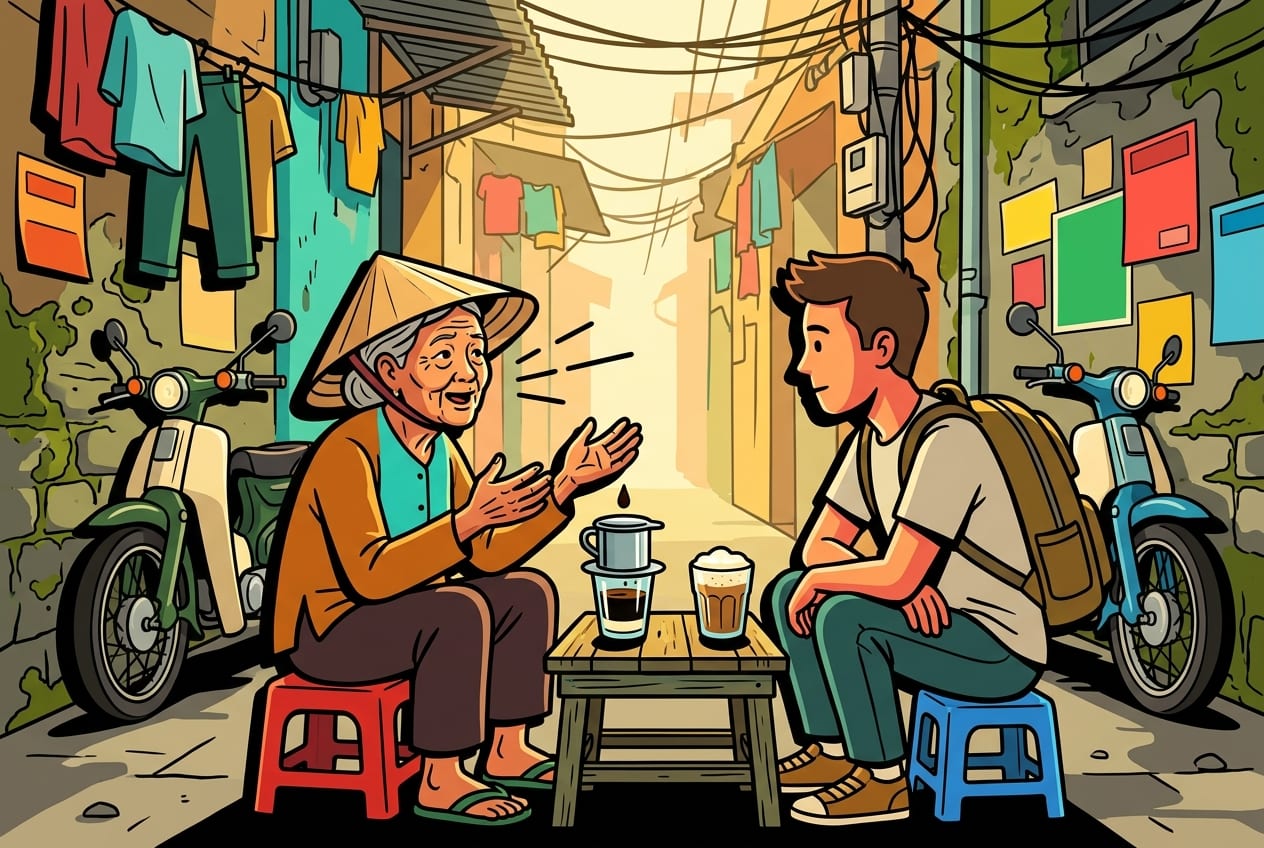
Picture this: You are sitting on a tiny blue plastic stool in a narrow, sun-dappled alleyway in the imperial city of Hue. The air is thick with the rich aroma of simmering beef bones and lemongrass from a nearby noodle cart. You’ve just ordered a signature salt coffee at the famous Cà Phê Muối Vy Dạ—still an absolute steal at 20,000 VND ($0.80 USD). You feel confident. You’ve spent weeks practicing your northern "cái gì" (what) and southern "ở đâu" (where) on language apps. But when the friendly, middle-aged female vendor in her colorful floral-patterned đồ bộ (traditional loungewear) asks you a question, it sounds less like the smooth tones of Hanoi or the sweet cadence of Saigon, and more like a rapid-fire series of heavy, rhythmic bursts. Welcome to the linguistic heart of Central Vietnam.
To truly connect with the locals stretching from the historic citadel of Hue down to the coastal high-rises of Da Nang and the lantern-lit streets of Hoi An, you have to look beyond standard textbooks. The regional dialect of Central Vietnam (tiếng Miền Trung) is a badge of honor for the people who live here. In an era where travelers seek highly localized, slow-travel experiences, learning a few words of this unique dialect is the ultimate cultural key. It instantly melts the ice, transforming you from a passing tourist into an appreciated guest who respects the local heritage.
The Secret Code of Central Vietnam: What is Chi, Mô, Tê, Răng?
Chi, Mô, Tê, and Răng are the defining pillars of the Central Vietnamese dialect, translating directly to 'what,' 'where,' 'that/there,' and 'how/why.' Used daily in Hue, Da Nang, and Hoi An, these four words replace standard northern and southern terms, acting as an instant cultural handshake for travelers.
If you have ever studied standard Vietnamese, you know that the language relies on specific question words. However, in Central Vietnam, the linguistic landscape shifts dramatically. The local dialect compresses and swaps out entire words. The absolute core of this regional vocabulary is the iconic quartet: Chi, Mô, Tê, Răng. Once you understand these four words, the local conversations around you will suddenly start making sense.
Let's break down how these local words map to the standard Vietnamese you might have heard in Hanoi or Ho Chi Minh City:
- Chi replaces gì (What)
- Mô replaces đâu (Where)
- Tê replaces kia or đó (That / Over there)
- Răng replaces sao or thế nào (How / Why)
But the swaps do not stop there. To make things even more interesting, locals also use Ni instead of này (This), and Rứa instead of thế or vậy (So / Like that). According to linguistic overviews of Vietnamese dialects on Wikipedia, these regional variations are not just random slang; they are deeply rooted historical developments that have persisted for centuries, preserving the unique identity of the central provinces.
Why Does Central Vietnamese Sound So Different?
Central Vietnamese sounds distinct due to the region's rugged geography and historically harsh climate, which shaped a dialect characterized by short, highly compressed tones. Unlike the melodic northern cadence or sweet southern rhythm, the central accent is rapid, heavy, and deeply rooted in local survival and close-knit community bonds.
To understand why people in Central Vietnam speak this way, you have to look at the region's geography and history. This narrow strip of land is squeezed between the East Vietnam Sea and the rugged Truong Son (Annamite) mountain range. Historically, this terrain isolated local communities, allowing regional speech patterns to develop independently. Furthermore, the region is famous for its harsh climate—enduring scorching, dry winds in the summer and severe typhoons and floods in the autumn.
This rugged lifestyle directly influenced the spoken language. Central Vietnamese is highly compressed, heavy, and incredibly fast. Locals joke that they do not have the time or energy to waste on long, breezy vowels when they are constantly battling the elements. While Southern Vietnamese is famous for its sweet, relaxed, and almost musical flow, and Northern Vietnamese is known for its clear, precise, and intellectual cadence, Central Vietnamese is practical, direct, and deeply affectionate.
The Tone Flattening Phenomenon
Tone flattening in Central Vietnamese refers to the linguistic merging of the rising-falling question tone and the high-rising tilde tone into a heavy, truncated glottal stop. This structural shift makes the dialect sound direct and defensive to outsiders, though it carries immense warmth and local pride.
One of the first things travelers notice when arriving in Hue or Da Nang is that the pitch of the local voices sounds lower and flatter. In standard Vietnamese, there are six distinct tones, including the dipping-rising question tone (hỏi) and the high-rising, glottalized tilde tone (ngã). In the Central dialect, these two tones are flattened and truncated. They merge into a single, heavy, downward-pulling tone that ends abruptly in the throat.
To an untrained ear—or even to a visiting Saigonese tourist—this can make the local speech sound aggressive, defensive, or even angry at first. However, this is simply the natural weight of the dialect. Once you get past the initial acoustic shock, you will realize that the people of Central Vietnam are incredibly warm, hospitable, and eager to share their culture with visitors.
Street-Level Survival: How to Use These Words at Food Stalls
To use the Central dialect at food stalls, swap standard pronouns and questions for local equivalents like asking 'Chi rứa?' for 'What is that?' or 'Đường đi mô rứa?' for directions. These small linguistic adjustments immediately build rapport with street vendors, unlocking authentic local hospitality and smiles.
The best place to practice your new linguistic skills is at local street food stalls. Whether you are exploring the bustling aisles of Da Nang's famous Chợ Cồn (Con Market) or hunting for a hidden alleyway cafe like Trình Cà Phê (famous for its rich avocado coffee at 40,000 VND), dropping a local word will instantly transform your interaction with the vendor.
Imagine pulling up a plastic stool in front of a steaming pot of Bún Bò Huế (Hue beef noodle soup). Instead of pointing and asking the standard "Cái gì thế?", look at the vendor, smile, and ask: "Chi rứa?" (What is that?). The "rứa" at the end acts as a soft conversational particle, making the phrase sound natural and polite.
If you are trying to find your way to a specific landmark or a hidden food stall, instead of asking "Đường đi đâu thế?", try asking a passerby: "Đường đi mô rứa?" (Where is the road?). When it comes time to pay for your meal, point to your empty bowl and ask: "Cái ni mấy tê?" (How much for this one?). You can learn more about how regional tastes and terms differ across the country in our guide to regional coffee differences.
When you use these words, the vendor's eyes will almost certainly light up. You might get a friendly chuckle, a slightly larger portion of noodles, or a warm correction of your accent. In Vietnamese culture, showing that you have taken the time to learn their specific regional tongue signals a profound level of respect for their local identity, which stands proudly apart from the political cadence of Hanoi or the commercial buzz of Saigon.
Linguistic Golden Rules: Do Not Mock the Accent
The golden rule when practicing the Central Vietnamese dialect is to use the vocabulary playfully and with genuine warmth, without ever mocking or exaggerating the heavy accent. Respecting the local phonetic weight ensures your attempts at regional slang are received as appreciative cultural connection rather than ridicule.
While locals love it when travelers try to use their vocabulary, there is a fine line between playful connection and mockery. Because the Central dialect is so phonetically distinct and heavy, it has historically been the subject of gentle teasing in Vietnamese media. Consequently, locals can be sensitive if they feel their accent is being caricatured or made fun of.
To keep your interactions positive and respectful, follow these simple guidelines:
- Keep it natural: Do not try to fake a heavy, dramatic accent. Speak with your normal voice, but simply swap out the vocabulary words (using Chi instead of Gì, for example).
- Smile and be humble: If a vendor laughs when you say "Chi rứa?", laugh along with them! They are not laughing at you; they are charmed by the effort. Ask them to repeat the correct pronunciation.
- Acknowledge the difficulty: If you struggle, simply say "Tiếng Miền Trung khó quá!" (Central Vietnamese is so difficult!). This shows you recognize the complexity of their dialect.
For more practical tips on navigating local interactions and understanding the warm cultural hospitality of the country, check out the official travel resources on the Vietnam National Authority of Tourism website.
Do
- Do use 'Chi, Mô, Tê, Răng' playfully when ordering street food or buying souvenirs.
- Do smile and show humility if locals laugh or gently correct your pronunciation.
- Do appreciate the heavy, flat tones as a symbol of regional resilience and history.
- Do try local specialty dishes like Bún Bò Huế and Bánh Mỳ Phượng while practicing your vocabulary.
Don't
- Don't exaggerate or mimic the heavy, flat tones in a mocking or theatrical way.
- Don't assume locals are angry or defensive just because their accent sounds heavy and direct.
- Don't get discouraged if a vendor doesn't understand you on the first try; just point and smile.
Why do Northern and Southern Vietnamese people sometimes struggle to understand the Central dialect?
The Central dialect uses a completely different set of core vocabulary words (like Chi, Mô, Tê, Răng) and compresses the standard six tones into a flatter, heavier cadence. Because the tones are truncated and many vowel sounds are shifted, even native Vietnamese speakers from Hanoi or Saigon often require a few days to adjust to the rapid-fire speed of Central speech.
Is it considered rude or offensive if I mispronounce these regional words while trying to talk to a street vendor?
Not at all, as long as your intent is respectful and friendly. Vietnamese culture highly values effort and humility. If you attempt to use local words like 'Chi rứa' with a warm smile, vendors will appreciate your interest in their unique regional identity and will often happily help you correct your pronunciation.
Where exactly in Vietnam will I hear this dialect spoken most prominently?
You will hear the Central dialect most prominently in the provinces of the North-Central coast and South-Central coast, particularly in the cultural hubs of Hue, Da Nang, Hoi An, and the surrounding provinces of Quang Tri, Quang Binh, and Quang Nam. While the accent varies slightly between Hue and Da Nang, the core vocabulary remains highly consistent.
Practise the words you just read
Vietnamese phrases for real situations, each with native audio in both accents.
Topics
Read more
Other posts from our Vietnamese learning blog.

By Xinchao team
The Cat-and-Mouse Game of Hanoi's Train Street: Your 2026 Survival Guide to Visiting Safely (and Legally)
How do you navigate the guards, barricades, and narrow tracks of Hanoi's Train Street in 2026? Learn the insider rules to visit safely, legally, and respectfully.

By Xinchao team
Midnight at the Cemetery: Why Thousands of Vietnamese Pilgrims Flock to Cô Sáu under the Stars
Discover the deep history, essential etiquette, and practical steps for participating in Côn Đảo's famous midnight pilgrimage to the grave of Cô Sáu.

By Xinchao team
Beyond the Beach: Why You Must Experience Ninh Thuan’s Mystical Cham Kate Festival
Ready to go beyond the beach? Experience Ninh Thuan's mystical Cham Kate Festival at Po Klong Garai. Learn the deep cultural meanings, crucial etiquette, and expert survival tips for expats.