The Sea’s Gentle Giants: Why Vietnam’s Fishermen Build Elaborate Tombs for Whales
To the coastal communities of Central Vietnam, the whale is not a mere animal, but a protective deity. Step inside the sacred Lăng Ông temples where massive skeletons are worshipped with royal honors.
For centuries, the fishermen of Central Vietnam have looked out at the vast, unpredictable waters of the East Sea with a mixture of profound respect and quiet dread. Before GPS, modern weather tracking, and steel-hulled vessels, a sudden tropical storm meant almost certain death for those aboard simple wooden boats. In this high-stakes environment, survival was not just a matter of skill—it required divine intervention. This vulnerability birthed one of the most fascinating and deeply touching spiritual traditions in Southeast Asia: the worship of the whale, known affectionately and reverently as Cá Ông (Lord Whale).
To step into coastal Vietnam is to realize that the ocean is not just a source of food, but a living, breathing realm of gods and spirits. Unlike Western whaling histories, the maritime communities here have never hunted these gentle giants. Instead, they view them as guardians of the sea, physical deities that actively rescue sailors from the jaws of typhoons. When a whale dies and washes ashore, it is not treated as a carcass to be cleared, but as a fallen god demanding a royal funeral. This is the story of how a marine mammal became Vietnam's most beloved coastal savior, and how you can experience this living mythology today.
Who is Cá Ông? The Legend of the Lord Whale
The legend of Cá Ông, or the Lord Whale, stems from Vietnamese maritime mythology where the Bodhisattva Avalokiteshvara tore her silk robe into pieces to create whales to save shipwrecked fishermen. Today, Central Vietnamese fishing communities worship the whale as a protective sea deity who controls storms and guides lost boats to safety.
To understand the roots of whale worship, one must look to Buddhist folklore. According to local legend, the Avalokiteshvara Bodhisattva (known in Vietnam as Quan Âm, the Goddess of Mercy) was flying over the stormy seas when she heard the desperate cries of drowning fishermen. Moved by their plight, she tore her sacred saffron-and-silk robe into countless tiny pieces and scattered them across the water. The moment these scraps touched the waves, they transformed into massive, gentle whales. Quan Âm endowed these creatures with a compassionate soul and a singular mission: to seek out distressed ships during tempests, cushion them with their massive bodies, and guide them safely back to the shore.
Over time, this Buddhist origin story fused with indigenous Cham beliefs and imperial decrees. During the Nguyen Dynasty, emperors officially recognized this folk religion to solidify their control over coastal regions and honor the maritime community. Emperors bestowed grand titles upon the whale deity, naming him Nam Hải Thần Ngọc (the Jade Deity of the Southern Sea). Royal edicts demanded that any village harboring a deceased whale must build a dedicated temple to house its bones, cementing the whale's status as an official state-sanctioned protector of the realm.
The Mourning Ritual: How a Coastal Village Buries a Deity
When a dead whale washes ashore in Central Vietnam, the village holds a royal funeral. The first person to spot the whale acts as the deity's eldest son, wearing a white mourning headband for three years. After several years of burial, the bones are exhumed, cleaned with wine, and enshrined.
When a deceased whale drift-washes onto a beach, the fishing village immediately halts all daily activities. A profound silence falls over the community. The discovery is treated with the exact same gravity as the death of a village patriarch. However, the spiritual burden of this event falls heaviest on one specific individual: the person who first spotted the whale. Local belief holds that this finder has been chosen by the deity himself to act as his "eldest son" (trưởng nam).
This honorary son must lead the funeral procession, organize the burial, and wear the traditional white cotton mourning headband (khăn tang) for up to three years. During this period, he must observe strict cultural protocols, often abstaining from festive celebrations or major personal milestones to show filial piety to his fallen spiritual father. The whale's body is carefully pulled ashore using ropes, wrapped in fine red silk, and buried in a sacred coastal graveyard. After three to five years, once the earth has done its work, the village performs the cải táng (exhumation). The bones are carefully dug up, lovingly washed with rice wine and ginger water, and ceremonially transferred to an ossuary inside the local Lăng Ông (Whale Temple) to be worshipped forever.
Inside the Whale Temples in Vietnam: Architecture and Atmosphere
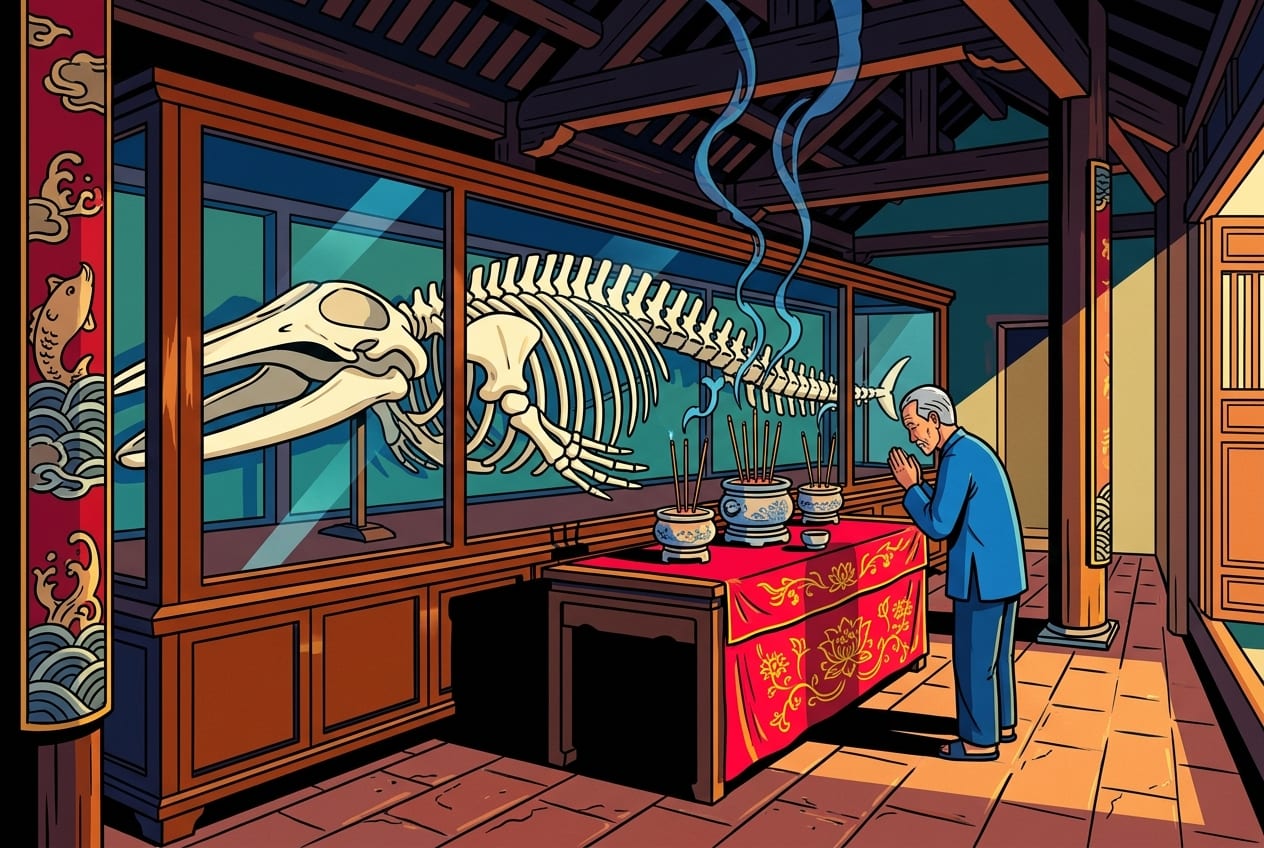
Whale temples in Vietnam, known as Lăng Ông, blend imperial architecture with coastal grit, featuring terracotta roofs, ceramic mosaics, and altars draped in red silk. Inside, massive glass cases hold centuries-old whale bones, surrounded by burning sandalwood incense, yellow chrysanthemums, and offerings of rice wine from local fishing families.
Visually, a Lăng Ông is a striking blend of imperial Vietnamese architecture and rugged maritime grit. If you are already familiar with mainland Buddhist shrines from our guide to pagoda-hopping in Vietnam, you will find that these coastal temples have an entirely different, salt-crusted energy. The exterior features weathered terracotta-tiled roofs adorned with intricate khảm sành—mosaics made of broken ceramic and porcelain shards depicting dragons, phoenixes, and swirling ocean waves that seem to defy the corrosive salty air.
Inside, the sensory experience is overwhelming. The air is thick with the sweet, heavy scent of burning sandalwood incense mingling with the sharp, salty tang of the nearby sea. The dominant colors are imperial yellow, lacquer red, and ocean blue. At the center sits a grand altar draped in red silk embroidered with gold Chinese characters, flanked by brass incense burners and offerings of fresh yellow chrysanthemums, pomelos, and cups of rice wine. Behind the altar, massive glass-and-wood display cases house the giant, yellowed, ivory-like ribcages and vertebrae of the whales, illuminated by warm, low-hanging amber bulbs. Outside, the tropical sun beats down on a harbor filled with bright turquoise and red wooden fishing boats (ghe bầu), each painted with protective "boat eyes" (mắt thuyền) on the bow to ward off sea monsters.
Top Whale Temples in Vietnam to Visit in 2025–2026
Travelers can visit Vạn Thủy Tú in Phan Thiet, which houses Southeast Asia’s largest whale skeleton for an entry fee of 20,000 VND. Alternatively, Lăng Tân on Ly Son Island offers a remote look at restored specimens, accessible via a round-trip ferry from Sa Ky Port for about 350,000 VND.
For travelers seeking to witness this living tradition in 2025–2026, the most iconic and accessible sites are located in Central and South-Central Vietnam. Vạn Thủy Tú in Phan Thiet (Binh Thuan province) remains the premier destination. Built in 1762, it houses Southeast Asia’s largest whale skeleton—measuring an astonishing 22 meters. Entry to Vạn Thủy Tú is incredibly affordable, costing just 20,000 VND (approx. $0.80 USD), making it an easy add-on to any Mui Ne itinerary.
For an off-the-beaten-path adventure, head to Lăng Tân on Ly Son Island (Quang Ngai province). This remote island community recently restored its historic whale skeletons, which are deeply integrated into the local identity. You can reach the island via a high-speed ferry from Sa Ky Port for approximately 350,000 VND ($14 USD) round-trip. To experience the culture at its peak, plan your visit around the annual Nghinh Ông Festival (Whale Worshipping Festival). While dates vary by the lunar calendar, the Can Gio Nghinh Ông Festival (near Ho Chi Minh City) takes place mid-autumn (typically September or October), while Central Vietnamese coastal villages celebrate in the spring (March or April).
Temple Etiquette: How to Visit a Lăng Ông Respectfully
Visitors to whale temples must dress modestly by covering shoulders and knees, remove hats, and refrain from touching sacred bones. When observing active beachside ceremonies, maintain a distance of fifteen meters, avoid flash photography, and make a small donation of 20,000 to 50,000 VND in the temple's contribution box.
Navigating these sacred spaces requires strict adherence to local etiquette. These are not museums; they are active places of worship where fishermen pray for their lives before heading out to sea. When visiting a Lăng Ông, dress modestly: shoulders and knees must be covered, and hats must be removed before entering the altar room. Never touch the whale bones or the glass display cases, as this is considered a severe desecration of the deity.
While entry is often free or nominal, it is customary to place a small donation of 20,000 to 50,000 VND in the temple’s contribution box (hòm công đức) to help the local elders maintain the shrine. If you are fortunate enough to stumble upon an active beachside funeral or exhumation ceremony, keep a respectful distance of at least 15 meters, do not use flash photography, and never speak loudly or laugh, as these rituals are deeply emotional and sacred to the fishing community.
Do
- Dress modestly with your shoulders and knees covered when entering a Lăng Ông.
- Remove your hat and sunglasses before stepping into the altar room.
- Leave a small donation in the 'hòm công đức' to help the community preserve the bones.
- Speak in quiet, whispered tones inside the temple out of respect for the elders.
Don't
- Never touch the whale bones or lean against the glass display cases.
- Avoid using flash photography inside the temple, as it degrades the ancient wood and paint.
- Do not laugh, shout, or make jokes if you witness a beachside whale funeral.
- Never point your feet directly at the altar when sitting or observing the displays.
Is it possible for foreign travelers to attend a Nghinh Ông Festival?
Yes, foreign travelers are welcome to attend the Nghinh Ông Festival. However, because it is a deeply religious event for local fishing communities, you must remain a respectful observer. Do not crowd the ritual boats during the sea procession, keep a polite distance during beachside prayers, and dress modestly throughout the festivities.
Are the bones displayed inside the Lăng Ông temples real?
Yes, the vast majority of the bones displayed in temples like Vạn Thủy Tú are completely authentic. They have been meticulously recovered, cleaned, and preserved by generations of local fishermen. Some temples house hundreds of individual skeletons of various sizes, ranging from small dolphins to massive blue whales.
Why do the wooden fishing boats parked outside the temples have eyes painted on them?
Known as 'mắt thuyền' (boat eyes), these are painted on the bows of wooden fishing vessels to help the boat 'see' and avoid hidden rocks, sea monsters, and storms. It is a sister tradition to Cá Ông worship, showcasing the deep spiritual relationship Vietnamese fishermen maintain with the unpredictable ocean.
Practise the words you just read
Vietnamese phrases for real situations, each with native audio in both accents.
Topics
Read more
Other posts from our Vietnamese learning blog.

By Xinchao team
The Cat-and-Mouse Game of Hanoi's Train Street: Your 2026 Survival Guide to Visiting Safely (and Legally)
How do you navigate the guards, barricades, and narrow tracks of Hanoi's Train Street in 2026? Learn the insider rules to visit safely, legally, and respectfully.

By Xinchao team
Midnight at the Cemetery: Why Thousands of Vietnamese Pilgrims Flock to Cô Sáu under the Stars
Discover the deep history, essential etiquette, and practical steps for participating in Côn Đảo's famous midnight pilgrimage to the grave of Cô Sáu.

By Xinchao team
Beyond the Beach: Why You Must Experience Ninh Thuan’s Mystical Cham Kate Festival
Ready to go beyond the beach? Experience Ninh Thuan's mystical Cham Kate Festival at Po Klong Garai. Learn the deep cultural meanings, crucial etiquette, and expert survival tips for expats.