Chasing the Mother Goddess: Inside Vietnam's Trance-Inducing Lên Đồng Rituals
Step inside the sensory whirlwind of Đạo Mẫu, Vietnam's ancient matriarchal faith, where spirit mediums dance, distribute blessings, and channel historical deities.
What is Lên Đồng? The Heartbeat of Đạo Mẫu
The Lên Đồng ritual Vietnam celebrates is a vibrant spirit-mediumship ceremony central to Đạo Mẫu, the country's indigenous Mother Goddess religion. Recognized by UNESCO as Intangible Cultural Heritage, this matriarchal practice allows human mediums to channel historical heroes and deities, bringing blessings of health, wealth, and peace directly to the community.
To step into a temple hosting a Lên Đồng ceremony is to step into a living, breathing theater of the soul. Unlike major world religions that point toward a distant, transcendental afterlife, Vietnam's indigenous belief system, Đạo Mẫu, worships nature and the maternal protectors of the universe. In this world, the divine is not detached; it is immediate, tangible, and ready to dance with the living. According to UNESCO's official heritage profile, the beliefs in the Mother Goddesses of the Three Realms (Heaven, Water, and Mountains/Forests) form a core pillar of Vietnamese spiritual identity.
Rather than focusing on abstract dogma, Đạo Mẫu honors historical figures, national heroes, and ancestors who fought to protect or cultivate the land. When you watch a thanh đồng (spirit medium) perform, you are not just witnessing a religious rite; you are watching a historical reenactment of national folklore. In 2025 and 2026, this ancient practice has undergone a massive cultural renaissance. Once stigmatized in the late 20th century as "backward superstition," it is now celebrated as a peak expression of traditional fashion, music, and performance art. Millennial and Gen Z Vietnamese are flocking back to these temples, proudly reclaiming the ritual as a symbol of their cultural heritage, much like the broader celebrations seen during Vietnam's First-Ever Culture Day.
The Sensory Spectacle: Colors, Costumes, and Trance Music
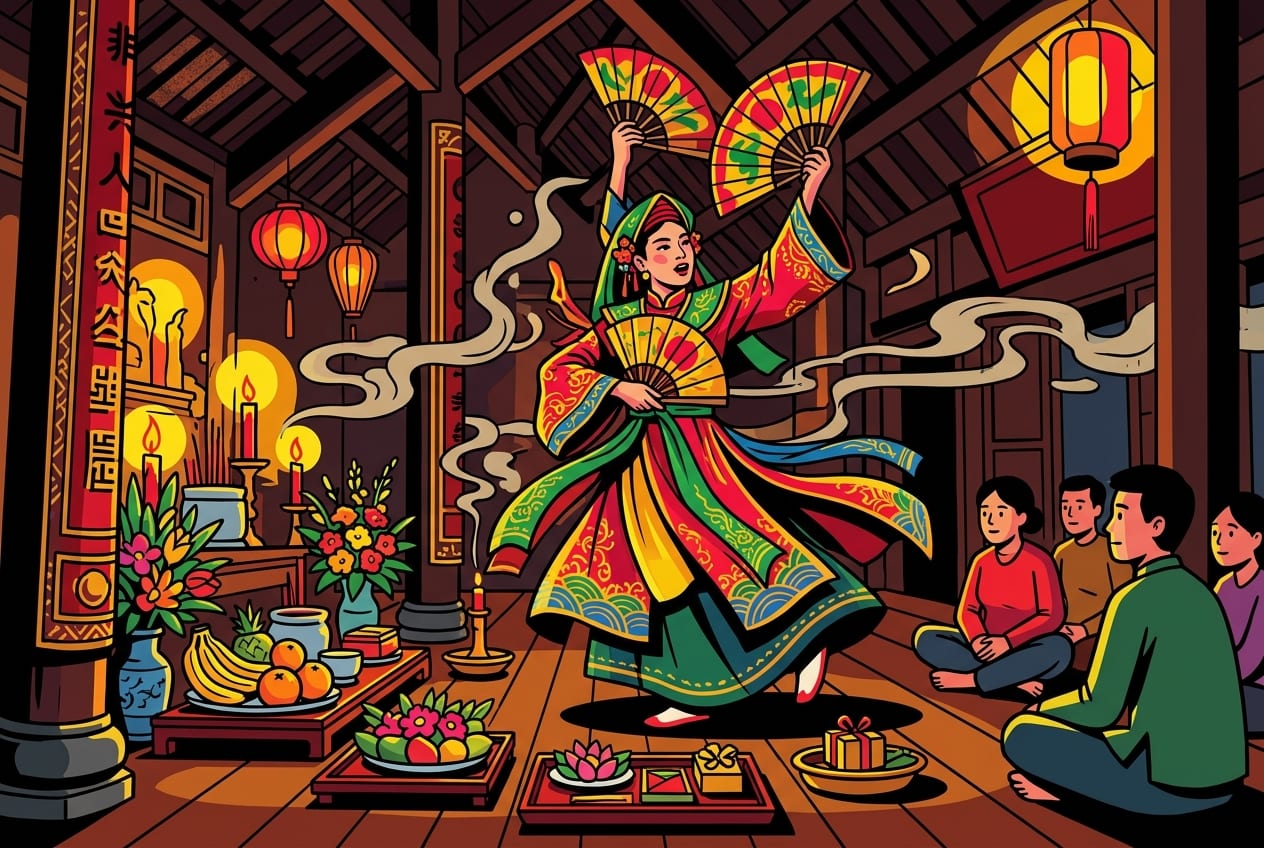
A Lên Đồng ceremony is a dramatic sensory experience characterized by elaborate silk costumes representing the Four Palaces, hypnotic Chầu Văn trance music, and the sweet aroma of burning sandalwood incense. Mediums perform highly stylized dances using swords, fans, and incense to invite deities to possess them.
The atmosphere of a Lên Đồng ritual is thick with sensory details. Inside the temple, the air is heavy with the sweet, woody scent of burning sandalwood incense (nhang) and the warmth of flickering beeswax candles. The visual palette is defined by the Tứ Phủ (Four Palaces), each represented by a distinct, brilliant color: Red for the Heaven Palace (Thiên Phủ), Green for the Forest Palace (Nhạc Phủ), White for the Water Palace (Thoải Phủ), and Yellow for the Earth Palace (Địa Phủ).
As the ceremony unfolds, the medium undergoes rapid, dramatic costume changes to match the specific deity possessing them. One moment they may wear a heavy emerald-green silk robe embroidered with golden dragons to represent a fierce mountain prince; the next, they are draped in shimmering white silk and a delicate beaded veil to channel a graceful water goddess. The transformation is driven by Chầu Văn, a hypnotic, fast-paced genre of traditional music. Musicians play the đàn nguyệt (two-stringed moon lute) and beat brass cymbals, creating an infectious, driving rhythm designed to guide both the medium and the audience into a state of spiritual ecstasy. As noted in coverage by Reuters on Vietnam's Mother Goddess revival, this combination of music, dance, and vibrant costuming creates an incredibly powerful, communal atmosphere that transcends language barriers.
Where to Witness a Lên Đồng Ritual in Vietnam
Travelers can witness a Lên Đồng ritual Vietnam offers at urban temples like Hanoi's Phủ Tây Hồ (West Lake Temple) or historic Old Quarter shrines. For the ultimate spiritual pilgrimage, visit Phủ Dầy in Nam Định Province, the historical epicenter of the Mother Goddess belief system.
While ceremonies take place throughout the year, the peak seasons align with the third lunar month (honoring the Mother Goddess Liễu Hạnh) and the eighth lunar month. If you are planning your itinerary, here are the top spots to experience this hypnotic tradition:
- Hà Nội (Urban Epicenter): The most accessible location for travelers is Phủ Tây Hồ (West Lake Temple), which attracts massive crowds on the first and fifteenth days of every lunar month. For a more intimate, historic experience, wander into the narrow alleyways of the Old Quarter to find Đền Bạch Mã (White Horse Temple) or smaller private home altars (điện thờ) along streets like Hàng Bạc or Hàng Hành. These urban temples offer a striking contrast to the quiet, contemplative spaces described in our Zen & Lens: Your Guide to Pagoda-Hopping for Peace and Perfect Shots in Vietnam.
- Nam Định Province (The Spiritual Cradle): Located about 1.5 hours south of Hanoi, Phủ Dầy in Vụ Bản District is the absolute heart of Đạo Mẫu. This massive temple complex hosts spectacular, multi-day festivals during the third lunar month, drawing thousands of mediums, musicians, and pilgrims from all over the country.
Attending a public ritual is entirely free, but the financial scale of these ceremonies is staggering. A private Lên Đồng funded by a wealthy devotee can cost anywhere from 30 million to over 200 million VND ($1,200 to $8,000 USD). This money pays for the elaborate offerings of fruit, roasted pigs, and paper models, the highly skilled Chầu Văn band, and the distribution of phát lộc (blessed gifts) to the crowd.
Essential Etiquette: How to Be a Respectful Guest
When attending a Lên Đồng ritual, travelers must wear modest clothing covering shoulders and knees, remove their shoes before entering the temple floor, and never point the soles of their feet toward the altar. Always seek permission before taking photographs or filming the medium's sacred trance performance.
Because Lên Đồng is a deeply sacred living tradition, travelers must approach these spaces with genuine humility and cultural sensitivity. Temples are not tourist stages; they are active places of worship where locals seek solace and blessings. To ensure you remain a respectful observer, follow these strict rules of etiquette:
First, dress modestly. Ensure your shoulders and knees are completely covered. Avoid wearing all-black or all-white outfits, as these colors are strongly associated with mourning and funerals in Vietnamese culture; instead, wear respectful, colorful, or neutral smart-casual clothing. When entering the temple floor, you must remove your shoes. Sit cross-legged or with your legs tucked neatly to one side. Never point the soles of your feet directly at the altar, the statues, or the medium, as this is considered highly offensive across Southeast Asia.
Second, understand the ritual of Lộc (blessings). During the dance, the deity (through the medium) will distribute blessed items like fruit, sweets, cigarettes, or small cash to the audience. If the medium approaches you and hands you a gift, accept it with both hands, bow your head slightly, and express your gratitude. Do not immediately consume or open the gift; place it respectfully in your bag or beside you until that specific deity's segment of the ritual has concluded.
Do
- Dress modestly with shoulders and knees fully covered.
- Remove your shoes before stepping onto the temple floor mats.
- Accept any distributed blessings (lộc) with both hands and a polite bow.
- Sit quietly, keeping your legs tucked to the side or crossed away from the altar.
Don't
- Never point the soles of your feet toward the altar, statues, or the medium.
- Do not step onto the central red carpet reserved exclusively for the medium's performance.
- Avoid using flash photography or filming without asking the temple keepers first.
- Do not wear all-black or all-white clothing, which signifies mourning.
Frequently Asked Questions About Lên Đồng
Understanding the nuances of the Lên Đồng ritual in Vietnam helps travelers navigate these sacred ceremonies with confidence. Common questions center around the cost of attendance, the meaning of blessed gifts distributed by mediums, and how to participate respectfully without disrupting the spiritual energy of the temple.
Do I need to pay an entrance fee to watch a Lên Đồng ritual in a temple?
No, public Lên Đồng rituals are completely free to attend. Anyone is welcome to sit and watch. However, if you sit near the front, it is polite to bring a stack of small, crisp VND bills (such as 10,000 or 20,000 VND notes) to place on the offering trays or to exchange when the medium distributes blessings.
What should I do if the spirit medium hands me a cigarette, beer, or cash during the dance?
This is called 'lộc' (blessed fortune). You should accept it with both hands, bow your head slightly, and say 'Cảm ơn' (thank you). Do not refuse it, as turning down a blessing from a deity is considered bad luck. You can keep the small cash note as a lucky charm and enjoy the sweets or fruit later.
Why do some mediums smoke cigarettes or drink alcohol during the ceremony?
In the Dao Mau belief system, different historical spirits possess the medium throughout the night. Some of these spirits—particularly the young princes or forest deities—were known in folklore to enjoy drinking, smoking, or feasting. The medium performs these actions to show that the specific spirit has fully taken over their physical body.
Practise the words you just read
Vietnamese phrases for real situations, each with native audio in both accents.
Topics
Read more
Other posts from our Vietnamese learning blog.

By Xinchao team
The Cat-and-Mouse Game of Hanoi's Train Street: Your 2026 Survival Guide to Visiting Safely (and Legally)
How do you navigate the guards, barricades, and narrow tracks of Hanoi's Train Street in 2026? Learn the insider rules to visit safely, legally, and respectfully.

By Xinchao team
Midnight at the Cemetery: Why Thousands of Vietnamese Pilgrims Flock to Cô Sáu under the Stars
Discover the deep history, essential etiquette, and practical steps for participating in Côn Đảo's famous midnight pilgrimage to the grave of Cô Sáu.

By Xinchao team
Beyond the Beach: Why You Must Experience Ninh Thuan’s Mystical Cham Kate Festival
Ready to go beyond the beach? Experience Ninh Thuan's mystical Cham Kate Festival at Po Klong Garai. Learn the deep cultural meanings, crucial etiquette, and expert survival tips for expats.