Mud, Sweat, and Steers: Your 2026 Guide to the Thrilling Khmer Bull Racing Festival in An Giang
Step into the splashing mud of the Mekong Delta for the ultimate guide to the Bay Nui Bull Racing Festival—a heart-pounding cultural race deeply rooted in Khmer spiritual tradition.
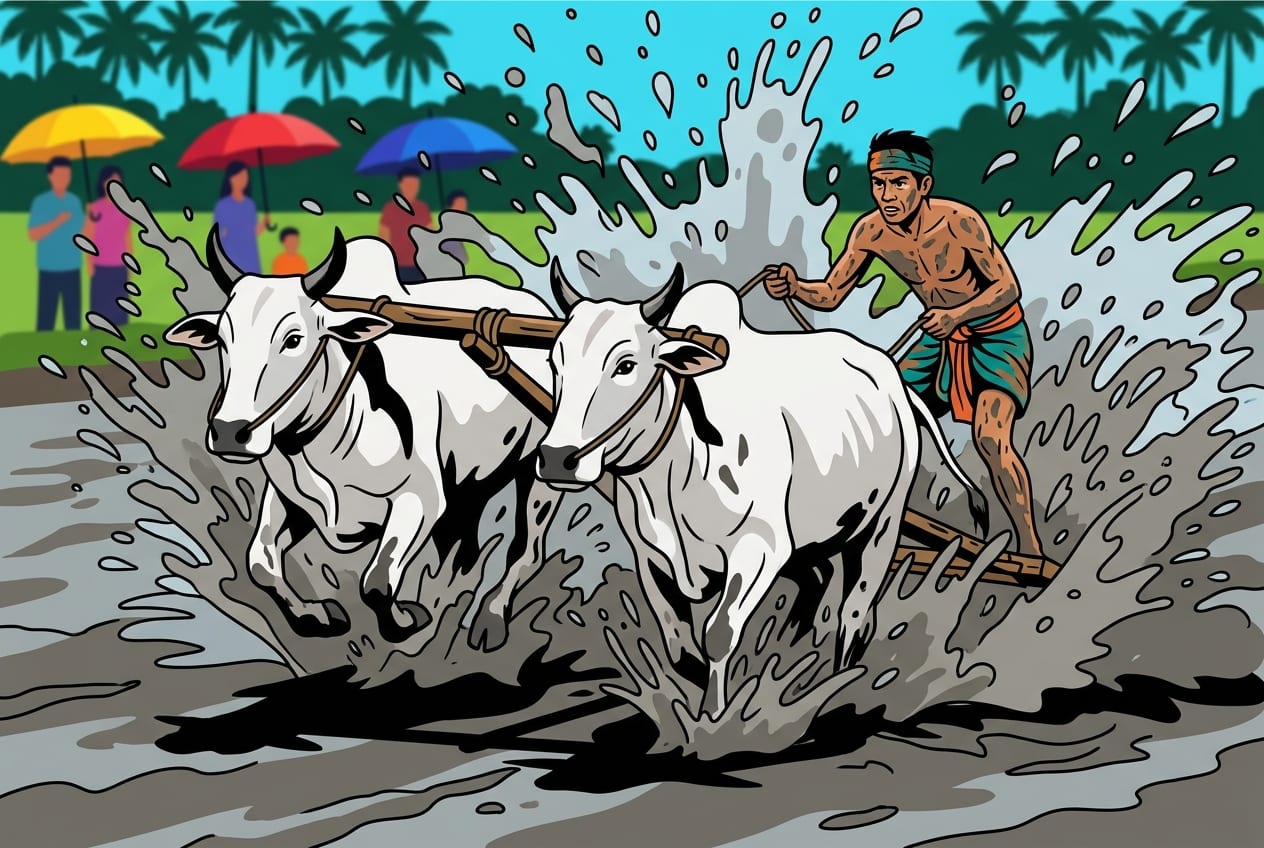
If you think you have seen everything the Mekong Delta has to offer—from the serene labyrinth of Mekong Delta's iconic floating markets to quiet fruit orchards—think again. Every autumn, the peaceful, emerald-green plains of An Giang Province transform into a high-octane, mud-splattered arena. Here, powerful bulls charge down waterlogged rice paddies at terrifying speeds, cheered on by thousands of roaring spectators. This is the legendary Bay Nui (Seven Mountains) Bull Racing Festival, one of Vietnam’s most electrifying and culturally rich spectacles. For adventurous travelers, this event offers an unforgettable look into the heart of Vietnam's ethnic Khmer community.
What is the Khmer Bull Racing Festival?
The Khmer Bull Racing Festival, locally known as the Bay Nui Bull Race, is a sacred spiritual sport held in Vietnam's An Giang province. It marks the culmination of the Sene Dolta festival, where ethnic Khmer communities honor their ancestors and pray for a bountiful wet-season rice harvest.
To truly appreciate the race, you have to understand the why behind the mud. For the local Khmer people, this festival is deeply spiritual, far transcending mere sport. It serves as the grand finale of Sene Dolta, a major festival dedicated to expressing gratitude to ancestors. Historically, local farmers would bring their strongest bulls to help the monks plow the temple's rice fields before the new planting season. Over time, this communal work evolved into a friendly competition, and eventually, the legendary festival we see today.
The competing bulls are not ordinary farm animals. They are pampered, highly trained athletes representing different villages and pagodas. In the months leading up to the race, these bulls are fed special diets—often including eggs, beer, and honey—and are shielded from hard farm work. Winning the race brings immense pride, communal prestige, and blessings of prosperity and a bumper crop to the victor's entire village. According to local belief, the winning pair of bulls brings good health and fortune to everyone who helped raise them.
When and Where to Catch the 2026 Action
The 2026 Khmer Bull Racing Festival is scheduled for October 9–11, coinciding with the late eighth and early ninth lunar months. The thrilling races rotate annually, centering around the muddy tracks of Tà Pạ Pagoda in Tri Tôn and Rô Pagoda in Tịnh Biên districts.
Because the festival date is tied to the Khmer lunar calendar, it shifts slightly every year on the Gregorian calendar. For 2026, the primary action centers around the scenic Tà Pạ Pagoda (Tri Tôn) and the Rô Pagoda (Tịnh Biên) in An Giang Province. The festival rotates venues annually between these two districts, ensuring both local communities get to host the prestigious event. You can check updates on regional schedules via the Vietnam National Authority of Tourism portal.
While admission to the festival grounds is entirely free, you should expect to pay nominal local fees. Motorbike parking run by nearby families costs around 10,000 to 20,000 VND ($0.40–$0.80 USD). To get to the festival, most travelers book a comfortable sleeper bus via FUTA Bus Lines (Phương Trang) from Ho Chi Minh City to Châu Đốc city. From Châu Đốc, you can rent a motorbike for a scenic 45-kilometer ride through the countryside to the racing fields of Tri Tôn or Tịnh Biên. For general geographical context on the region, you can refer to Wikipedia's An Giang Province guide.
The Anatomy of a Muddy Spectacle: How the Race Works
In this traditional race, pairs of highly trained bulls pull a jockey standing precariously on a wooden harrow across a waterlogged mud track. Reaching speeds of 50 km/h, the competition tests the jockey's balance and the bulls' synchronized power over two intense laps.
The race track itself is a waterlogged, muddy rectangular field, about 120 meters long and 100 meters wide, surrounded by safety embankments. Two pairs of bulls compete at a time in a sudden-death bracket. The race is split into two distinct phases: the warm-up lap (thả) and the final sprint (thả bánh or vượt).
During the warm-up, the jockeys guide their bulls slowly around the track to get them accustomed to the mud and the roaring crowd. But once they hit the final straightaway, the real madness begins. The jockeys use a small wooden goad (gậy thúc) to urge the bulls to their absolute maximum speed. The jockey must balance perfectly on a small, rake-like wooden harrow (bừa) while being dragged through the flying mud. If the jockey falls off, or if their bulls veer off the track, they are instantly disqualified. It is a breathtaking exhibition of raw speed, balance, and trust between man and beast.
Survival Guide: Mud, Crowds, and Flying Clods
To survive the chaotic festival, arrive at the tracks by 6:30 AM to secure a viewing spot. Wear old clothing, bring a high-quality poncho for monsoon rains, and protect camera lenses with plastic sleeves from flying mud that can spray up to ten feet high.
Attending the festival is an incredible experience, but it requires preparation. The racing fields open early, and the best viewing spots along the muddy banks fill up with thousands of passionate locals and professional photographers by 6:30 AM. If you arrive late, you will likely be staring at the backs of heads.
Dress for mess. The flying mud kicked up by the charging bulls is clay-heavy and will permanently stain your clothes. Wear shoes with good grip, as the grassy banks get incredibly slippery. October falls squarely within the Mekong Delta's monsoon season, so pack a reliable poncho and a dry bag for your phone and wallet. If you are bringing professional camera gear, a plastic rain sleeve is mandatory; the mud spray can easily reach 10 to 15 meters from the track.
Between races, take the opportunity to sample local street food from the vendors lining the dirt roads. Try a bowl of bún cá Châu Đốc, a savory fish noodle soup infused with fresh turmeric and local herbs, and wash it down with a cup of sweet, refreshing nước thốt nốt (Palmyra palm juice) freshly harvested from the surrounding trees.
Cultural Etiquette: Respecting Monks and Sacred Spaces
When attending, travelers must dress modestly with shoulders and knees covered to visit nearby pagodas. Respect the highly revered Khmer Theravada Buddhist monks by keeping clear of their designated seating areas, and always stay safely behind the protective bamboo track barriers.
While the atmosphere at the track is wild and loud, the underlying festival is deeply religious. The Khmer people practice Theravada Buddhism, and their local monks play a central role in organizing the races. Monks often sit in designated VIP pavilions near the finish line; always give them their space, do not block their views, and avoid loud or disruptive behavior near their seating areas.
Before or after the races, you will likely want to visit the stunning Khmer pagodas nearby, like Tà Pạ Pagoda or Rô Pagoda. For tips on how to behave respectfully in these sacred spaces, check out our comprehensive spiritual pagoda-hopping guide. Always remember to cover your shoulders and knees, remove your shoes before entering the main sanctuary, and never touch a monk or their robes.
Do
- Arrive at the racing track by 6:30 AM to secure a clear view along the muddy banks.
- Wear clothes and footwear that you do not mind getting permanently stained with clay mud.
- Cover your shoulders and knees if you plan to visit the nearby Tà Pạ or Rô Pagodas.
- Stay strictly behind the designated bamboo safety barriers at all times.
Don't
- Do not stand on or crowd the designated VIP seating areas reserved for Khmer Theravada Buddhist monks.
- Do not use flash photography near the starting line, as it can easily startle the highly strung racing bulls.
- Do not attempt to cross the track while races are actively running.
What should I do if a bull charges toward the spectator safety barrier?
If a bull veers off-course toward the crowd, remain calm and step back quickly behind the bamboo barriers or move up onto the elevated dirt banks. Do not run directly down the track, as the bulls are steered in a straight line and will try to follow the path of least resistance.
Can I buy food and drinks directly at the Tà Pạ or Rô Pagoda racing tracks?
Yes, numerous local Khmer vendors set up temporary stalls along the edges of the fields. You can buy refreshing local nước thốt nốt (Palmyra palm juice) for about 15,000 VND ($0.60 USD) and bowls of savory bún cá Châu Đốc (fish noodle soup) for around 50,000 VND ($2.00 USD).
Is it safe to bring high-end DSLR or mirrorless cameras close to the muddy track?
It is safe only if you use professional weather-sealing or a protective plastic rain sleeve. The racing bulls kick up thick, clay-heavy mud that can spray up to 15 meters from the track, which can easily ruin unprotected dials, buttons, and lenses.
Practise the words you just read
Vietnamese phrases for real situations, each with native audio in both accents.
Topics
Read more
Other posts from our Vietnamese learning blog.

By Xinchao team
The Cat-and-Mouse Game of Hanoi's Train Street: Your 2026 Survival Guide to Visiting Safely (and Legally)
How do you navigate the guards, barricades, and narrow tracks of Hanoi's Train Street in 2026? Learn the insider rules to visit safely, legally, and respectfully.

By Xinchao team
Midnight at the Cemetery: Why Thousands of Vietnamese Pilgrims Flock to Cô Sáu under the Stars
Discover the deep history, essential etiquette, and practical steps for participating in Côn Đảo's famous midnight pilgrimage to the grave of Cô Sáu.

By Xinchao team
Beyond the Beach: Why You Must Experience Ninh Thuan’s Mystical Cham Kate Festival
Ready to go beyond the beach? Experience Ninh Thuan's mystical Cham Kate Festival at Po Klong Garai. Learn the deep cultural meanings, crucial etiquette, and expert survival tips for expats.