Why Is Everyone Eating in Narrow Alleys? A Deep Dive into Hoi An’s Heritage Street Food
Step into the yellow-walled alleys of Hoi An to discover why its food is a UNESCO-recognized treasure, blending Japanese, Chinese, and Vietnamese legacies in every bite.
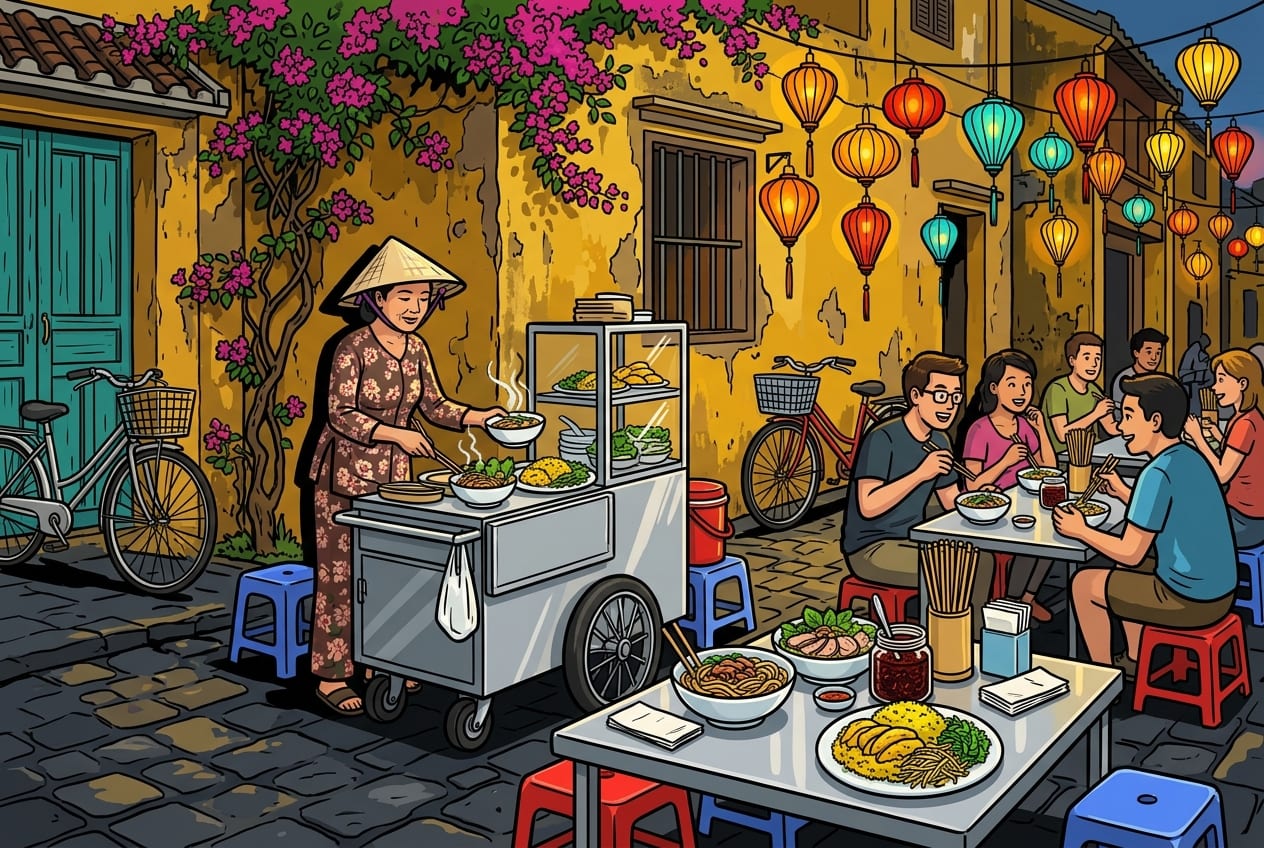
If you stand still for a moment in the heart of Hoi An’s Ancient Town, the air doesn't just smell like incense and old wood. It smells like wood-smoke, rendered pork fat, and the sharp, clean scent of Thai basil. This town is a living museum, but its most important exhibits aren't behind glass—they are served in ceramic bowls on low wooden tables tucked into alleyways so narrow you could touch both walls at once. UNESCO World Heritage Centre recognizes this port as a perfectly preserved example of a Southeast Asian trading port, and that history is exactly what you are tasting when you sit down for a meal here.
Dining in Hoi An is an exercise in intimacy. Because space is at a premium in these centuries-old merchant houses, the best food often spills out into the street. You might find yourself rubbing elbows with a local tailor or a fellow traveler, all while a motorbike carefully maneuvers past your stool. It is a sensory overload that somehow feels peaceful, anchored by the deep, savory flavors of dishes that have been perfected over hundreds of years. To understand Hoi An street food is to understand the soul of central Vietnam.
The Legend of Cao Lau: More Than Just a Noodle
Cao Lau is Hoi An's signature noodle dish, characterized by thick, chewy rice noodles, sliced char siu pork, crunchy rice crackers, and fresh greens. Its unique texture comes from soaking rice in lye water made from local wood ash and boiling it with water from the ancient Ba Le Well, creating a heritage flavor.
You cannot find authentic Cao Lau anywhere else in the world. People have tried to replicate it in Da Nang, Saigon, and even California, but they always fail. Why? Because the 'soul' of the noodle is tied to the geography of the town. Legend has it that the rice must be soaked in lye water made from the ash of trees grown on the nearby Cham Islands, and the water must be drawn from the thousand-year-old Ba Le Well. This isn't just a culinary myth; the specific mineral content of the well water and the alkalinity of the ash give the noodles a firm, almost springy bite that feels more like pasta than a typical Vietnamese rice noodle.
The dish itself is a map of Hoi An’s history. The thick noodles resemble Japanese udon, the savory roasted pork (Xa Xiu) is clearly Chinese, and the mountain of fresh herbs and crispy rice crackers is purely Vietnamese. When you eat it, you aren't just having lunch; you are consuming the 17th-century trade routes that made this town famous. It’s often served with a small amount of intense broth at the bottom, just enough to coat the noodles without turning it into a soup.
Cơm Gà Hội An: The Golden Rice of the Merchants
Hoi An Chicken Rice, or Com Ga, is a delicate dish of turmeric-infused rice cooked in chicken broth, topped with shredded free-range chicken, sliced onions, and Vietnamese coriander. It is served with a side of spicy chili jam and a small bowl of savory giblet gravy, representing the city's refined culinary style.
While you can find chicken rice across Southeast Asia, from Hainan to Singapore, the version in Hoi An is distinctively elegant. The rice is dyed a vibrant, sunset yellow using fresh turmeric and is cooked until each grain is separate and fluffy. The chicken used is 'ga ta' (local free-range chicken), which is leaner and much more flavorful than the plump, industrial birds found in Western supermarkets.
The secret to a great Com Ga lies in the 'bóp'—the mixing. The shredded chicken is tossed with lime juice, thin slices of onion, and 'rau răm' (Vietnamese coriander) before being placed on the rice. This creates a bright, zesty contrast to the rich, fatty rice. Often, a tiny bowl of 'tương ớt' (Hoi An chili jam) is provided on the side. This jam is sweet, smoky, and dangerously addictive. Just as Is Fish Sauce the Secret Glue Holding Vietnamese Families Together?, this chili jam is the glue that binds the flavors of Hoi An together.
The Etiquette of the Alleyway: How to Eat Like a Local
Dining in Hoi An’s narrow alleys requires a blend of spatial awareness and social grace. Travelers should expect to share communal tables, keep their voices at a moderate level, and pay the vendor directly after finishing. Respecting the 'first customer' of the day is also a significant local cultural practice.
Hoi An's street food scene is built on 'quán'—small, often family-run stalls. When you enter a narrow alleyway like the famous 'Hoi An Food Alley' (Ngõ Ẩm Thực), don't wait for a hostess. If there is an empty stool, take it. If the table is shared, a simple nod to your neighbors is enough. It is considered polite to keep your elbows tucked in; these tables were designed for a different era where space was the ultimate luxury.
One unique aspect of Hoi An etiquette is the 'mở hàng' or the first sale of the day. If you are the first customer at a street stall in the morning, try not to haggle too hard or walk away without buying anything. Locals believe the first customer sets the tone for the entire day’s luck. Being a 'good' first customer is seen as bringing 'vía tốt' (good energy) to the vendor. Also, remember that many of these stalls have been in the same family for three or four generations—treating the vendor with the respect you'd give an auntie or uncle goes a long way.
Do
- Carry small denominations of cash (VND), as street vendors rarely take cards.
- Use the provided wet wipes (khăn lạnh) but be aware they often cost a few thousand Dong.
- Wait for your turn patiently; many famous stalls are run by just one or two elderly people.
- Try the local chili jam, but start with a small dab—it’s deceptively spicy.
Don't
- Don't stick your chopsticks vertically into a bowl of rice; it resembles incense for the dead.
- Avoid shouting for service; a polite wave or 'Em ơi' is much more effective.
- Don't be afraid of the 'alley'—the best food is often hidden away from the main lantern-lit streets.
Beyond the Big Two: Banh Mi and White Rose Dumplings
While Cao Lau and Com Ga dominate the headlines, Hoi An's culinary repertoire includes 'Banh Mi'—the world-famous baguette sandwich—and 'Banh Bao Banh Vac' (White Rose Dumplings). These dishes highlight the French colonial influence and the delicate artistry of local families who have guarded their secret recipes for generations.
No trip to Hoi An is complete without a Banh Mi. While Saigon’s Banh Mi is known for its variety of cold cuts, Hoi An’s version is defined by its bread—extra crispy and tapered at the ends—and its sauce. The late Anthony Bourdain famously called the Banh Mi Phuong a 'symphony in a sandwich.' The bread is smeared with rich pate, homemade mayonnaise, and then stuffed with grilled pork, ham, and a garden’s worth of herbs.
Then there are the 'White Rose' dumplings (Banh Bao Banh Vac). These translucent shrimp dumplings are bunched up to look like roses and topped with crispy fried shallots. Interestingly, all the White Rose dumplings in the city are made by a single family and distributed to the various restaurants. It’s a literal monopoly on a heritage dish, ensuring the quality remains exactly as it was a century ago.
Why the Water Matters: The Ba Le Well
The Ba Le Well is a historic 10th-century Cham well in Hoi An that remains the essential source of water for authentic local dishes. Its unique mineral composition is credited with giving Cao Lau noodles their specific texture and preventing the rice from becoming mushy during the cooking process.
You might wonder why a well matters in the age of modern plumbing. For the people of Hoi An, the Ba Le Well is a sacred connection to the past. The Cham people, who ruled this area before the Vietnamese moved south, were master hydrologists. They dug this well to reach a specific aquifer that never runs dry, even in the harshest droughts. Today, you can still see water carriers transporting heavy buckets from the well to the various Cao Lau workshops in the early morning hours. It is this commitment to tradition that keeps the food in Hoi An from becoming a generic tourist product.
Why is Cao Lau only found in Hoi An and not in other Vietnamese cities?
Authentic Cao Lau requires three specific local ingredients: water from the ancient Ba Le Well, lye made from the ash of trees on the Cham Islands, and rice from the local fields. Without the specific mineral content of the well water and the alkalinity of that specific ash, the noodles lose their signature firm, chewy texture.
Is it okay to sit at a table where someone is already eating in a narrow alley stall?
Yes, communal seating is the norm in Hoi An's narrow alleys. Space is limited, so vendors will fill every stool. It is polite to give a small nod or smile to the person already seated. It’s a great way to see what others are ordering and perhaps get a recommendation for your next dish!
What is the best time of day to find the best street food in Hoi An?
For the most authentic experience, go early in the morning (6:00 AM - 8:00 AM) for breakfast soups or late in the afternoon (4:00 PM - 6:00 PM) when the 'snack' vendors come out. Many of the most famous heritage stalls sell out by mid-day, so being an early bird pays off in flavor.
As the sun sets and the lanterns begin to glow, the food scene in Hoi An shifts. The narrow alleys become even more crowded, the steam from the pots catches the light, and the clinking of ceramic bowls creates a rhythmic soundtrack. Whether you are tucking into a bowl of golden rice or chewing on a piece of history-laden Cao Lau, you aren't just a tourist—you are a guest at a table that has been set for centuries.
Practise the words you just read
Vietnamese phrases for real situations, each with native audio in both accents.
Topics
Read more
Other posts from our Vietnamese learning blog.
By Xinchao team
Entering the Red Kingdom: An Expat's Guide to Navigating Vĩnh Long’s Majestic Mang Thít Brick Kilns
Discover the majestic Mang Thít brick kilns of Vĩnh Long. This comprehensive expat guide covers boat tours, scooter routes, local etiquette, and the rich cultural history of the Mekong Delta's 'Red Kingdom'.
By Xinchao team
Alleyway Symphonies: Can You Decode Vietnam's Hilarious Street Vendor Cries?
What are those loud megaphone sounds in Vietnam's alleys? Learn to decode Vietnamese street vendor cries (tiếng rao) and order food like a local expat.
By Xinchao team
Duck! Your Expat Survival Guide to Catching Flying Rice at Vietnam's Chaotic 'Cơm Niêu Đập' Restaurants
Ready for dinner and a show? Discover how to navigate Vietnam's chaotic flying clay pot rice restaurants without taking a crispy projectile to the face.