No Visa Required? Your 2026 Guide to Crossing the Border at the Joint Vietnam-China Ban Gioc Waterfall Zone
Can you actually walk across the Vietnam-China border at Ban Gioc without a visa? Yes—but you can't just wander over. Here is the ultimate survival blueprint for this groundbreaking joint scenic zone.
The Groundbreaking Reality: Crossing the Border Without a Visa
The Ban Gioc-Detian Joint Scenic Area allows international tourists to cross the Vietnam-China border visa-free using simplified permits. By pre-registering through authorized local agencies, visitors can legally explore the Chinese side of the falls for up to five hours in organized groups.
For decades, travelers stood on the banks of the Quay Son River, gazing at the massive, thundering cascades of Ban Gioc on the Vietnamese side and Detian on the Chinese side, wondering what it would be like to simply step across. In the past, doing so required a full, pre-arranged visa for either nation and a long detour through official international checkpoints. Today, the Ban Gioc (Vietnam) – Detian (China) Joint Scenic Area is fully operational. This means you can experience a historic bilateral initiative where the border is not a barrier, but a shared bridge. However, because this is a highly sensitive frontier zone, you cannot simply wander across the river. There is a very specific, highly regulated process that keeps this unique pocket of Southeast Asia safe, peaceful, and accessible.
Step-by-Step Survival Guide: How to Book and Cross Legally
To cross the border at Ban Gioc, you must submit your physical passport to a licensed Cao Bang travel agency 24 to 48 hours in advance, pay a fee of approximately 250,000 VND, and join a guided group of 5 to 20 people at international crossing Station No. 53.
The most important rule of the Ban Gioc waterfall border crossing is that independent crossings are strictly forbidden. You must be part of an official, pre-registered tour group. Fortunately, this is easy to arrange. You can book your slot through premier local accommodations like the Saigon-Ban Gioc Resort or the cultural homestays in the nearby Khuoi Ky Stone Village. The local operators handle the paperwork, submitting your passport details directly to the border control database.
On the day of your crossing, you must carry your physical passport (which must be valid for at least six months). If you are wondering where the 'Ga' or border checkpoint is located, keep in mind that this is not a train station, but a dedicated international crossing point known as Station No. 53. Arrive by 8:30 AM to beat the mid-day crowds. The border gates operate from 9:00 AM to 5:00 PM Hanoi time. Once you step onto the Chinese side, your 5-hour countdown begins. You will be accompanied by a bilateral tour guide who ensures everyone remains within the designated scenic zone. For more detailed geographical history on these magnificent falls, you can read Wikipedia's Ban Gioc-Detian Falls page.
The Cultural Fabric: Why This Border is a Sacred Shared Space
For the local Tay and Nung ethnic minorities, the Ban Gioc border zone represents a historic landscape of peaceful coexistence. The joint tourism initiative revitalizes ancient stone villages like Khuoi Ky, turning traditional crafts and local chestnuts into sustainable livelihoods that honor their ancestral heritage.
To understand why this joint scenic zone is such a monumental achievement, one must look at the people who call this valley home. The Tay and Nung ethnic minority groups have lived in Cao Bang Province for centuries, long before modern international borders were drawn on maps. For them, the river has always been a source of life, not a line of division. The economic success of the joint zone has directly revitalized local communities. In the nearby Khuoi Ky Stone Village, locals have converted their unique, centuries-old stone houses—originally built to defend against bandits—into homestays. Here, they sell hand-spun indigo brocade and sweet, roasted Trung Khanh chestnuts.
Because this is an active border, local communities place a high value on discretion and respect. Vietnamese culture places great emphasis on maintaining harmony and saving face, especially when dealing with international neighbors. When interacting with local vendors on either side of the river, a warm, polite demeanor goes a long way. Avoid any political discussions or debates about historical border conflicts. By showing respect for their home, you help ensure that this peaceful cross-border experiment remains open for future travelers.
Do
- Carry your physical passport with at least 6 months of validity left.
- Register with a local licensed travel agency at least 24 to 48 hours in advance.
- Bring cash in both Vietnamese Dong (VND) and Chinese Yuan (RMB).
- Keep your group guide in sight at all times while on the Chinese side.
Don't
- Do not take photos or videos of military personnel, border guard stations, or security checkpoints.
- Do not touch, climb on, or deface the historic border markers, including Marker 836.
- Do not bring up political history or border disputes with local guides or vendors.
- Do not wander outside the designated 5-hour scenic zone path on the Chinese side.
Practical Essentials: Cash, Connectivity, and Avoiding Roaming Traps
Navigating the Ban Gioc border requires carrying both Vietnamese Dong (VND) and Chinese Yuan (RMB) in cash, as international credit cards are rarely accepted. Travelers should also secure a dual-network eSIM to prevent expensive automatic roaming charges when mobile signals jump between country networks.
Deep in the limestone karsts of Cao Bang, modern conveniences like international ATMs and credit card terminals are incredibly rare. On the Vietnamese side, VND is king. On the Chinese side, digital payment platforms like WeChat Pay and Alipay are the norm, but as a short-term traveler, setting these up can be difficult. Therefore, carrying physical cash in both currencies is highly recommended. Keep small denominations handy for buying local snacks, water, or handmade souvenirs from riverside vendors.
Another common pitfall is mobile connectivity. Because the waterfalls carve through a narrow valley, cellular signals from Vietnamese and Chinese towers constantly overlap. If you rely on a standard SIM card, your phone may automatically switch back and forth between networks, triggering massive, unexpected international roaming charges. To avoid this, purchase a regional eSIM that covers both Vietnam and China, or manually lock your phone's network carrier settings to your Vietnamese provider before you approach the riverbank.
The Visual Magic of the Vietnamese Side
The Vietnamese side of Ban Gioc features emerald-green waters, white cascading falls, and golden terraced rice fields in autumn. Traditional double-decker bamboo rafts carry tourists close to the roaring cascades, while local Tay women sell indigo brocades along rustic pathways shaded by wild bamboo.
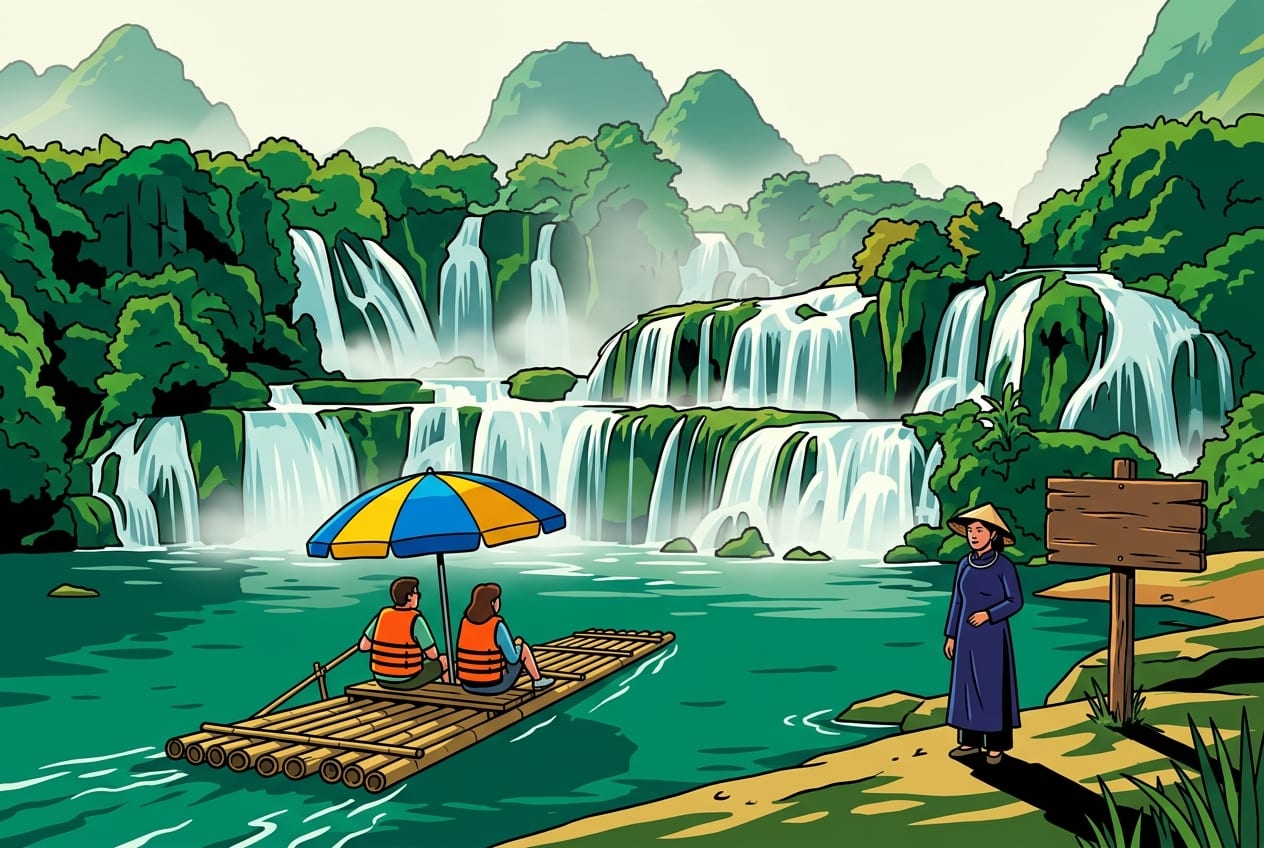
The landscape on the Vietnamese side of the falls is a masterpiece of natural colors. If you visit during the autumn harvest season from September to November, you will be treated to a stunning contrast of golden-yellow rice fields set against the stark, white foam of the rushing water. To get as close to the falls as possible, board one of the traditional double-decker bamboo rafts (bè tre). These rafts, easily recognizable by their bright blue and yellow canvas umbrellas, are piloted by local boatmen who navigate the swirling currents using long wooden poles. For up-to-date travel notices and seasonal safety guidelines, check the Vietnam National Authority of Tourism website.
Can I cross the Ban Gioc border independently without booking a tour group?
No, independent crossings are strictly prohibited at the Ban Gioc-Detian Joint Scenic Area. To cross legally, you must register through a licensed local travel agency or tour desk at least 24 to 48 hours in advance. They will submit your passport details to border authorities and assign you to an authorized group accompanied by a bilateral guide.
What happens if I accidentally exceed the 5-hour limit on the Chinese side?
Exceeding the 5-hour limit is a serious immigration violation in this sensitive border zone. Your bilateral tour guide is responsible for monitoring the time and keeping the group together. If you delay the group or attempt to stay behind, you may face questioning, heavy fines, or detention by border patrol officers from either country.
Can I use a photocopy or digital scan of my passport to cross?
No, you must present your physical passport at international crossing Station No. 53. Border control officers on both the Vietnamese and Chinese sides use specialized scanners to verify the security features of your physical document. Photocopies, digital scans, or mobile ID apps will not be accepted under any circumstances.
Practise the words you just read
Vietnamese phrases for real situations, each with native audio in both accents.
Topics
Read more
Other posts from our Vietnamese learning blog.

By Xinchao team
The Cat-and-Mouse Game of Hanoi's Train Street: Your 2026 Survival Guide to Visiting Safely (and Legally)
How do you navigate the guards, barricades, and narrow tracks of Hanoi's Train Street in 2026? Learn the insider rules to visit safely, legally, and respectfully.

By Xinchao team
Midnight at the Cemetery: Why Thousands of Vietnamese Pilgrims Flock to Cô Sáu under the Stars
Discover the deep history, essential etiquette, and practical steps for participating in Côn Đảo's famous midnight pilgrimage to the grave of Cô Sáu.

By Xinchao team
Beyond the Beach: Why You Must Experience Ninh Thuan’s Mystical Cham Kate Festival
Ready to go beyond the beach? Experience Ninh Thuan's mystical Cham Kate Festival at Po Klong Garai. Learn the deep cultural meanings, crucial etiquette, and expert survival tips for expats.