Why is Everyone Screaming Numbers at My Dinner Table?
Discover the high-energy world of Vietnamese 'Nhậu' culture. Learn why people shout 'Một, Hai, Ba, Dô!', the rules of the 100% toast, and how to survive the sidewalk beer scene.
The Rhythmic Pulse of the Vietnamese Sidewalk
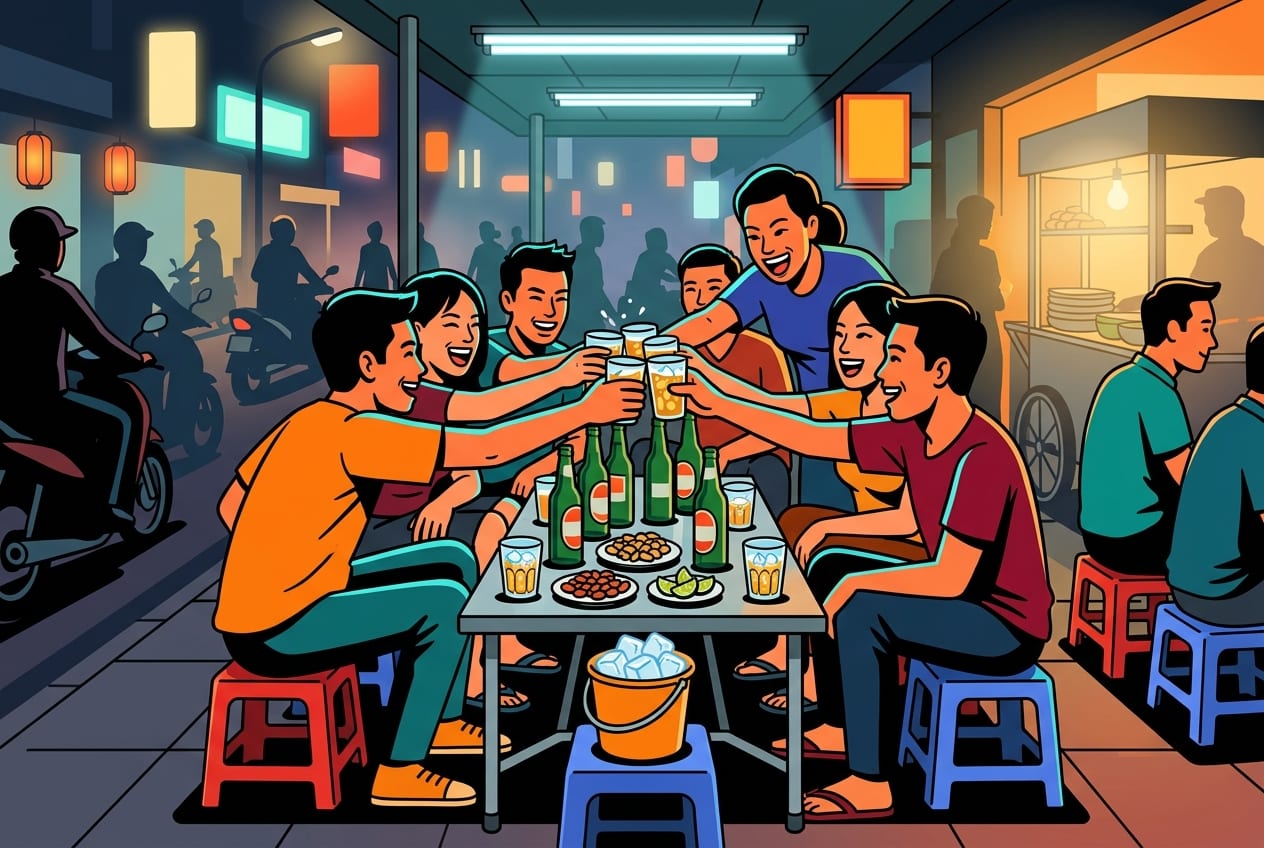
Vietnamese sidewalk drinking, or "nhậu," is a vibrant social ritual where friends gather on low plastic stools to share beer and snacks. It is less about the alcohol itself and more about strengthening community bonds, releasing daily stress, and creating a loud, joyful atmosphere that defines the local urban nightlife.
If you walk down any street in Saigon or Hanoi after 6:00 PM, you will hear it before you see it. It starts as a low rumble of conversation and the clinking of glass, punctuated by the roar of motorbikes. Then, suddenly, a thunderous roar erupts from a nearby table: "Một, Hai, Ba, Dô!" This isn't a protest or a sports chant; it is the heartbeat of Vietnamese social life. To the uninitiated traveler, it might look like chaos, but to a local, it is the sound of friendship, business deals being sealed, and families reconnecting after a long day.
The setting is almost always the same: a "quán nhậu" (drinking spot). Forget fancy chairs and white tablecloths. Here, the kings are the red and blue plastic stools that sit barely a foot off the ground. These stools are the great equalizers of Vietnam. Whether you are a billionaire CEO or a construction worker, everyone sits at the same height, knees tucked in, leaning over a simple metal table. The air is thick with the smell of grilled seafood, roasted peanuts, and the humid evening breeze. This is where the real Vietnam happens, far away from the quiet museums and air-conditioned malls.
Breaking Down the Một, Hai, Ba, Dô! Chant
The "Một, Hai, Ba, Dô!" chant is the universal signal for a collective toast in Vietnam. It translates to "One, Two, Three, Yo!" and serves to synchronize the group’s energy. By shouting together, drinkers demonstrate their unity and ensure that no one is left out of the shared celebration.
Why do we shout? In Western cultures, you might raise a glass and say "Cheers" to the person sitting next to you. In Vietnam, drinking is a team sport. If you take a sip of your beer alone, it’s almost considered a bit sad or even rude. You wait for the group. When someone feels the energy is right, they will start the countdown. The full version usually goes like this:
Một, hai, ba, DÔ! (One, two, three, YO!) Hai, ba, DÔ! (Two, three, YO!) Hai, ba, UỐNG! (Two, three, DRINK!)
By the time you reach the final "Uống!", the energy at the table has peaked. Everyone clinks their glasses in the center, often with enough force to splash a bit of beer on the table. This physical contact of the glasses is crucial. It represents the clashing of spirits and the merging of the group into one. If you are sitting at a table of ten people, you are expected to make sure your glass touches as many others as possible. It is a noisy, messy, and beautiful display of togetherness.
The Ritual of Synchronization
Synchronization in Vietnamese drinking culture ensures that everyone participates at the same pace, fostering a sense of equality and togetherness. When the group shouts the final "Dô!", it marks a moment of shared focus where individual worries are set aside in favor of the collective joy of the table.
This synchronization also serves a practical purpose: it keeps the conversation flowing. Because everyone drinks at the same time, everyone also pauses at the same time. This creates natural breaks in the evening where new snacks can be ordered, stories can be told, or someone can join the table. It prevents the "awkward silence" because the chant acts as a reset button for the group's energy. If the vibe is dipping, someone simply shouts "Một, hai, ba..." and the party is instantly revived.
The 100% Rule and the Art of Social Bonding
The "100%" or "trăm phần trăm" rule is a playful challenge to finish one's glass in a single go. While it sounds intense, it is deeply rooted in the concept of "chân thành" or sincerity, showing your friends that you are fully committed to the gathering and the friendship.
You will often hear someone shout "Trăm phần trăm!" (One hundred percent!) after the chant. This is a request for everyone to drain their glass. If you aren't feeling quite that ambitious, you might negotiate for "Năm mươi phần trăm" (Fifty percent). While it might seem like peer pressure, it is actually a form of bonding. In Vietnamese culture, sharing a drink to the bottom of the glass is a way of saying, "I have nothing to hide from you; we are true friends."
However, as a visitor, don't feel terrified. The Vietnamese are incredibly hospitable. If you smile, join the chant, and take a respectful sip, most people will be thrilled just to have you there. The effort to participate in the "Một, Hai, Ba, Dô!" is much more important than the actual amount of liquid you consume. It’s the spirit of the "cuộc vui" (the fun session) that matters most.
Survival Guide: The Ice, the Snacks, and the Stools
Navigating a Vietnamese drinking session requires understanding the physical environment, from the low-to-the-ground seating to the specific types of snacks served. Success involves pacing yourself, staying hydrated, and embracing the "mồi" (drinking food) to balance the beer, all while maintaining the high energy of the group.
To survive a long night of "nhậu," you must understand the holy trinity of the Vietnamese table: the ice, the "mồi," and the etiquette. First, let's talk about the ice. You will see a plastic bucket on the floor filled with large, clear cylinders of ice. A single, massive cube will be placed in your glass. This is non-negotiable. It keeps your beer cold in the 30-degree Celsius humidity and, importantly, it dilutes the beer slightly so you can keep going for hours.
Next is the "mồi" (pronounced like "moy"). This refers to the snacks specifically designed to accompany beer. You’ll start with "đậu phộng" (roasted peanuts) or "bánh đa" (large rice crackers). As the night progresses, the dishes get heavier: "mực nướng" (grilled dried squid), "nem chua" (fermented pork rolls with garlic and chili), or "ốc" (sea snails cooked in lemongrass). Never drink on an empty stomach in Vietnam; the food is just as important as the beer.
Why Your Beer Needs a Giant Ice Cube
Adding large ice cubes to beer is a practical Vietnamese habit born from the tropical heat and a history of limited refrigeration. The ice keeps the beer cold during long, humid evenings on the sidewalk and slightly dilutes the alcohol, allowing the social gathering to last much longer without exhaustion.
For many foreigners, putting ice in beer is a crime. But in the context of the Vietnamese sidewalk, it is a stroke of genius. Most "quán nhậu" don't have massive industrial refrigerators to keep thousands of bottles at 2 degrees Celsius. Instead, the beer is delivered at room temperature and chilled instantly by the "đá" (ice). The large size of the cube means it melts slowly, providing a consistent chill without turning your beer into water immediately. It also helps you stay hydrated in the heat—a secret weapon for avoiding a hangover the next morning.
Etiquette: The Subtle Rules of the Clink
Vietnamese drinking etiquette involves subtle gestures of respect, such as using both hands to hold a glass when toasting an elder. These small actions demonstrate one's upbringing and awareness of social hierarchy, ensuring that the lively atmosphere remains respectful and harmonious for everyone at the table.
Even in the middle of a loud, shouting match of "Một, Hai, Ba, Dô!", there are rules. If you are drinking with someone older than you or someone of higher status (like a boss), it is polite to hold your glass with both hands. When you clink, try to position the rim of your glass slightly lower than theirs. This is a sign of "kính trọng" (respect). It shows you acknowledge their position even while you are both having fun.
Another rule: if someone comes to your table to toast you specifically, you should stand up (or at least straighten your posture) and give them your full attention. Drinking in Vietnam is a series of mini-connections. You aren't just drinking with a crowd; you are drinking with individuals within that crowd. If someone catches your eye from across the table and raises their glass, that is an invitation for a private "dô" within the larger party.
Do
- Always wait for a group chant before taking your first big gulp.
- Use two hands when toasting someone older than you.
- Eat plenty of 'mồi' (snacks) to pace yourself.
- Keep an eye on your friends' glasses and offer to pour for them if they are low.
Don't
- Don't drink alone without acknowledging the table.
- Don't feel forced to drink 100% if you've reached your limit; a polite 'năm mươi phần trăm' (50%) is okay.
- Don't be afraid of the ice; it is your best friend in the heat.
- Don't forget to say 'cảm ơn' (thank you) when someone pours for you.
What should I do if I don't drink alcohol but want to join the 'Một, Hai, Ba, Dô!'?
No problem at all! You can easily join in with a glass of Coke, soda water, or even iced tea (trà đá). The most important part is the energy and the participation in the chant. Just raise your glass, shout along, and clink with the rest—no one will judge you for the contents of your glass.
Why do people keep pouring more beer into my glass before it's empty?
In Vietnam, an empty glass is seen as a sign of neglect by the host or friends. People will constantly top you up to show hospitality and ensure you are always ready for the next toast. If you really want to stop, keep your glass relatively full and place your hand over the top or politely say 'mình đủ rồi' (I've had enough).
Is it normal for strangers at the next table to invite me for a toast?
Yes, it is very common! Vietnamese drinking culture is extremely social. If a group nearby sees you enjoying yourself, they might raise their glasses and shout 'Dô!' toward you. It’s a friendly gesture. You can just smile, raise your glass back, and say 'Dô!'—you don't necessarily have to go over to their table.
At the end of the night, as the pile of empty green bottles grows under the table and the streetlights begin to dim, you'll realize that the "Một, Hai, Ba, Dô!" is more than just a noise. It is the sound of Vietnamese resilience and joy. No matter how hard the workday was, there is always room on a small plastic stool for a friend, a cold beer, and a loud, rhythmic reminder that you are not alone. So, next time you hear that countdown, don't be shy. Grab your glass, find a stool, and get ready to shout. Dô!
Practise the words you just read
Vietnamese phrases for real situations, each with native audio in both accents.
Topics
Read more
Other posts from our Vietnamese learning blog.
By Xinchao team
The Cat-and-Mouse Game of Hanoi's Train Street: Your 2026 Survival Guide to Visiting Safely (and Legally)
How do you navigate the guards, barricades, and narrow tracks of Hanoi's Train Street in 2026? Learn the insider rules to visit safely, legally, and respectfully.
By Xinchao team
Midnight at the Cemetery: Why Thousands of Vietnamese Pilgrims Flock to Cô Sáu under the Stars
Discover the deep history, essential etiquette, and practical steps for participating in Côn Đảo's famous midnight pilgrimage to the grave of Cô Sáu.
By Xinchao team
Beyond the Beach: Why You Must Experience Ninh Thuan’s Mystical Cham Kate Festival
Ready to go beyond the beach? Experience Ninh Thuan's mystical Cham Kate Festival at Po Klong Garai. Learn the deep cultural meanings, crucial etiquette, and expert survival tips for expats.