Landing Like a Local: Navigating the Airport Taxi Chaos in Vietnam
Don't get overwhelmed at the airport! Learn why taxi brokers approach you and how to navigate the arrival terminal like a Vietnamese street specialist.
The First Five Minutes: A Sensory Overload
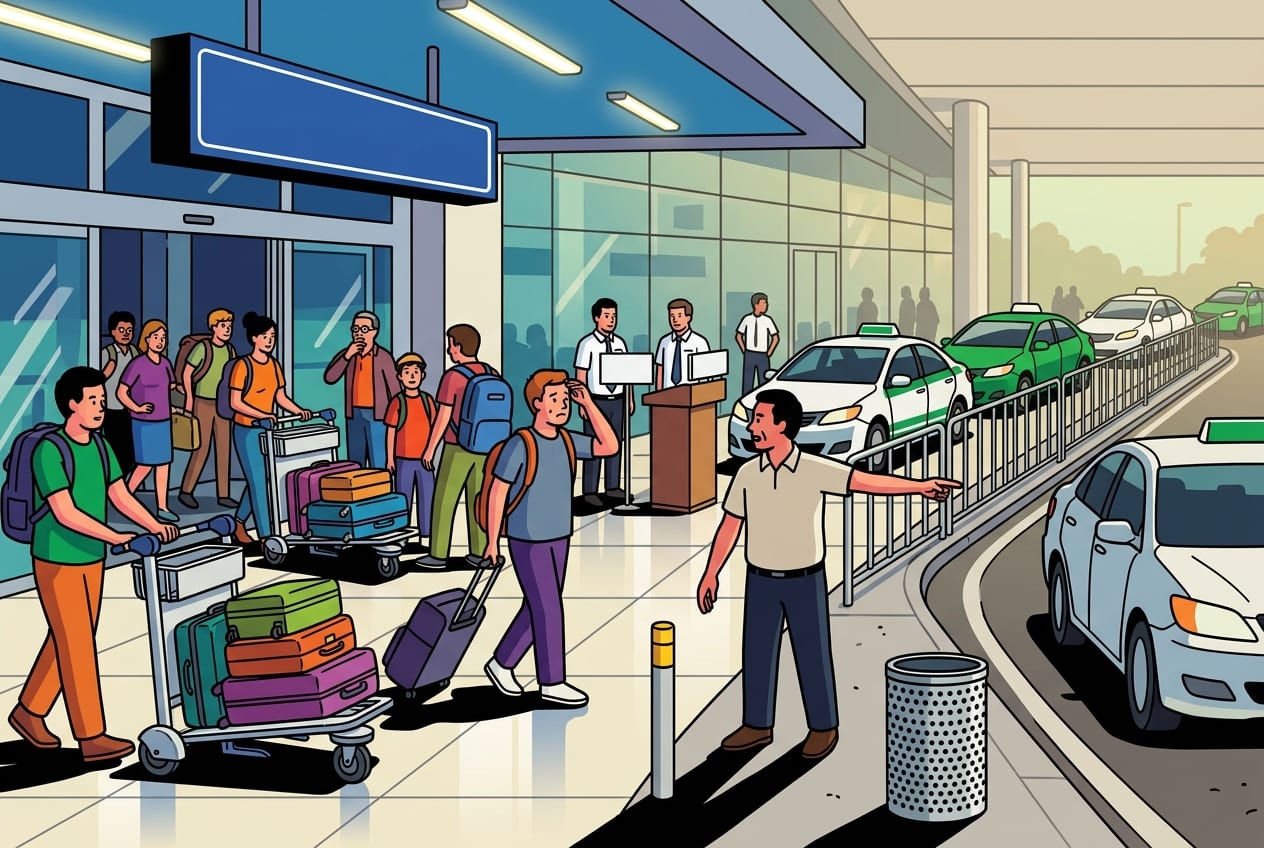
You’ve just stepped off a long flight. The automatic glass doors of the airport slide open, and a wall of humid, tropical air hits you. It’s a mix of jasmine, exhaust fumes, and the buzz of a thousand conversations. Before you can even find your bearings, someone in a plain polo shirt is standing right in your personal space. He’s smiling, gesturing toward a car you can’t see, and asking, 'Taxi? Where you go? Good price for you!'
For many first-time visitors to Vietnam, this is the 'moment of truth.' It feels aggressive, maybe even like a trap. But to understand this, you have to understand the Vietnamese 'hustle.' In a culture where the street is the marketplace, waiting in a quiet line isn't the norm. People go to the customer, not the other way around. This person is likely a 'cò' (a broker or intermediary). They aren't necessarily 'bad' people, but they are looking to make a commission by connecting you with a private driver, and that commission usually comes out of your pocket.
Why the 'Fixed Price' isn't Always a Favor
The broker will often quote you a 'fixed price' that sounds reasonable—maybe 500,000 VND ($20 USD) for a ride to the city center. They might tell you the meter is 'broken' or that traffic is so bad that a meter would cost you double. In Vietnam, negotiation is a way of life. When you agree to a fixed price without knowing the distance, you are essentially paying for their peace of mind (and their lunch). A metered taxi or a ride-hailing app like Grab will almost always be cheaper, even in heavy traffic.
Why do they do this? It’s about 'chắc ăn' (certainty). Drivers want to know exactly how much they will earn before they start the engine. They dislike the uncertainty of the meter as much as you dislike the uncertainty of being overcharged. However, as a traveler, your best bet is to stick to the reputable brands that locals trust. Look for the drivers in formal white shirts and green ties—these are usually from Mai Linh or Vinasun, the two most reliable companies.
Do
- Smile and say 'Không, cảm ơn' (No, thank you) firmly if you aren't interested.
- Look for the official taxi queue usually located to the left or right of the main exit.
- Use a ride-hailing app like Grab to check the 'fair price' before talking to anyone.
- Keep your luggage close to you until you are sure of the driver and the car.
Don't
- Don't let anyone pull your luggage cart for you unless they are a uniformed airport porter.
- Don't get angry or shout; this causes everyone to 'lose face' and makes the situation worse.
- Don't follow someone to a parking lot far away from the official taxi lanes.
- Don't show large stacks of cash while negotiating at the curb.
The Art of Saving Face at the Curb
In Vietnam, 'Face' (Diện tích) is everything. If you feel pressured, the worst thing you can do is start a loud argument. This makes the driver look bad in front of his peers, and it makes you look like an 'uncultured' tourist. Instead, use what I call the 'Professional Pivot.' Acknowledge them with a small nod, say 'I have a Grab' or 'I am meeting a friend,' and keep walking toward the official taxi stand. By giving a specific reason, you allow the broker to move on to the next person without feeling like they failed a negotiation.
Remember, the airport is a theater. Everyone has a role. The brokers are the actors trying to get your attention, and the official taxi dispatchers (the ones with the walkie-talkies and clipboards) are the directors. If you want a stress-free entry into Vietnam, find the director. They will point you to a car where the meter is mandatory and the driver is held accountable by a large company.
Should I tip the taxi driver when I arrive at my hotel?
Tipping is not strictly mandatory in Vietnam, but it is highly appreciated. For a long airport run, rounding up the bill (e.g., from 185,000 to 200,000 VND) is a kind gesture. If the driver helped with heavy bags in the heat, a small tip of 20,000–50,000 VND is considered very generous.
What should I do if the driver refuses to turn on the meter?
If you are already in the car, calmly point to the meter and say 'Làm ơn bật đồng hồ' (Please turn on the meter). If they refuse or insist on a high fixed price, ask them to stop and let you out immediately while you are still near the airport security. Usually, the threat of you leaving will make the meter 'magically' start working.
How do I recognize a 'fake' taxi?
Fake taxis often mimic the colors of famous brands like Mai Linh (green) or Vinasun (white/red) but will have slightly different names or phone numbers on the door. Look for a clear taxi sign on the roof, a driver in a full uniform with a name badge, and a functioning meter and GPS unit on the dashboard.
Navigating the airport is your first 'cultural test' in Vietnam. It’s loud, it’s busy, and everyone wants your business. But once you understand that the 'cò' is just a part of the local ecosystem, you can navigate it with a smile and a firm 'no.' In our next post, we will look at how to handle the ride itself, including toll fees and navigating the narrow alleys of the city center!
Hear these phrases
Each one is recorded in both the northern and southern accent.
Topics
Read more
Other posts from our Vietnamese learning blog.
By Xinchao team
The Silent Alley Threat: Your Survival Guide to Vietnam's Ultra-Quiet EV Revolution
Vietnam's iconic, roaring alleyways are falling silent as electric bikes and mini-EVs take over. Here is how to navigate these sensory-shifted streets safely.
By Xinchao team
The Cat-and-Mouse Game of Hanoi's Train Street: Your 2026 Survival Guide to Visiting Safely (and Legally)
How do you navigate the guards, barricades, and narrow tracks of Hanoi's Train Street in 2026? Learn the insider rules to visit safely, legally, and respectfully.

By Xinchao team
Midnight at the Cemetery: Why Thousands of Vietnamese Pilgrims Flock to Cô Sáu under the Stars
Discover the deep history, essential etiquette, and practical steps for participating in Côn Đảo's famous midnight pilgrimage to the grave of Cô Sáu.